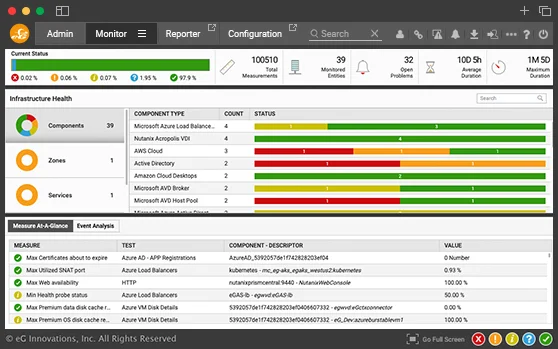


Proactively diagnose, and report on the performance using Citrix virtual apps and desktops monitoring with eG Enterprise. Get
end-to-end visibility, automatically correlate performance across tiers and quickly get to the root-cause of performance problems and maximize service uptime and performance.
Trusted by leading companies


Supports the latest version of Citrix Workspace components. Explore Citrix monitoring solutions for:


Optimize your virtual workspace with Citrix Monitoring to provide real-time insights and enhanced performance management for your Citrix environment.

eG Enterprise goes well beyond what Citrix Director offers, providing visibility into the entire Citrix service delivery chain. You can:
Learn more about Virtual Apps, Virtual Desktops
eG Enterprise delivers best-of-breed performance monitoring for Citrix Virtual Apps and Desktops 7.x environments. Get the best Citrix monitoring software at a very affordable price – monthly charge per user is less than the price of a cup of coffee.

Because we use eG Innovations as a proactive monitoring tool, we can pinpoint latency right away, before users even feel it. They go about their business day to day, without worrying about IT problems.

Proactively find and fix issues before end users are affected with Citrix end user experience monitoring service. Leverage eG Enterprise for Citrix server performance monitoring and gain detailed analytics and real-time insights to ensure reliability of your Citrix server environment.


Virtual Apps | Virtual Desktops | XenMobile | ADC (NetScaler) | StoreFront | PVS | Citrix Cloud | SCOM Management Pack
eG Enterprise is  certified for all products in the Citrix stack
Citrix monitoring helps to measure the performance of your Citrix environment and get alerts when something happens that might impact the end-user experience. Citrix monitoring tools like eG Enterprise help to identify the root-cause of problems to provide quicker resolution times.
You can use Citrix Director to monitor what is happening just within your Citrix environment. If you want full end-to-end visibility in a single pane of glass then you can choose a Citrix monitoring tool like eG Enterprise which monitors everything.
You can choose to use native Citrix monitoring tools such as Citrix Director. The drawback is that these tools only tell you about what is happening within the Citrix stack. If you want end-to-end visibility, then eG Enterprise is the right Citrix monitoring tool.
The best Citrix monitoring tool is the one that helps you deliver the best end-user experience possible. For some organizations, Citrix Director might be enough. However, if you want end-to-end visibility of all components then eG Enterprise is the right tool.
Citrix Director is a good monitoring tool to let you know about performance problems in your Citrix environment. To enable comprehensive Citrix server performance monitor, eG Enterprise is the best choice. It provides a deeper into Citrix and non-Citrix deployments for end-to-end visibility in a single pane of glass.
Yes, eG Enterprise works for Citrix Cloud and Citrix on-premises deployments - or a hybrid of both! Moving to Citrix Cloud doesn't solve every performance problem for end-users and you still need to manage multiple components yourself which Citrix Director doesn't cover.
Yes, eG Enterprise is purpose built to focus on helping IT teams deliver a better end-user experience rather than reporting on resource usage. It monitors both the application and IT infrastructure tiers to correlate performance and identify the root-cause of any issues. eG Enterprise offers a single glass of pane for Citrix XenApp performance monitoring and other Citrix tools.