eG VDI Monitor Gives
Administrators a Crystal Ball View into Virtual Desktop Infrastructures
The many moving parts of a VDI deployment can derail implementations as well as overly complicate troubleshooting problems. eG VDI Monitor counters those problems by providing administrators with the most valuable resource of all, actionable information.
by Frank J. Ohlhorst
August 30, 2010 - Many administrators are discovering that VDI (Virtual Desktop Infrastructure) is much more complicated and less reliable than originally thought. Those discoveries have resulted in stalled VDI implementations or worse yet, failed VDI pilot projects. Many of VDI’s problems are attributable to the overall complexity of integrating connection brokers, hypervisors, hosts and display protocols so they work together.
Additional problems come from endpoint failures that affect the end user experience. However, those problems are not insurmountable as long as those managing VDI deployments are equipped with the proper tools.
eG VDI Monitor is one of those tools, a virtual Swiss army knife of management and monitoring capabilities that empowers administrators to quickly deal with the intricacies of VDI -- before end users complain. eG VDI Monitor works as an end-to-end management product that monitors the various pieces that make up a VDI platform. eG VDI monitor works with multiple hypervisors, including Hyper-V, XenServer, and V-Sphere, as well as with connection brokers, such as Leostream, Xen Desktop and VMware View.
eG VDI Monitor is part of the eG Enterprise Suite, a comprehensive set of integrated utilities aimed at monitoring the performance of business services and applications end-to-end instead of by silos/domains like other monitoring tools. The eG Enterprise Suite adds functionality by using plug-ins, and optional add-ons, allowing an administrator to build out a customized monitoring and support solution.
What makes eG VDI Monitor different from the other desktop monitoring tools on the market is how well it functions in virtual environments. Most notable is the product’s ability to “look inside” a virtual machine. Administrators can monitor and report on user activity on the virtual machine, which can make a significant difference when trying to resolve problems on a VDI platform. With the ability to pin-point problems, especially those directly related to something the user did, eG VDI monitor becomes a powerful troubleshooting tool, which is sorely needed to get VDI deployments back on track.
Monitoring and identifying problems is only one part of the puzzle. eG VDI Monitor offers information proactively, with warnings and alerts that predict forthcoming problems -- before the end user is affected. For example, if the product identifies an above-normal TCP transmission errors or increased latency, the administrator is informed of a potential problem and can act on it before operations are affected.
eG VDI Monitor is able to accomplish that by combining tracking of a user’s virtual activities with end-to-end monitoring of all components used for VDI. That includes hardware and software elements such as servers, routers, switches, connection brokers, hypervisors and display protocols, as well as bandwidth use, throughput and latency.
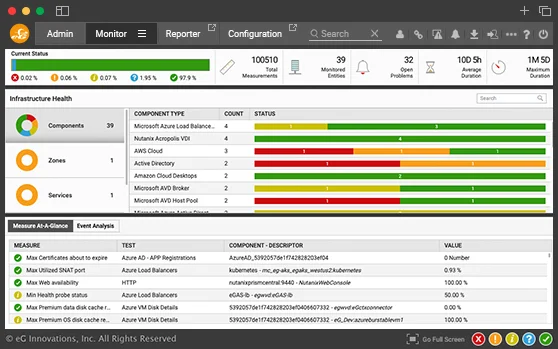
VDI Monitor uses a browser-based management console that is surprisingly easy to use. The console (or dashboard) is organized in a logical fashion and uses easily-understood terms to explain the various monitoring and management capabilities.
The primary interface is broken up by tabs and sub menus, with the main screen showing all monitored elements graphically. The dashboard is designed to present the most valuable information as quickly as possible. Administrators are able to determine the health of the infrastructure with a quick glance at colored bar graphs.
How We Tested
eG VDI Monitor was tested using a pilot VDI implementation that consisted of an IBM Series X3200 server with dual Xeon CPUs, a Dell Poweredge 2900 with a pair of Xeon CPUs. Both systems were running Windows Server 2003 and were configured with 16G bytes of RAM and Citrix XenDesktop 4, as well as the appropriate software components, such as vCenter 4 and Windows IIS 6.
Installation of eG VDI Monitor can be a complicated and daunting process that involves several steps and decisions, so it is best to approach the installation with a plan and review all of the documentation and capabilities before diving in. That said, the installation process did not throw up any real surprises or come grinding to a halt. Installation requires familiarity with several technologies, including Microsoft server OSs, Internet Information Server, Citrix Xen Desktop, Active Directory and other technologies that are common in a complex network. eG Innovations offers support and help as well as authorized reseller partners who can help with installation and configuration.
Once the management suite is installed, the product is able to auto-discover virtual machines on the network (or more correctly, on the monitored server). Administrators have several tools available to them to deploy agents or go agent- less and build groups of monitored components. Once again, configuration takes a bit of effort and is best accomplished by someone with the appropriate technical knowledge.
The dashboard features a list of monitored elements, ranging from CPU utilization to disk usage to IP traffic. These resources are colored to indicate status; red means there is a triggered event warning, while green means all systems are go. There are two other severity colors, which serve to make it clear what the true root cause is (red icon) versus effects of a problem. Simply put, that is the whole ideology behind the product: with a glance, administrators can determine if everything is AOK or precisely what aspect of the VDI is causing troubles that loom in the near future.
The dashboard offers drill-down capabilities, allowing a deeper look into specific monitored events and, while doing so, offers a visual representation of the relationships among all of the components. That proves to be very handy when trying to track down an application (virtual) performance problem.
The product features “triggers” throughout, allowing notifications to be automated and eliminate the need for someone to constantly monitor the console for problems. Administrators create triggers (for example, create an alert for over utilization) and then have alerts pushed out via email, text message and other alerting technologies.
The reporting module offers extensive “static” reports that give insight on performance over a period of time, number and types of alerts that occurred and activity summary. For most administrators, the reports prove to be a good way to backup how a problem was solved, show where the blame lies for a particular problem or prove ROI of the product and VDI solutions.
eG Innovations succeeds at placing important information at an administrator’s fingertips, which otherwise would be hard to identify by using the tools that are often bundled in with the various vendor products.
The eG VDI Monitor can be a powerful ally for administrators looking to prove that a VDI implementation was successful or better yet, how to make sure it is successful. Also, given the performance data it collects on the current VDI implementation, eG VDI Monitor is also a handy capacity planning tool for understanding how many more desktops can be added without pushing the limits.
# # #
All trademarks, service marks and company names are the property of their respective owners.