Let Business Rules Direct Your...
Hot technology trends, new product news and industry buzz
- by Mark Hall
July 31, 2006(Computerworld) -- ...internal SOA projects. With IT departments mesmerized by the potential productivity paybacks of service-oriented architectures (SOA), it isn't illogical for them to consider that their component-based J2EE and .Net apps are ideal candidates to be recast as Web services. But a couple of SOA vendors caution that a wiser path might be to first look at applications laden with business rules -- no matter what language they're written in. Many business rules and policies
change constantly, and writing them as Web services means you can easily alter them because they're no longer intertwined with other parts of an application's code. Pierre Haren, CEO of ILog Inc. in Mountain View, Calif., estimates that 20% to 35% of a big company's application portfolio "can be traced back to a policy that can be written as a business rule." Haren says you should look at an application's rate of change. If it's high, put the app on your list to migrate to an SOA.
Annrai O'Toole, CEO of Cape Clear Software Inc. in Waltham, Mass., says you need to define your Web services at the business-rule level "because that's what the business gets." His advice: "Start at the business policy and work back to the technology." }
Chargeback equation changes as...
...
Linux gets embedded in IT equipment. Naren Nachiappan, a vice president and general manager at Wind River Systems Inc. in Alameda, Calif., envisions a time when CIOs can precisely invoice business users for their consumption of corporate IT resources, from the use of CPU cycles by individual workers to how much network bandwidth a remote sales office chews up. Nachiappan says he's optimistic about that prospect because developers who embed software in IT equipment are shifting from proprietary technologies to Linux. Wind River is known best for its VxWorks real-time operating system, which is used in one-of-a-kind devices such as the Mars rovers Spirit and Opportunity. But it's now focusing most of its attention on an internal Linux distribution and software development tools that can be used for a wider range of projects.
The upside for CIOs, Nachiappan says, is that appliances, routers, switches and other IT devices will be able to leverage a common operating system to layer on sophisticated management and usage-metering services. "A device is no longer a black box doing embedded things," he says.
Generic software agent improves...
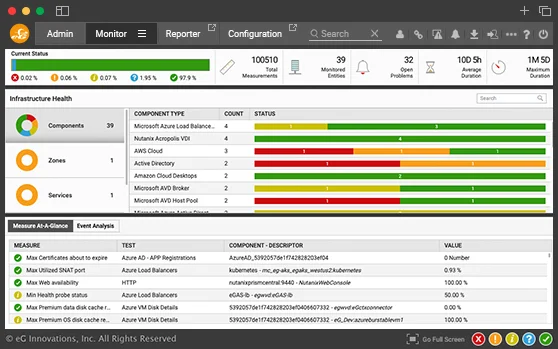
...deployment time for systems management tools. Bala Murugan, chief architect at eG Innovations Pte. in Singapore, says systems management software that depends on specialized agents for every operating system becomes time-consuming and expensive to deploy. That's why he designed his company's eG Enterprise monitoring software to use a generic agent. Murugan says the agent gathers hundreds of thousands of metrics and uses a secure HTTP link to communicate with eG's management console. Luckily, after the software generates an automatic baseline of how your systems are running, the agent only reports exceptions to the eG Manager console, Murugan says. In Q4, the company will add capacity planning tools to help you plan system upgrades based on current end-user activity or what-if scenarios. Mobile devices may get new power...
...and performance capabilities. Gerry Sollner, senior executive vice president at Woburn, Mass.-based Kenet Inc., says makers of handhelds and other "power-constrained systems" could reap systems-level power savings of up to 10% when they use his company's new analog-to-digital converter (ADC) chips. The company achieves the power savings by moving electrons more efficiently as they transition from analog to digital processes, Sollner says. The ADCs also pile on the performance, Kenet claims. CEO Phillip LoPresti says handheld designers will be able to choose between offering end users more battery life and giving them power-hungry features that weren't previously possible. Kenet plans to begin shipping the chips in Q4 and expects handhelds equipped with them to be ready by the 2007 holidays.
Data center audit is worth...
...the effort. John Bostick, CEO of dbaDirect Inc. in Florence, Ky., says the database management services provider is undergoing the third annual Statement on Auditing Standards 70 Type II audit of its data center's IT processes. SAS 70 "is as disruptive as a financial audit," Bostick says. But prior to the first audit, "our documentation was lumpy," he notes. Now it's proof of the data center's security and efficiency, Bostick claims. He says that data center process documentation "should become part of your culture."
# # #
All trademarks, service marks and company names are the property of their respective owners.