Microsoft’s SQL server has emerged as the database engine of choice for most applications hosted on the Microsoft Windows platform. Services in various domains – healthcare, manufacturing, banking, etc. – rely on the backend database servers for data storage and access. Any performance degradation or unavailability of the database servers can severely impact the performance of the entire service, often causing customer dissatisfaction and lost business revenue.
The eG SQL Monitor provides in-depth monitoring for Microsoft SQL database servers. By monitoring a database server engine's availability and responsiveness round the clock, the eG SQL server monitor generates alerts immediately as and when a problem is detected. The eG SQL monitor also tracks in real-time the utilization of each of the databases hosted on the server. Using the user login/logout statistics that the eG SQL monitor provides, administrators can determine which applications are taking up more of the SQL server’s resources. In order to be proactive, the eG SQL monitor also monitors key metrics that can provide early warning indicators of problems. The host operating system is monitored to ensure that the server hardware that is hosting the SQL server is appropriately sized (e.g., sufficient free memory exists, disk utilization is within bounds, CPU usage is acceptable, etc.). Errors reported in the Windows event logs are also trapped and brought to the attention of administrators
![]() |
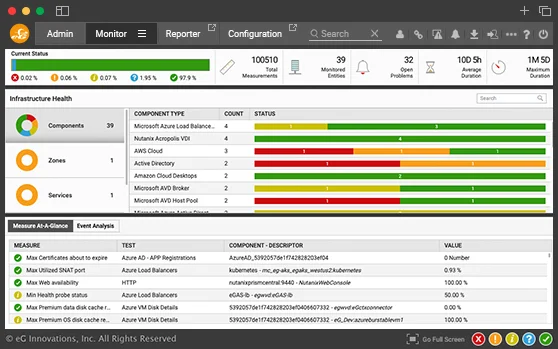
| Microsoft SQL server monitoring using the eG Enterprise Suite |
![]() |
| Microsoft SQL Server report showing database performance and usage |
| SQL Server Performance Monitoring | Is the Microsoft SQL database server available for servicing requests? What is the response time for a typical query? How many logins/logouts are happening on the SQL server? Which applications/users are accessing the SQL server and what is their respective resource usage? What queries are each of the applications currently executing? |
| SQL Server Engine Monitoring | What is the CPU utilization of the SQL database server engine? How much time is the SQL server spending on processing vs. I/O? What is the typical workload on the database server? Which databases are imposing most load on the database server engine? How many processes are running, and what queries are they executing? Which user(s) are executing these queries? |
| Lock Activity Monitoring | What is the typical locking activity on the database? Which processes are being blocked and by whom? Which are the root-blocker processes, and what queries are they executing? Are any deadlocks happening? |
| Database Activity and Space Monitoring | What databases are hosted on the SQL server? Is any of the databases reaching capacity? Which of the databases is seeing more transaction activity? How many active transactions are currently happening to each of the database server? |
| SQL Memory Monitoring | Is there sufficient memory available for the SQL server? How much memory is the server consuming and how much is it willing to consume? How much memory is used for connections, how much for locks, and how much for query optimizations? What is the server’s cache hit ratio? How many pages are available in the server’s buffer pool? How many of these are free pages? |
| Operating System Monitoring | Is there sufficient disk capacity? Is there excessive contention for CPU or memory resources? Are the disks unusually busy? Which processes are taking up most resources (CPU, memory, disk, etc.)? |