English
 Deutsch
 Espanol
 Français
 Portuguese
 中文
 한국어
 日本語

Microsoft Hyper-V Performance Monitoring Software
Simplify monitoring, diagnosis, and reporting of Hyper-V infrastructures. Monitor hypervisor performance and correlate with VM and application performance.
Start Free Trial Book a Live Demo
Trusted by leading companies


Why monitor
Microsoft Hyper-V?
- Hyper-V infrastructures are used to support business-critical servers and applications. Failure or slowness of these servers and applications is business impacting.
- Failure or slowness of one Hyper-V server affects the performance of all VMs hosted on it. So, the impact of failure or slowness is severe.
- Hyper-V performance depends on several factors. Processors, memory, storage LUNs, storage adapters, network interfaces, and hardware all need to be monitored.
- For fast problem diagnosis, it is important to triage a problem and determine the root-cause: is it the hypervisor, or storage, or the virtual network, or the VMs that are causing the issue?

Common Hyper-V performance problems
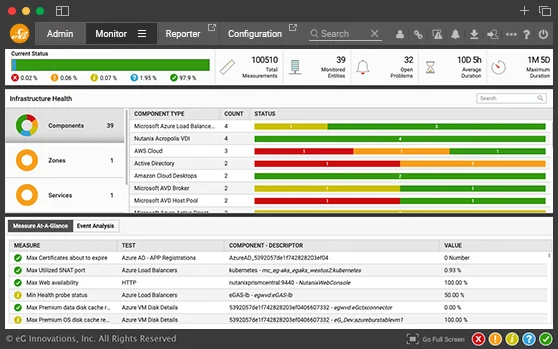
Dashboards and reports


Hyper-V and virtual desktop workloads
Go beyond Hyper-V with end-to-end visibility across heterogeneous infrastructures and comprehensive
operating system metrics from every VM guest
- Monitor CPU, memory, disk space, handles, and network traffic inside every VM
- Monitor Hyper-V performance and resource usage, and right-size VMs
- Get user experience insights, code level visibility, top queries, and more
- Get 360° visibility of virtual guests and desktop performance
- Well-recognized bottleneck indicators such as CPU and disk queue lengths are monitored so performance degradations can be proactively reported.
- Helps eliminate downtime and application slowdowns with automatic root-cause diagnosis and proactive alerts
| Hyper-V Host Monitoring |
What is the CPU load on the hypervisor, on the root partition, and each of the virtual guests? How many logical processors are currently supported by the hypervisor? Which logical processor is being used excessively? Who is making more use of the CPU resources - the VMs or the hypervisor? Is the root partition consuming memory resources excessively? How many virtual processors are currently utilized? Which virtual processor is being utilized excessively? Who is making more use of the virtual processor - the parent partition? the hypervisor? or the VMs? Which network adapter/switch are seeing the most traffic? Are all critical Hyper-V processes and services up and running? |
| Virtual Guests Monitoring |
How many virtual guest machines are running? What are their IP addresses/host names and operating systems? How many virtual processors are currently supported by each VM? Is any VM utilizing the allocated CPU resources excessively? What is the total disk capacity of each VM? Is any VM running out of disk space? Which guest is using large memory pages? Have Integration Components not been installed on any VM? Is any VM experiencing network latencies? Which processes on a guest are taking up high disk, CPU, and memory resources? Is there excessive queuing for disk access on any guest operating system? Which applications could be causing these accesses? |
| Virtual Desktop Monitoring |
How many desktops are powered on simultaneously on the Hyper-V server? Which users are logged on and when did each user login? How much CPU, memory, disk, and network resources is each desktop taking? What is the typical duration of a user session? Who has the peak usage times? What applications are running on each desktop? |
| VM Migration Monitoring |
Which Hyper-V server is a virtual guest running on? When was a guest moved from a Hyper-V server? Which Hyper-V server was the guest moved to? Why was the guest migrated? What activities on the Hyper-V host caused the migration? |
Inside-and-outside VM monitoring and root cause

Go beyond Microsoft SCVMM with end-to-end monitoring of heterogeneous infrastructures and
visibility of OS metrics from every VM guest.
Truly Virtualization-Aware Root-Cause Diagnosis

What eG Enterprise monitors (hosts, root partition, VMs, clusters, live migration)
- Total Performance Visibility Across the Hyper-V Infrastructure Monitor the performance of every layer, every tier of the end-to-end service so you know what's working and what's not.
- Deep Insights into Virtual Application Performance In-depth visibility inside each application's performance so you know how the application is performing, how its virtual machine is performing and how the hypervisor it is hosted on is performing.
- Proactive Detection and Resolution of Performance Issues Auto-baseline your Hyper-V infrastructure; get proactive alerts when your infrastructure usage and performance are abnormal. Automatically correlate across metrics from different tiers to identify and fix issues before users call.

- Powerful Reporting that identifies bottlenecks, top resource consuming applications and VMs to right-size your environment for maximum ROI.