Skip to content
User experience, infrastructure and applications feed AI analysis with evidence and a recommended action.

eG Enterprise 7.6

What's new in
eG Enterprise 7.6: evidence first, then AI

What's new in eG Enterprise 7.6 rests on one principle: eG Enterprise structures the evidence, and GenAI explains it, so your team reaches the root cause sooner. Coverage grows across applications, workspaces, cloud and infrastructure.

New in 7.6

  • GenAI: Anthropic Claude, Azure OpenAI Service
  • OpenAI usage, cost and key monitoring
  • Zscaler ZIA, ZPA and ZDX monitoring
  • Spring WebFlux tracing, Go Runtime Monitoring
  • Amazon ECS monitoring on AWS Fargate

Not ready to talk? Read the 7.6 changes by area, or, if you already run eG Enterprise, go to the release notes and upgrade guidance.

  • 25 yearsof expertise
    since 2001
  • 1000+customers
  • 650+technologies
    supported
  • ISO 27001:2022certified
  • SOC 2 Type 2audited

How the AI in 7.6 works on
structured evidence

More coverage

7.6 monitors more of your stack, from digital workspaces and applications to cloud, containers and infrastructure.

More coverage

eG Enterprise does the diagnostic work before GenAI is involved. It applies domain-specific monitoring and analytics to the technologies it covers. Machine learning and anomaly detection flag what is unusual, and dependency mapping shows what connects to what. eG Enterprise's patented root-cause engine then turns measurements, topology and baselines into structured evidence. That groundwork spans 8,000 checks across 650+ technologies.

Deeper diagnostics

7.6 adds more domain-specific health models, topology, configuration context and capacity insight.

Deeper diagnostics

The AI in 7.6 has two jobs. For your operations team, GenAI explains diagnostic evidence and performance trends, sums up findings and suggests what to investigate. Two GenAI services are new: Anthropic Claude and Azure OpenAI Service. 7.6 also monitors the OpenAI services your applications depend on: health, usage and spend. It tracks latency, token use and keys, with usage split by project and capability.

AI on evidence

GenAI explains findings eG Enterprise has already structured, so your team understands them sooner.

AI on evidence

Hand a model large volumes of undifferentiated telemetry and ask it to decide what matters, and its explanation is no more reliable than the context it was given. In 7.6, GenAI reads the evidence eG Enterprise has already structured, not raw telemetry. Each explanation should still be checked against the metrics and diagnostics behind it before anyone makes a change, and the evidence is there to check. GenAI is opt-in, and you can switch it off.

What changed in 7.6, by the area you run

Pick a section to read the main changes for that area.

Two new GenAI services, and OpenAI monitoring

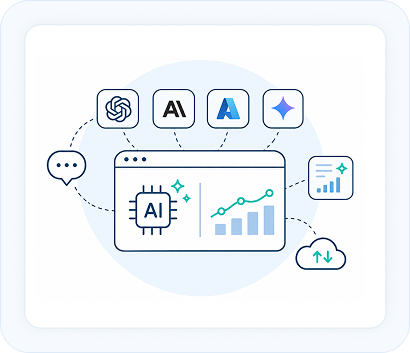
7.6 adds Anthropic Claude and Azure OpenAI Service as GenAI choices. OpenAI ChatGPT and Google Gemini were supported before. Choose the one your cloud, security and governance standards allow. Administrators can now ask GenAI to read diagnostic evidence and performance trends over time and return a short summary. Each administrator can get responses in their preferred local language, chosen from the ten in the eG user profile.

7.6 also monitors the OpenAI services your applications use, agentless, via the OpenAI REST APIs. Per project and API capability, it tracks requests, availability, failures, error rates and response latency. It also tracks token consumption, Admin and Project keys, and cost per day and per month.

AI monitoring enhancements in eG Enterprise 7.6.

Follow a slow session back to its cause

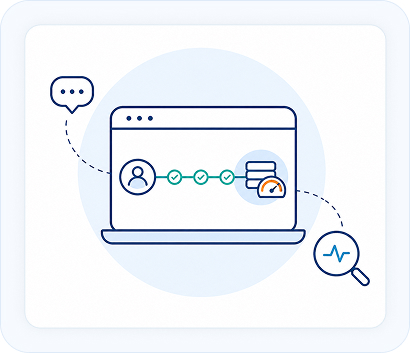
7.6 adds checkpoints along the delivery chain, letting you follow a symptom back to the layer behind it. If you run Azure Virtual Desktop session hosts on Azure Local, the Azure control plane and your on-premises resources now share one view. For Amazon WorkSpaces Applications (formerly Amazon AppStream 2.0), monitoring now groups session hosts by Fleet and breaks each user's logon into its stages.

Citrix coverage adds Citrix Cloud service principals and License Activation Service connectivity, and it spots zombie sessions and black-hole machines. 7.6 checks whether Horizon desktops have Teams media optimization turned on. Physical endpoint monitoring now shows Microsoft Teams meeting performance, including latency, jitter and packet loss. Zscaler ZIA, ZPA and ZDX now report into one console beside your endpoint, network, cloud and application data.

Digital workspaces monitoring enhancements in eG Enterprise 7.6.

New SAP checks and simpler Teams call setup

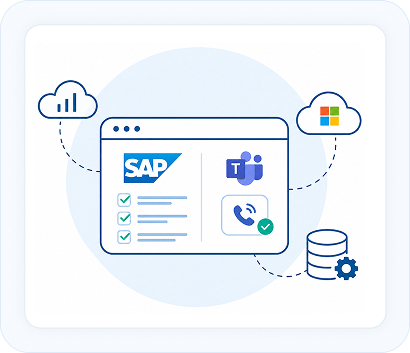
SAP gets more domain-specific checks aimed at its own failure modes. SAP Cloud Connector traffic is analyzed per resource, so unusual request patterns stand out. License monitoring can alert you before an SAP ABAP license expires. SAP Best Practice Checks show each setting's current value, the expected value, the result and the recommended corrective guidance. eG Enterprise now also monitors the MPI memory pipes and buffers used by SAP Web Dispatcher and SAP ABAP instances.

Microsoft 365 monitoring was already in the product. In 7.6 it uses Microsoft Graph APIs to track completed Teams calls, which makes deployment much simpler. Before 7.6, a webhook collector in the DMZ was required. eG Enterprise now reports the configuration, usage and performance of Microsoft Power Platform / Dynamics 365.

Enterprise applications monitoring enhancements in eG Enterprise 7.6.

Spring WebFlux tracing and Go runtime monitoring

7.6 aims to cut false synthetic failures without weakening the checks. You can record and replay Web App Simulation in Microsoft Edge, in addition to the existing Google Chrome support. HTTP and SSL certificate tests now work through enterprise proxies that authenticate with NTLM or Kerberos.

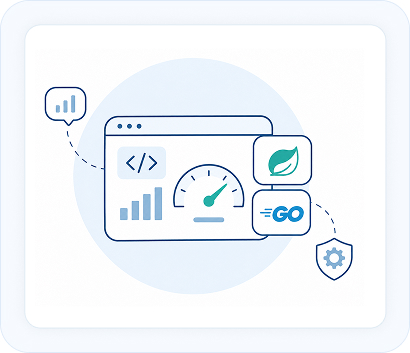
Java APM tracing now covers non-blocking Spring WebFlux applications end to end, down to reactive queries on MySQL, Oracle and Microsoft SQL Server. Traces expose slow calls to Amazon S3, SNS and SQS. The APM dashboard adds Application Flow Insights, which points to the tiers and dependencies where latency and errors build up. .NET Core tracing now works on Linux ARM64, including containers, and PHP APM adds PHP 8.4 and 8.5. Go Runtime Monitoring, new in 7.6, tracks goroutines, garbage collection and heap usage.

Application performance monitoring monitoring enhancements in eG Enterprise 7.6.

New hypervisor, container, cloud and database coverage

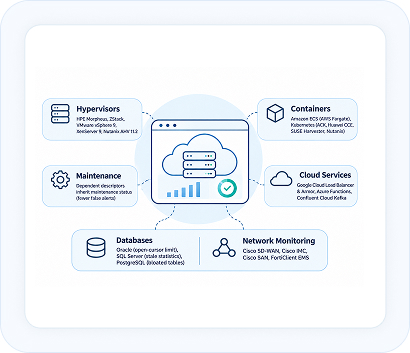
Nutanix monitoring switches to Nutanix v4 APIs, and cached sessions put less load on Prism Central. During planned work, dependent descriptors can inherit a component's maintenance status, so fewer false alerts fire. Hypervisor support now covers HPE Morpheus VM Essentials, ZStack ZSphere and ZStack hypervisors, VMware vSphere 9, XenServer 9 and Nutanix AHV 11.2.

Amazon ECS workloads on AWS Fargate get cluster and task monitoring. Kubernetes support adds ACK, Huawei CCE, SUSE Harvester and Nutanix Kubernetes Platform. Monitoring now covers Google Cloud Load Balancer and Google Cloud Armor, plus Microsoft Azure Functions and Confluent Cloud Kafka. On databases, 7.6 flags Oracle sessions near their open-cursor limit, stale statistics in Microsoft SQL Server and bloated PostgreSQL tables. Network monitoring goes further for Cisco SD-WAN, Cisco IMC, Cisco SAN and FortiClient EMS.

Infrastructure monitoring enhancements in eG Enterprise 7.6.

Parallel agent upgrades and clearer tenant licensing

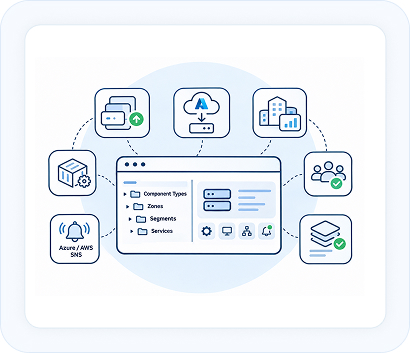
Navigation is now a tree of component types, Zones, Segments and Services, with better handling of nested Zones. Each component now gets an asset view that gathers its configuration, operating system, network, agents and active alerts. Agent and VM-agent upgrades run in parallel up to a limit you set, so large rollouts take less time. You can tell container agents apart from conventional ones. The Manager can now push eG agents to Azure VMs. Delegated teams can see whether the agents on their own systems are running.

MSPs can see license consumption by tenant more clearly. SMS notifications can go via Azure Communication Services or AWS SNS. Hotfixes now follow a more structured patch-management process designed to make them easier to track and verify.

Platform and MSP monitoring enhancements in eG Enterprise 7.6.

Choose your next step

See 7.6 on the systems you run

Tell us what you run. We will shape the demo around the 7.6 changes that apply to you.

By continuing, you agree to our Privacy Policy and Terms of Use.

Try eG Enterprise free for 30 days

Sign up with your work email. The trial runs on SaaS and needs no credit card.

Build the business case for 7.6

The Value Calculator App helps you estimate what eG Enterprise could be worth in your estate. Use it whether you are new to eG Enterprise or planning the upgrade to 7.6.

Open the Value Calculator App

Questions about 7.6

Does the AI replace eG Enterprise's root-cause analysis?

No. eG Enterprise makes the diagnosis first, with its own domain-specific monitoring, anomaly detection and root-cause diagnostics. GenAI then explains that diagnosis, sums up the related findings and suggests what to investigate next. You turn GenAI on when you want it, and you can turn it off again.

Related reading

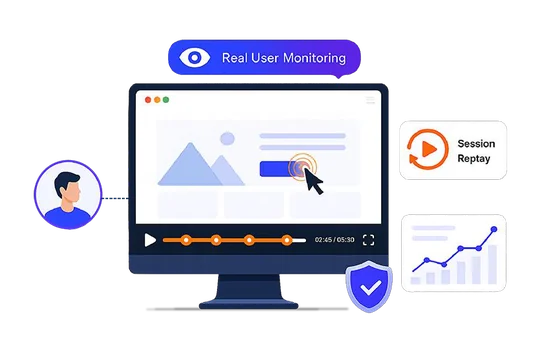
Real user monitoring and session replay illustration
News

eG Enterprise 7.6 press release

In the hospitality industry, every second counts—especially when it comes to online...

Book a 7.6 demo, or try eG Enterprise free

Book a demo shaped around your own stack. The 30-day free trial of eG Enterprise needs no credit card. In a demo, ask to see the Anthropic Claude and Azure OpenAI Service integrations and the OpenAI monitoring added in 7.6. eG Innovations is present in 14 countries with customers in more than 50.