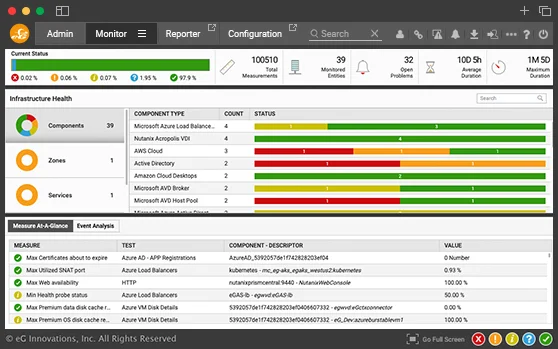
eG Total Performance Visibility
  •   Facebook  Linkedin  twitter  Blog


eG Configuration Manager


config-quote1

Why Monitor Configuration and Change?

There are many instances of performance issues with business-critical services being caused because a server, network device, or application was not correctly configured. Human errors during updates to the configuration may also cause unexpected performance degradation. A recent Hurwitz & Associates report titled "Configuration Errors are the Road to Ruin" highlights the importance of configuration and change management in IT infrastructures. This report indicates that over 72% of respondents regarded configuration changes, updates or deployments as a significant cause of business service downtimes.

divider

The Benefits of Unified Configuration and Performance Monitoring

Knowing what configuration changes have happened around the time when a significant performance change was observed allows administrators to more accurately and rapidly identify the cause of a problem and to bring the IT services back to normal operation quickly. In the process, a lot of time and effort spent during fire-fighting can be saved. By eliminating guesswork, unified configuration and performance monitoring allows IT organizations to reduce mean time to repair, improve service uptime and reduce IT operations costs.

config-img1
Figure 1: The Configuration Management Dashboard

For unified configuration and performance monitoring, administrators require:

  • the ability to track the correct configuration of each and every IT infrastructure component including a server, network, application, or virtualization platform;
  • the capability to detect the number and type of changes in the configuration of a component over time;
  • ready access to monitoring information and reports on performance metrics and configuration and change information from a central console;

divider

Configuration and Change Monitoring using eG Enterprise

The eG Configuration Manager provides administrators with the ability to view configuration and change management from a central web console (Figure 1). It employs agent-based and agentless mechanisms to extract critical configuration and change details from each of the managed components in the environment. Configuration information is not only collected at the network and operating system layers (e.g., what hot fixes have been applied, what software has been installed), the eG Configuration Manager also obtains configuration information at the application layers (e.g., what is the heap size setting for a Java virtual machine? How many connections have been configured in a WebLogic server's connection pool? What is the maximum size of an Oracle tablespace? - see Figure 2) and at the virtualization platform layer (e.g., how much memory is allocated to each virtual machine).

config-img2
Figure 2: The Current Configuration of an Oracle Database

The same agent that is used for performance monitoring is used to collect configuration metrics as well. Hence, deployment of the monitoring solution is considerably eased. The agent-manager communication is 100% web-based, thereby ensuring that the monitoring system can be deployed without changing any firewall rules. Further, the agent is intelligent enough to only communicate change information back to the eG Enterprise manager, thereby ensuring that the network bandwidth used for the configuration monitoring is very minimal. The metrics collected are stored in a common, central database repository and administrators can use a web console to access both performance and configuration metrics relating to their infrastructure.

divider

Capabilities of the eG Configuration Manager

  • Track server assets.
  • Monitor the current configuration of network devices, servers, and applications.
  • Compare current configuration across servers.
  • Report on configuration changes during specific time periods.
  • Compare configuration across servers; Identify servers that are deviating from a golden configuration.
  • Search for networks, servers, applications with a specific configuration.


By tracking the configurations of a component over time, the eG configuration manager also reports on configuration changes and when the changes happened (Figure 3). By time correlating change information with performance information, administrators can get vital clues as to whether any configuration changes (whether automated, manual, or unintentional) may have caused a performance degradation.

Administrators can also use the eG configuration manager to compare configurations across applications, servers, and networks. This way, if one server is performing well, but another is not, an administrator can quickly determine configuration differences between the two servers that could be responsible for the performance difference.


config-img3
Figure 3: Configuration changes for a Windows server
config-img4
Figure 4: Distribution of servers based on physical memory
available on the server
divider

What the eG Configuration and Change Manager Reveals

  • Which platforms is a particular application currently running on?
  • Is an unlicensed copy of an application being used anywhere?
  • What are all of the applications currently executing on a particular system?
  • Which versions of an operating system are currently available in the target infrastructure?
  • Do any operating systems need to be upgraded?
  • What is the current configuration of an application?
  • Is all mandatory software (such as antivirus software) available and running on all managed systems? If not, which systems do not have such software?
  • Are all services critical to the functioning of the system and applica tions up and running?
  • Has a particular software patch been applied to all target systems?
  • Do any systems require additional hard disk space? If so, which ones?
  • Do any systems require more RAM? If so, which ones?
  • Have all Windows systems been updated with their latest service pack?
  • Have any configuration changes occurred during a stipulated period? If so, when and what are the details?
  • Could a particular configuration change have induced a drop in the performance of the system or application?
  • Can any difference be noticed in the configuration of two components of the same type? If so, could this difference be the cause for the poor performance of one of the components?


The eG Enterprise configuration and change monitoring functionality is supported for Windows, Solaris, Linux, HPUX, AIX, OpenVMS and AS/400 operating systems, VMware vSphere and Citrix XenServer virtualization platforms, and applications including Citrix XenApp, Microsoft Terminal servers, Oracle database servers, Microsoft SQL, Microsoft IIS, and Apache web servers.


divider

Benefits of the eG Enterprise Configuration Manager

  • Assess how a configuration change could have influenced overall performance of the system, application or service;
  • Compare configuration across infrastructure components and identify components that may not be configured correctly;
  • Detect unplanned/unauthorized configuration changes in the click of a button;
  • Generate a snapshot of all IT assets of an organization including applications, operating systems, devices, software, hardware, and services;
  • Quickly access the basic configuration information pertaining to any network device, server, application, or virtualization platform in the infrastructure;