English
 Deutsch
 Espanol
 Français
 Portuguese
 中文
中文 한국어
한국어 日本語
日本語
Anomaly Detection
What is Anomaly Detection in IT Monitoring?
Anomaly detection within AI-driven monitoring automatically identifies deviations from normal patterns, detecting potential security threats, system failures, performance slowdowns, or cyber risks in real-time. Good, automated anomaly detection enables proactive incident response and risk mitigation.
Anomaly detection is a core capability of modern IT infrastructure monitoring and AIOps platforms. It uses historical performance data, statistical analysis, and machine learning to identify behavior that differs from established patterns and alert IT teams to potential performance, availability, or security issues.
Automated anomaly detection is now a key functionality in many regulated sectors for ICT and IT compliance. Many standards, regulatory frameworks and directives now mandate that anomaly detection should be used to automate operational resilience, cybersecurity monitoring, and threat intelligence. For example, in the EU, the Digital Operational Resilience Act (DORA) mandates organizations to implement anomaly detection as outlined in Article 10 (“Detection”), and requires entities to identify potential risks and threats that could compromise operational resilience. Learn more: What is the Digital Operational Resilience Act (DORA)? Everything you need to know about DORA compliance | eG Innovations.
The Role of Baselines in IT Monitoring Anomaly Detection
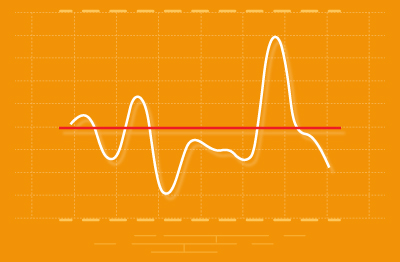
In IT monitoring, baselines play a critical role in detecting anomalies by establishing a reference point for what is considered normal system behavior. A baseline is built from historical performance data, common metrics measured include CPU usage, memory consumption, network traffic, or application response times. By comparing current metrics against this baseline, monitoring tools can identify unusual patterns or deviations that may indicate performance issues, security threats, or system failures. Baselines also adapt over time, accounting for expected variations and trends such as peak business hours or seasonal patterns. This proactive approach enables faster incident detection, reduces false alarms, and supports more accurate root cause analysis.
AIOps-based monitoring tools leverage statistical methods and machine learning to build up dynamic baselines unique to each system. The quality of the baseline formed is inherent to the quality and effectiveness of the resultant anomaly detection.
To learn more about automated baselines, see: What is Automatic Baselining? - IT Glossary | eG Innovations.
Metric Thresholds and Anomaly Detection
Anomaly detection depends largely on detecting deviations from the expected baseline based on historical past performance. Most enterprise monitoring tools will offer some control over anomaly detection via the provision of dynamic thresholds, where some measure of what is considered a significant deviation can be made to avoid false alerts and alert storms.
The more advanced monitoring tools provide the capabilities to combine static and dynamic metric thresholds to ensure stable anomaly detection. To learn more, see Static vs Dynamic Alert Thresholds for Monitoring | eG Innovations.
Accurate anomaly detection usually relies on other mechanisms to eliminate noise and statistically insignificant events. Techniques implemented in monitoring tools include:
How Does AIOps Improve Anomaly Detection?
AIOps (Artificial Intelligence for IT Operations) combines machine learning, statistical analysis, event correlation, and automation to improve anomaly detection across complex IT environments. An AIOps platform can analyze large volumes of metrics, events, logs, and traces to identify unusual behavior that may otherwise be difficult for IT teams to detect manually.
In enterprise level IT monitoring tools, AIOps plays an important role in automating and scaling anomaly detection. Leveraging machine learning in combination with other numerical techniques, AIOps-based monitoring tools can process and identify patterns within data far beyond the capabilities of a manual operator.
Auto-discovery and auto-deploy technologies within AIOps platforms ensures that anomaly detection occurs without delay and the need for manually-instigated deployment. This is especially important within dynamic or ephemeral systems such as Kubernetes or cloud.
The number of metrics, events, logs and traces analyzed by a monitoring platform for anomalies is important for a proactive monitoring strategy. Whilst many tools will analyze headline metrics such as RAM, CPU and IOPs, it is anomalies in metrics not normally watched by a human operator that will often give the first warning signs of an IT issue long before user experience or application performance is impacted. When evaluating the quality of anomaly detection offered, coverage of metrics should be considered, and whether the monitoring tool will detect anomalies such as:
Why Anomaly Detection Matters for IT Operations & Security
Choosing IT monitoring tools with good anomaly detection, helps organizations with:
Anomaly Detection vs. Predictive Analysis
Anomaly detection and predictive analysis are both important techniques in IT operations, and monitoring, but they serve different objectives.
Anomaly detection is about identifying data points, events, or behaviors that deviate from the expected norm. It answers the question: “Is something unusual happening right now?” For example, sudden spikes in network traffic, unexpected server downtime, or a surge in login failures could be flagged as anomalies. It focuses on real-time or historical deviations that may indicate performance issues, cyberattacks, or misconfigurations.
Predictive analysis, by contrast, looks forward. It uses historical data, statistical models, and machine learning to forecast future outcomes. It answers the question: “What is likely to happen next?”, for example, predicting when disk space will run out, estimating future application load during peak hours, or forecasting system failures before they occur.
Generally, anomaly detection is reactive and diagnostic, alerting you when something unexpected occurs, while predictive analysis is proactive and forward-looking, helping prevent issues by anticipating future trends.
Under-the-hood both techniques leverage similar mathematical and / or computational techniques and algorithms to analyze data from IT systems and applications.
Frequently Asked Questions (FAQs)
AIOps (Artificial Intelligence for IT Operations) combines AI, machine learning, and big data analytics to automate IT operations. It helps organizations monitor complex IT environments, identify issues faster, reduce manual workloads, and improve system reliability through intelligent analysis of operational data.
AIOps improves anomaly detection by continuously analyzing large volumes of IT data and identifying unusual patterns that may indicate potential issues. Using machine learning, it detects anomalies in real time, reduces false alerts, and enables IT teams to resolve problems before they impact business operations.
An AIOps platform is a software solution that uses AI and machine learning to collect, correlate, and analyze data from multiple IT systems. It provides automated insights, root cause analysis, event correlation, and predictive monitoring to help teams manage infrastructure and applications more efficiently.
Common AIOps use cases include anomaly detection, incident management, root cause analysis, performance monitoring, predictive maintenance, event correlation, capacity planning, and automated remediation. These capabilities help organizations minimize downtime, improve service performance, and accelerate IT operations across complex environments.