eG Total Performance Visibility
  •   Facebook  Linkedin  twitter  Blog


Virtualization Monitoring


The Importance of Virtual Server Management

virtualization monitors
IT infrastructures are changing and virtualization technology is at the forefront of this change. With virtualization technology in place, enterprises can be a lot more agile than they have been in the past. New servers and desktops can be provisioned as virtual machines in a matter of minutes, rather than in days. Using virtualization technologies, enterprises can also benefit from increased cost savings through more efficient space and power usage. Hardware resources - CPU, memory, disk, etc. - of a physical server can also be efficiently shared across virtual machines hosted on it. Owing to its increased benefits, virtualization technology is being widely adopted across sectors - in finance, healthcare, government, education, telecoms, etc.

While resource sharing through use of virtualization technologies has its advantages, this also produces new challenges for monitoring and management. In a physical environment, a problem with one machine does not impact other machines. However, this is not the case in a virtualized infrastructure. For example, a single malfunctioning virtual machine (VM) can impact the performance seen by other virtual machines on the same physical server. Administrators also have to be careful when provisioning resources for VMs and when deciding which physical machines or clusters should host the VMs. Insufficient allocation of resources to VMs or physical machines can adversely affect the performance of applications running in a virtualized infrastructure.

Monitoring a Virtual Server is Different from Monitoring a Physical Server

virtualization monitoring tools
Today, enterprises have a choice of virtualization technologies. X86 virtualization using VMware vSphere, Citrix XenServer, or Microsoft Hyper-V is very popular. Unix virtualization technologies using Oracle Solaris Logical Domains, AIX Logical Partitions, etc. is also used in large Unix server farms. Even if a virtual server boots using an operating system such as Linux (e.g., VMware vSphere or XenServer) or Microsoft Windows (e.g., Hyper-V), it is not possible to just use a monitoring agent developed for a physical server to monitor virtualization. Such an agent can only monitor the operating system used to boot the server and cannot monitor the virtualization aspects of the server. Metrics such as how many VMs are hosted on the server, how many are powered on, what is the CPU, memory, disk consumption of each VM, etc. cannot be obtained if the monitoring agent is not virtualization-aware.

Each of the virtualization platforms mentioned above is architected differently and supports a different interface for monitoring. The administration tools embedded in the virtualization platform (e.g., vCenter for VMware vSphere, XenCenter for Citrix XenServer, etc.) are specific to the virtualization platform and are not designed to support multi-vendor virtualization monitoring. Enterprises that use a combination of these virtualization technologies therefore require a third party solution that can monitor their heterogeneous virtual servers from a common console.

Virtualization Monitoring using eG Enterprise

 
eG Enterprise's single agent technology has been enhanced to be virtualization-aware. Using different interfaces (web services, command line, scripting, etc.), eG agents can collect metrics from many of the popular virtualization platforms including VMware vSphere/ESX, Citrix XenServer, Microsoft Hyper-V and Virtual Server, Solaris Logical Domains and Containers, AIX Logical Partitions, etc. For each virtualization platform, the APIs used for the metric collection are based on vendor recommended best practices. Hence, eG Enterprise is the only virtualization monitoring tool in the industry that is certified to be VMware Ready Optimized and Citrix Ready certified.

To monitor a virtual infrastructure, eG Enterprise includes a patent-pending In-N-Out monitoring technology. By connecting to each virtual server, eG agents obtain the "outside" view of the infrastructure. This outside view indicates how the hypervisor is being used and which VMs are consuming excessive CPU, memory, or disk resources.


Metrics collected using the Outside View

  • Physical CPU usage of the Hypervisor and the individual VMs
  • Ready time for each VM
  • CPU throttling for the hypervisor and VMs
  • Physical memory configured and used on the virtual server
  • Active memory for each VM
  • Zero memory for each VM
  • Swap memory usage for each VM
  • Balloon memory for each VM
  • Balloon memory for each VM
  • Network bandwidth incoming and outgoing from each VM
  • Availability and usage of each datastore
  • I/O activity for each of the storage LUNs configured for the virtual server
  • Disk queuing for each storage LUN
  • Errors in the virtual server logs
  • The number of VMs registered and powered on and the IP addresses for each of the VMs


To complement the outside view, eG agents also provide an "inside" view of each VM. While the outside view indicates the percentage of physical resources that a VM consumes, the inside view highlights which applications running in the VM are responsible for the resource consumption. This information is critical for problem isolation and diagnosis.

Metrics collected using the Inside View

  • Virtual CPU usage of a VM
  • Top processes consuming CPU in the VM
  • Free memory available in the VM operating system
  • The top memory consuming processes in the VM operating system
  • Disk activity inside the VM and the top processes responsible for the I/O activity
  • Utilization of each of the disk partitions in the VM operating system
  • Disk queuing in the VM operating system
  • Traffic incoming and outgoing through each of the network interfaces of the VM operating system
  • TCP retransmissions from the VM operating system to clients
  • Which users are logged on to the virtual machine


virtual server management
In-N-Out monitoring of a virtualized server using eG Enterprise

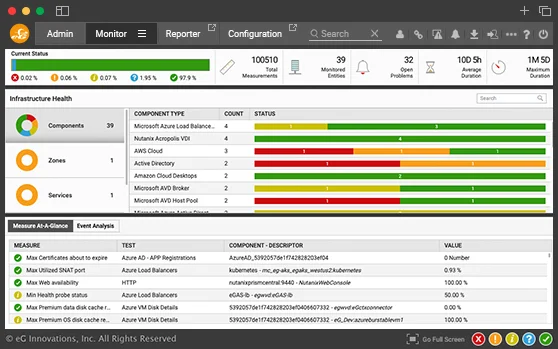
Administrators can monitor these heterogeneous technologies from a common web console. A variety of reports including operations reports, capacity reports, snapshot reports, etc. are available to administrators from the web-based reporting module. And what's more - consistent with eG Enterprise's single agent architecture, the licensing is per virtual server and not based on the number of CPU cores or sockets, or based on the number of VMs being monitored.


Benefits of Virtualization Monitoring with eG Enterprise

Single integrated monitoring interface for heterogeneous, multi-vendor virtualization technologies: With our virtualization management software you get a single pane of glass view into the virtualized infrastructure; administrators can see the real-time status of all their virtual servers (VMware vSphere/ESX, Citrix XenServer, Microsoft Hyper-V and Virtual Server, Oracle Solaris LDOMs and Containers, etc.) from a web console.
Rapid problem troubleshooting: When a problem happens, administrators can know exactly what is causing the problem. eG Enterprise's unique In-N-Out monitoring architecture provides a 360 degree view of each and every virtual machine - from the outside and from the inside.
Unparalleled flexibility in licensing and deployment: Since the license is not tied to a specific virtualization technology, you can move licenses across virtualization technologies. Also, you pay for monitoring the server, not for CPU cores, sockets, or VMs.
Be proactive: Automatic baselining by eG Enterprise ensures that you do not have to sit and configure thresholds for thousands of metrics. You can allow eG Enterprise to automatically determine the norms for each metric and to alert you when an abnormal condition is detected.