

Is it the database that is slowing your applications? Find out the root-cause of database performance problems using purpose built capabilities in eG Enterprise.
Free TrialTrusted by leading companies


In many infrastructures, a database server (or a cluster) supports multiple front-end servers. Consequently, when there is a performance bottleneck or failure of a database server, it impacts the performance of several services that rely on it. Effective database management requires a great deal of expertise, and Oracle monitoring tools are critical for successful IT service delivery. eG Enterprise helps you ensure top database performance by ensuring that:

eG Innovations delivers a robust, reliable and extremely valuable solution to deliver maximum uptime and user satisfaction. Pre-emptive alerting helps us to address performance issues immediately before they affect system and application availability


Track the key parameters that can affect database server performance:

| Database service monitoring | |
| Session monitoring | |
| Query monitoring | |
| Transaction monitoring | |
| Alert log monitoring | |
| Rollback segment monitoring | |
| Lock and latch monitoring | |
| Cache monitoring | |
| Full table scan monitoring | |
| Tablespace monitoring | |
| Hot file monitoring | |
| Redo log monitoring | |
| Object monitoring |
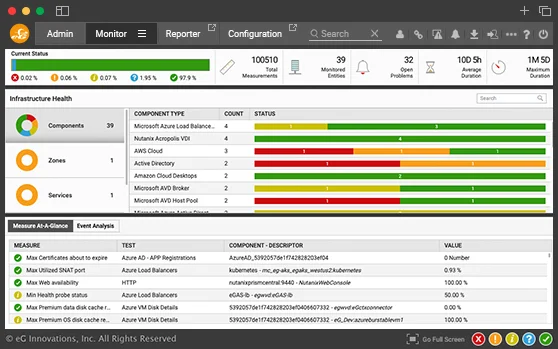
eG Enterprise allows database performance to be monitored in the context of the applications using the database server.
This eliminates finger-pointing between application development, application operations, and database admin teams.