

Trusted by leading companies


The need for monitoring applications and software is unquestionable, but server hardware monitoring is equally important. Sometimes, a malfunctioning server hardware component can cause server downtime, thereby adversely impacting the performance of a critical business service. Detecting and fixing a server hardware problem on time can increase service uptime and enhance customer satisfaction. Furthermore, if a server hardware failure is not identified and addressed on time, it could cause irreparable damage to the server hardware, bring down critical IT services, cause colossal data loss, and catapult maintenance costs.
eG Innovations delivers a robust, reliable and extremely valuable solution to deliver maximum uptime and user satisfaction. Pre-emptive alerting helps us to address performance issues immediately before they affect system and application availability.

One of the biggest challenges in monitoring server hardware is heterogeneity. IT infrastructures typically comprise of equipment from multiple manufacturers. Each manufacturer provides their own solution for monitoring and managing their server hardware. As a result, troubleshooting can be complex and time-consuming, precisely when speed is truly of the essence.
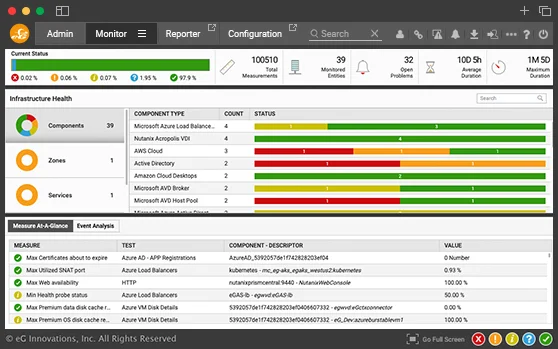
In a multi-vendor environment, IT administrators need a single integrated console from where they can monitor the heterogeneous server hardware components that they are responsible for. Administrators require automatic correlation between the performance of the server hardware and the user view of the IT services that use the server hardware, so that problems can be identified as being caused by the server hardware or by the software.

eG Enterprise offers integrated monitoring of multi-vendor server hardware from a central console. Monitoring of IBM, HP, Oracle and Dell server hardware is supported, irrespective of the operating system used (Windows, Linux, HPUX, Solaris, or AIX). Monitoring of servers running Windows, Linux, HPUX is done using SNMP. eG agents integrate with IBM Director agents, HP Insight agents, and Dell OpenManage agents for this purpose. For Solaris and AIX native OS hooks and commands are used to collect server hardware status information.
While agent-based monitoring is required for monitoring Oracle Solaris server hardware, Compaq/HP, Dell, and IBM servers are managed agentless using SNMP. Hardware monitoring is also supported for VMware servers. VMware APIs are used to assess the health of processor sensors, memory sensors, power supplies, to get fan speed, etc.

All of these metrics are integrated into specialized application models for over 650+ applications, servers, and devices that eG Enterprise includes. A patented root-cause diagnosis engine continuously analyzes the metrics to identify if there are any bottlenecks in the system, and where they are: the network, the operating system, the application, or the server hardware.
Using these metrics, administrators can proactively detect server hardware failures and rectify them, and therefore considerably reduce related service downtimes. eG Monitor for Hardware, with its ability to accurately report the status of multi-vendor server hardware running heterogeneous operating systems, is an ideal solution for server hardware monitoring.
eG Enterprise reveals a wealth of hardware performance/health information:
* Actual capabilities may vary according to the operating system in use and server hardware.