|
|
VMware virtual server technologies provide companies with the ability to do more with less resources. While this technology makes computing easier and efficient, virtualization makes IT infrastructures harder to monitor and manage. Effective monitoring and management is critical for these environments to be adequate replacements for traditional hardware-based infrastructures.
The eG Monitor for VMware® InfrastructuresTM (the eG VM MonitorTM), part of the eG Enterprise Suite, is a comprehensive solution for monitoring and managing all aspects of virtual hosts and guests, whether the infrastructure is used to support server or desktop applications. Coupled with the ability of the eG Enterprise Suite to monitor over 80 applications, including Citrix, Microsoft, Oracle, IBM, SAP, and others, the eG VM Monitor – with its patent-pending In-N-Out MonitoringTM technology -- provides a comprehensive end-to-end solution for monitoring and managing the performance of virtual IT infrastructures.
Administrators can use the eG VM Monitor to monitor the performance of their physical and virtual infrastructures, troubleshoot problems to determine where the root-cause lies, assess where capacity bottlenecks are, and plan the usage of their servers and applications to optimize the utilization of the physical and virtual resources. The key customer benefits of this solution include higher uptime, better end-to-end performance, and operational cost savings through more effective utilization of key IT staff. |
Multi-tier IT infrastructures are a nightmare to troubleshoot because of the dependencies that exist between application tiers. For instance, a failure in the database tier could result in slow downs in the application and web server tiers. Hence, monitoring solutions that view the infrastructure as independent silos cannot effectively monitor and diagnose problems in such infrastructures. The addition of virtualization to such infrastructures makes monitoring and management of these infrastructures even more challenging!
 |
Fig 1: A problem in one application can affect all the other applications involved in the service delivery. |
 |
 |
Fig 2: Excessive disk reads by the media server slow down Oracle database accesses |
Since a single VMware® vSphere/ESX Server is used to host multiple virtual machines (VMs), a single malfunctioning application on a VM can degrade the performance seen by applications hosted on the other VMs. Figures 1 and 2 illustrate such an example. In this scenario, users are experiencing slowness in their access to a web-based service. From the service topology, it is clear that the database server is the cause of the slowdown. Figure 2 illustrates that since the database server is hosted on the same vSphere/ESX server as a media server, high I/O activity due to increased access to the media server is resulting in the database server seeing slow disk accesses. To accurately diagnose the problem in this example, a monitoring solution must not only consider the inter-dependencies between applications that are involved in service delivery, but it must also consider the existential relationships between applications, virtual machines, and physical machines. Besides resource contention among guest virtual machines, applications executing on the vSphere/ESX service console can also affect the performance of the virtual infrastructure.
While knowing which VM is consuming excessive resources is helpful, it is even more important to understand whether the VM's behavior is normal. For instance, a memory leak in one of the applications executing inside a VM may be causing the VM's memory usage to increase over time. In such cases, it is essential that the monitoring solution be able to look in-depth into each guest VM and detect abnormalities. While deploying individual agents inside each VM provides this level of visibility, this can result in additional resource overhead, licensing fees, and maintenance cost.
Performance degradations in a virtual infrastructure may also be because a virtual machine has not been configured with sufficient resources to handle its workload. A monitoring solution must be able to differentiate problems resulting from inadequate virtual machine configuration and those resulting from hot-spots created by uneven distribution of load across vSphere/ESX servers. |
The eG VM Monitor extends the eG Enterprise monitoring technology to virtual environments. Using a patent-pending In-N-Out MonitoringTM approach, the eG VM Monitor provides a comprehensive view of an vSphere/ESX Server, including the performance of the VM kernel, the service console and all of its virtual machines. Agent-based monitoring can be used for ESX servers, while agentless monitoring can be used for ESXi servers. When agent-based monitoring is used, eG agents only have to be installed on the vSphere/ESX server -- not on individual guests. Using vSphere/ESX server APIs, the agents provide an “outside view” of a guest VM’s performance. The relative resource usage levels of the guest VMs show where the performance hogs exist. To complement the outside view, the eG agent obtains an “inside view” that details the user activity, resource allocation and the application mix running inside the VM guest operating system. All the capabilities of agent-based monitoring are also available with the agentless monitoring option for VMware vSphere/ESX servers. The eG VM Monitor automatically baselines all the metrics it collects, so that IT administrators can be informed proactively of any deviations from the norm. No other virtualization monitoring solution offers this combination of features.
 |
Monitoring VM guests: eG agents track the performance of each guest VM relative to shared infrastructure resources (outside view) as well as the workload and application mix of the individual guest VMs (inside view). |
From a monitoring and management standpoint, the eG monitor for VMware infrastructures goes well beyond managing virtualized servers as discrete entities. End-to-end business service views show the applications and network devices that support each business service, and the inter-dependencies among them. Applications are associated with the virtual machines they run on, and each virtual machine is mapped to the physical machine upon which it is hosted.
The dependency of the virtual machines to physical machines is determined dynamically, so as to support the VMware VMotion® Live Migration technology. A patented root-cause diagnosis engine analyzes the service topology graphs and the virtual-to-physical machine mappings to pin-point where the problems areas in the infrastructure lie.
|
| |
 |
Monitoring and Reporting of vSphere/ESX servers: Using a custom vSphere/ESX Server model, the eG VM Monitor correlates performance across the host and guest VMs. Extensive pre-built reports enable rapid identification of bottlenecks and streamline capacity planning. |
 |
 |
 |
 |
| vSphere/ESX Host Monitoring |
 |
What is the CPU load on the vSphere/ESX kernel, on the console, and each of the virtual guests? |
 |
What is the free memory in the vSphere/ESX kernel and the console? |
 |
Which network interfaces are seeing the most traffic? |
 |
Which storage devices are seeing high activity? |
 |
How much free space is available on each of the disk partitions? |
 |
Are there processes on the console VM that are taking up excessive resources? |
| |
|
| Virtual Guests Monitoring |
 |
How many virtual guest machines are running? What are their IP addresses/host names and operating systems? |
 |
What portion of the vSphere/ESX Server’s CPU is used by each guest? |
 |
Are there times when a guest is not getting CPU cycles; i.e., is the ready time too high? |
 |
How much of the memory allocated is a guest actively using? |
 |
Is the balloon driver enabled for a guest, and how much memory has it freed for each guest? |
 |
Which processes on a guest are taking up high disk, CPU or memory resources? |
|
| |
|
 |
Is there excessive paging or memory thrashing in a guest? |
 |
Do all the disk partitions inside the guest operating system have adequate space? |
 |
Is there excessive queuing for disk access on any guest operating system? Which applications could be causing these accesses? |
| |
|
| Virtual Desktop Monitoring |
 |
How many desktops are powered on simultaneously on the vSphere/ESX Server? |
 |
Which users are logged on and when did each user login? |
 |
How much CPU, memory, disk and network resources is each desktop taking? |
 |
What is the typical duration of a user session? |
 |
Who has the peak usage times? |
 |
What applications are running on each desktop? |
| |
|
| VMotion Monitoring |
 |
Which vSphere/ESX Server is a virtual guest running on? |
 |
When was a guest moved from an vSphere/ESX Server? Which vSphere/ESX Server was the guest moved to? |
 |
Why was the guest migrated? What activities on the vSphere/ESX host caused the migration? |
|
|
|
 |
 |
 |
 |
 |
 |
 |
 |
| Combined external and an internal views of VMware vSphere/ESX servers |
Real-time performance views of what the VMware host sees about the guests and what the guests see internally. |
| Deep diagnostics for VMware servers |
With a few clicks, drill down to the exact processes causing a problem. |
| Automatic correlation of performance |
Analyze performance across layers of the VMware infrastructure - the VM host, between the host and the guests, and across VM guests. |
| In-depth VMware VDI monitoring |
Know which users logged in, when, what applications they accessed, what resources they used, etc. |
| Monitor virtual environments with service views - not as silos |
Correlate the performance across applications hosted in the VMware environments, discover VM dependencies, and identify performance bottlenecks. |
| Single agent licensing for VMware servers |
One agent monitors the VM kernel, console, and all the VM guests. |
| Compatible with VMware Live Migration |
Detect live migration of servers across vSphere/ESX guests, determine the efficiency of live migration. |
| Extensive Reporting |
Customizable executive and operations reports on every aspect of your vSphere/ESX servers. Identify bottlenecks in real-time, plan the capacity of your VMware server farm. |
|
 |
 |
 |
 |
|
Are You Ready for Virtual Desktops?
If your IT organization is looking to use virtualization technologies to centralize deployment and management of desktops, you must consider the monitoring and management challenges that you will face as you roll out your virtual desktop infrastructure.
Your customers will expect their virtual desktops to be as reliable and as fast as their physical desktops. While centralizing desktops on large server farms gives you significant benefits, it also opens up a lot of challenges. A single server failure can bring down tens to hundreds of virtual desktops. Furthermore, since desktops share the same physical server resources, a single resource intensive desktop could reduce the resources available for other desktops.
What You Need to Monitor in Your Virtual Desktop Infrastructure
To monitor your virtual desktop infrastructure effectively, you must:
Monitor user activity – Not just VMs: In a virtual desktop infrastructure, the workload of a VM is dependent on which user is logged into the VM and what applications he/she is using. So it is important to monitor users and user activity, not just VMs.
Monitor activity inside the desktop: From the virtualization platform, administrators can determine what portion of the physical resources a VM is taking up. While this “outside” view of a VM provides an indicator of the level of activity of a VM, it does not provide additional details regarding why a specific VM is taking up excessive resources. In-depth monitoring to determine which process could be responsible for the increased workload of a VM is critical for effective problem diagnosis and for ensuring peak performance.
Monitor VDI end-to-end: While the virtualization platform and the virtual desktops are key components of the VDI infrastructure, the performance of the desktop service is also dependent on all the other infrastructure applications and network devices that function together to enable the service. To successfully monitor a VDI implementation, at a minimum you need to monitor all of the components that are involved in the delivery of a desktop with applications to the end user:
 |
 |
Virtual Desktops
|
 |
Hypervisors (vSphere, XenServer, Hyper-V) |
 |
Connection brokers (Citrix XenDesktop, Leostream, VMware View) |
 |
Profile servers |
 |
Licensing servers |
 |
Terminal servers |
 |
Network routers |
 |
Firewalls |
 |
Web front end servers |
 |
Active directory |
 |
Enterprise applications and databases |
|
|
 |
The eG VDI Monitor monitors all of these essential components to alert you to impending problems before users notice and complain.
|
 |
 |
 |
 |
Automated Monitoring, Diagnosis and Reporting
Using the eG VDI Monitor
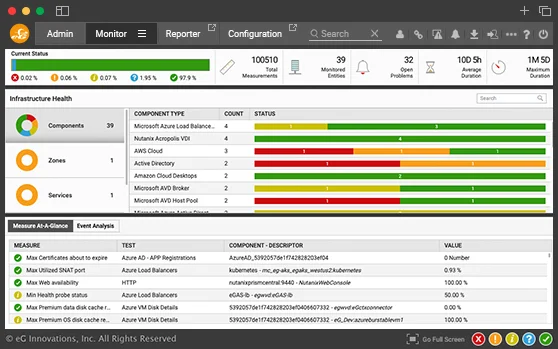
| The eG VDI Monitor, part of the eG Enterprise Suite, addresses the above key needs of VDI. You can use the eG VDI Monitor during your initial deployments to identify and eliminate bottlenecks. When a user calls your helpdesk saying that the virtual desktop service is slow or is not working, you can use the eG VDI Monitor to quickly determine the cause of the problem – i.e., is it the network? database? applications? virtual desktop? virtualization platform? storage? etc. Using a patented, automated root-cause diagnosis technology, the eG VDI Monitor analyzes performance across every tier of the infrastructure and correlates them over time. The result is a prioritized set of alerts with the most critical one pointing to the root cause of a problem. By focusing on the most critical alerts, the eG VDI Monitor ensures that you are working on the root cause of your problems. |
 |
As you start to scale your virtual desktop infrastructure, the eG VDI Monitor helps you with resource optimization and capacity planning. Using the wealth of metrics that it collects, you can determine where the hot spots in your infrastructure are, how you can balance load across your servers to maximize usage, and where you need to add resources to ensure that the quality of service does not suffer as you roll out additional virtual desktops.
Some of the key benefits you can achieve by using the eG VDI Monitor are:
 |
Low service downtimes and increased customer satisfaction |
 |
Clear problem demarcation and elimination of finger-pointing |
 |
Optimal usage of current resources |
 |
Easy to use with a short learning curve, so you do not need expert staff to be involved in routine fire fighting |
|
 |
|
|
 |
 |
 |
 |
Virtual Desktops or Server Based Computing?
eG Enterprise Monitors Both!
Virtual desktops and server-based computing (SBC) technologies (such as Microsoft Terminal Services and Citrix XenApp) have different use cases and are often used in parallel. Often, the same set of administrators are responsible for both environments. eG Enterprise is the only solution in the industry that offers unified monitoring, diagnostics and reporting for VDI and SBC infrastructures. A common look and feel, short learning curve and correlated reports and alerts are some of the benefits you can get when you use eG Enterprise for monitoring all your remote access services.
 |
 |
 |
 |
How Do We Deliver Rapid ROI?
Our eG Single Agent Solution doesn't care what virtualization platform you have, what type or size of server (cores, sockets, CPUs), you use, or how many virtual desktops per server you plan to run. For monitoring the virtualization platform, the only question is “How many physical servers do you want to monitor"? That's it.
Because of this simple, single agent architecture, you get...
 |
One price for monitoring a physical server (regardless of the number of virtual desktops) |
 |
One license to maintain regardless of the virtualization platform (vSphere, XenServer, etc.) or the connection broker (VMware View, Citrix XenDesktop, Leostream, etc.) |
 |
The ability to install and configure without the need for expensive consultants |
 |
The flexibility to change your infrastructure and continue to use the same monitoring solution without need to purchase additional plug-ins |
 |
|
 |
Simple, flexible, portable, agnostic and FAST. Justifying your recommendation to the number crunchers has never been easier.
What's more... your licenses are reusable. If you decide to move your existing server-based applications to virtual desktops, you can reuse licenses you are using for your SBC servers to the new servers that will be hosting virtual desktops.
|
 |
 |
 |
 |
By now, you should know that
you cannot use just
any server virtualization monitoring solution for your virtual desktop infrastructure. What you need is a solution that is optimized for monitoring the VDI service end-to-end. You need the eG VDI Monitor.
|
|
|
|