 English
 Deutsch
 Espanol
 Français
 Portuguese
 中文
中文 한국어
한국어 日本語
日本語
A Global Healthcare and Medical-Technology Company Consolidates Synthetic Monitoring with eG Enterprise
Replacing Dynatrace and Cisco AppDynamics across thick-client, web, and voice applications, at under half the software cost and 80%+ lower total cost of ownership.
At a Glance
- Industry Healthcare & Medical Technology
- Region Global, 12 locations
- Team Monitoring as a Service (MaaS)
- Delivery model 3 Systems Integrator (SI) partners
- Environment Web, thick-client, thin-client, and voice applications
- Replaced Dynatrace and Cisco AppDynamics
- Deployment Hybrid: on-premises management server plus eG-hosted bots
12
Global locations monitored
100s
Synthetic scripts in production
< ½
Software cost vs. comparable tools
80%+
Lower total cost of ownership (TCO)
1 day
From kickoff to first end-to-end simulation
Observability as a service, across a global estate
For a global healthcare and medical-technology company, application availability is a business issue, not only an IT one. Operations run around the clock, and even a minute of downtime can ripple through logistics, procurement, manufacturing, and customer-facing services worldwide. The estate spans modern web, modern desktop, and older legacy applications, some serving customers, some serving partners and suppliers, and others used by employees every day.
This mandate sits with the organization's Monitoring as a Service (MaaS) team, an internal initiative that delivers observability as a service across the enterprise. The team manages monitoring at enterprise scale, coordinating three Systems Integrator partners, and takes a best-of-breed approach across AIOps, ITSM automation, and GenAI. Synthetic monitoring is one capability within this wider platform, which also covers application performance, infrastructure, and database monitoring across more than 100 business services.
The Challenge
A gap the market's leaders could not fill
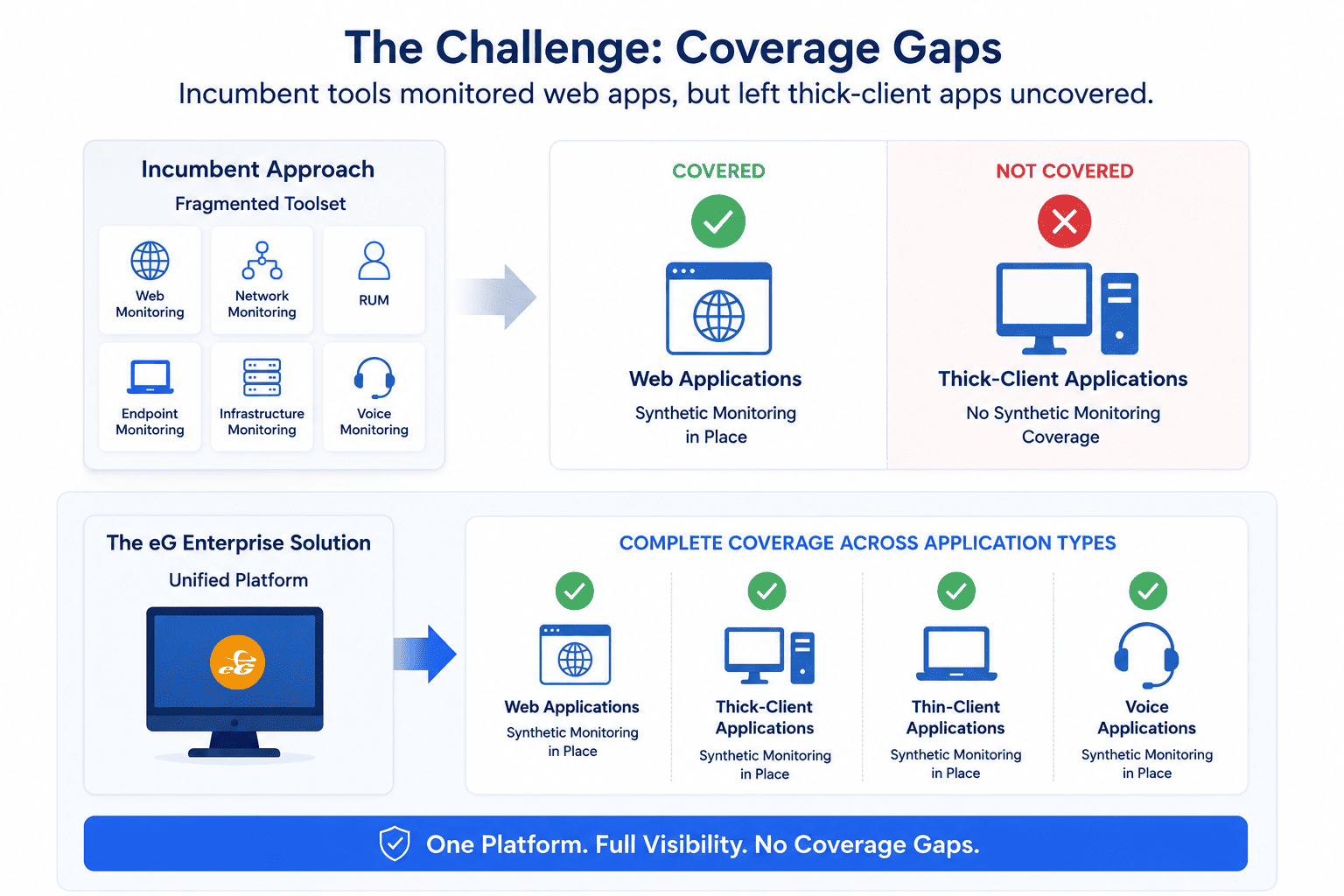
Synthetic monitoring, the continuous simulation of user transactions that catches failures and slowdowns before real users do, was central to the MaaS team's strategy. The incumbent tools, Dynatrace and Cisco AppDynamics, are respected APM platforms, but neither could fully cover what this organization needed.
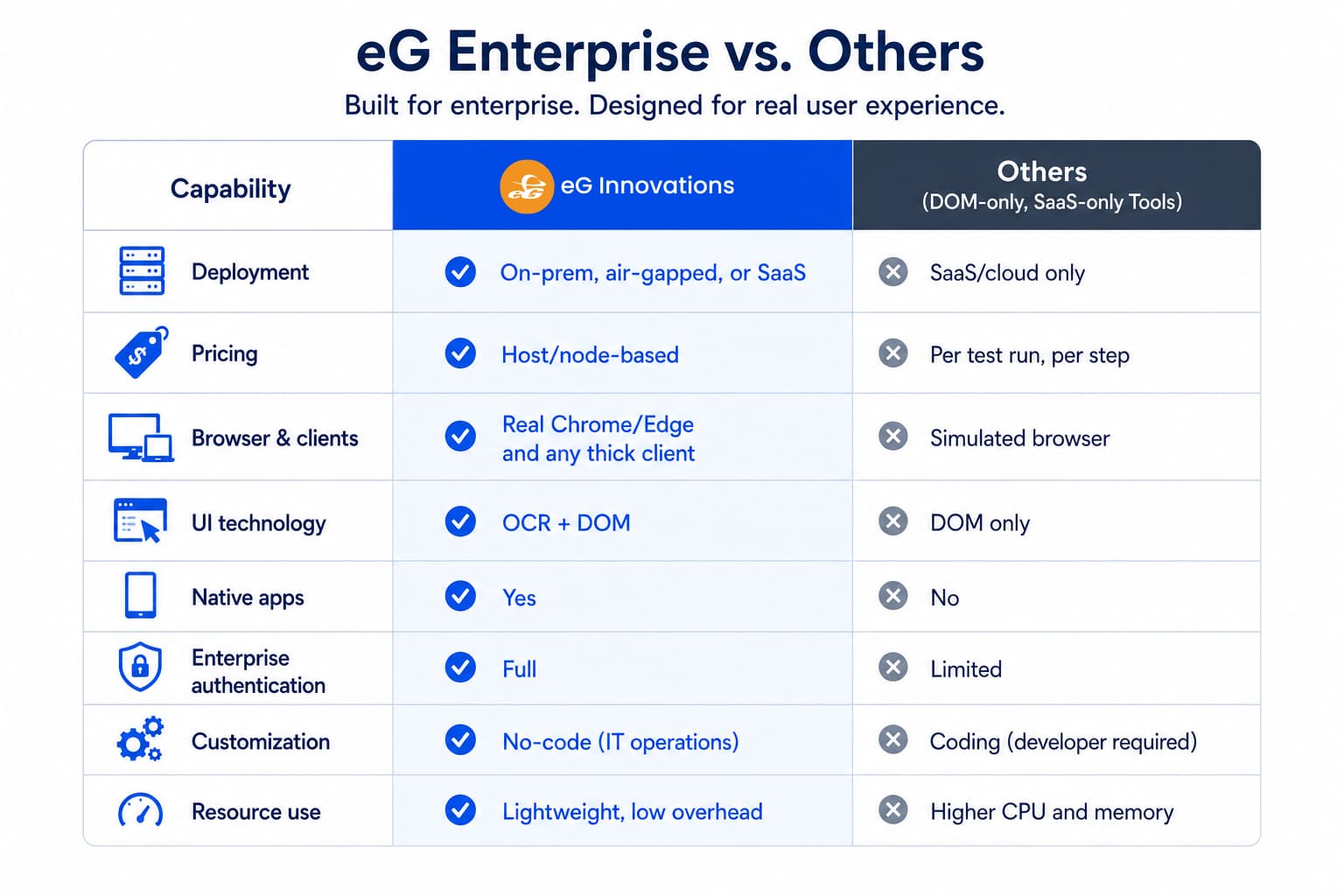
The trigger was a discontinued product. When Dynatrace sunset its simulation capability for thick-client desktop applications, a significant part of the estate was left without coverage. Finding a replacement was not straightforward: most synthetic monitoring tools simulate web applications using the Selenium engine, but few can handle thick-client applications, which do not conform to the structured input and output models that web automation relies on. Two further problems compounded it. The team lacked diagnostic clarity when a simulation failed, and per-script licensing models made enterprise-scale consolidation financially prohibitive.
The Solution
One no-code engine for every application type
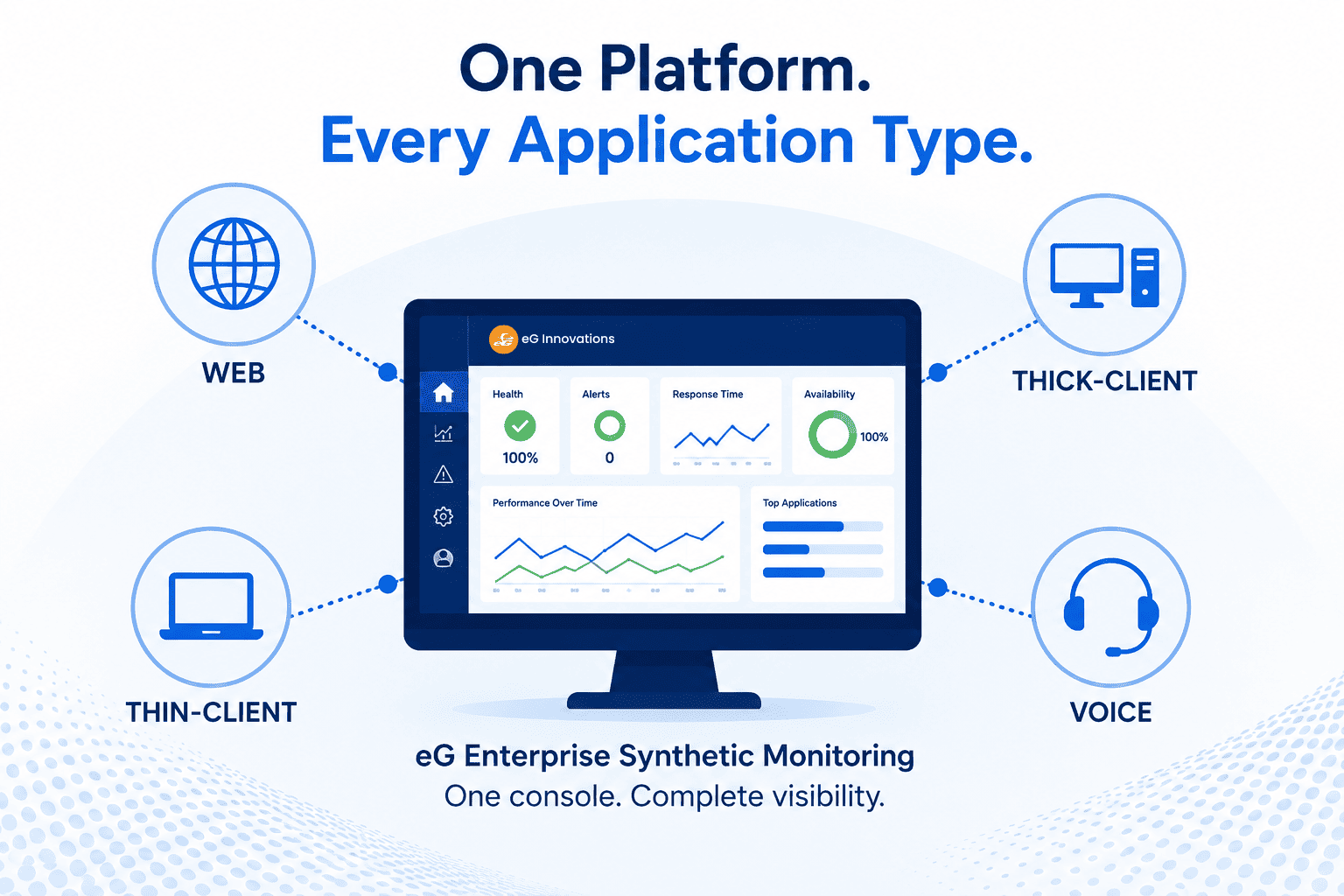
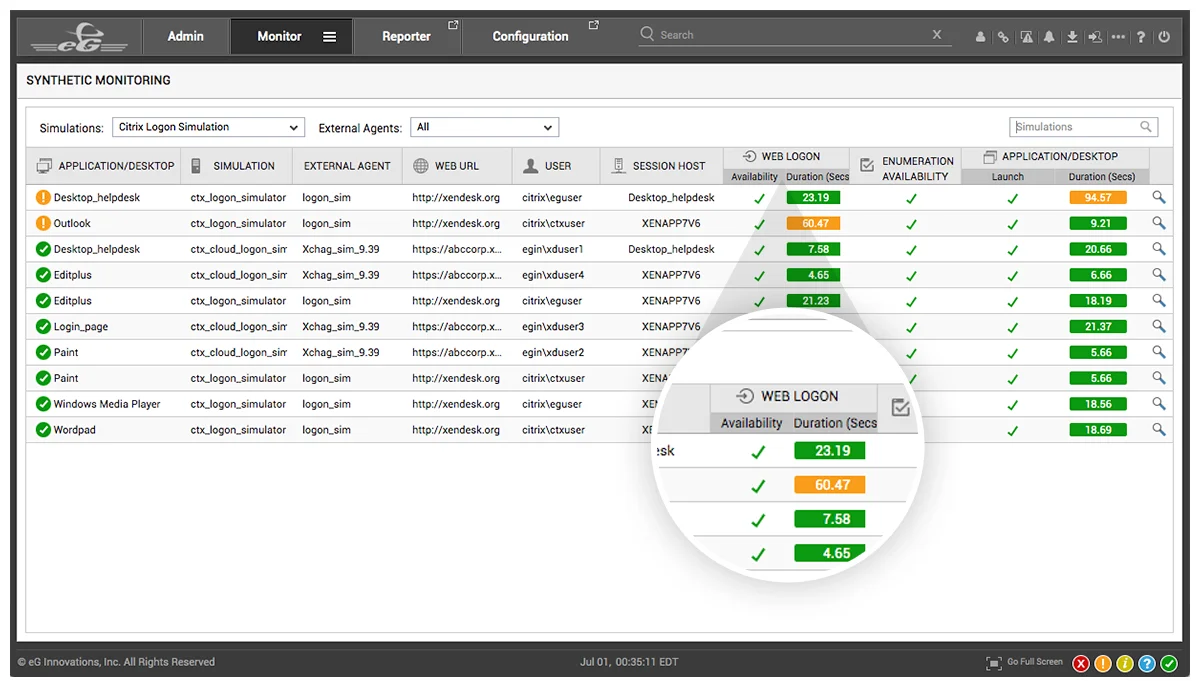
After evaluating multiple tools, the MaaS team selected eG Enterprise. Its Universal Synthetic Monitoring is a no-code, hybrid automation engine that combines OCR-based visual intelligence with DOM automation to simulate real user journeys across web, thin-client, and thick-client applications. The proof of concept was decisive: a complete end-to-end session simulation was running within a few hours.
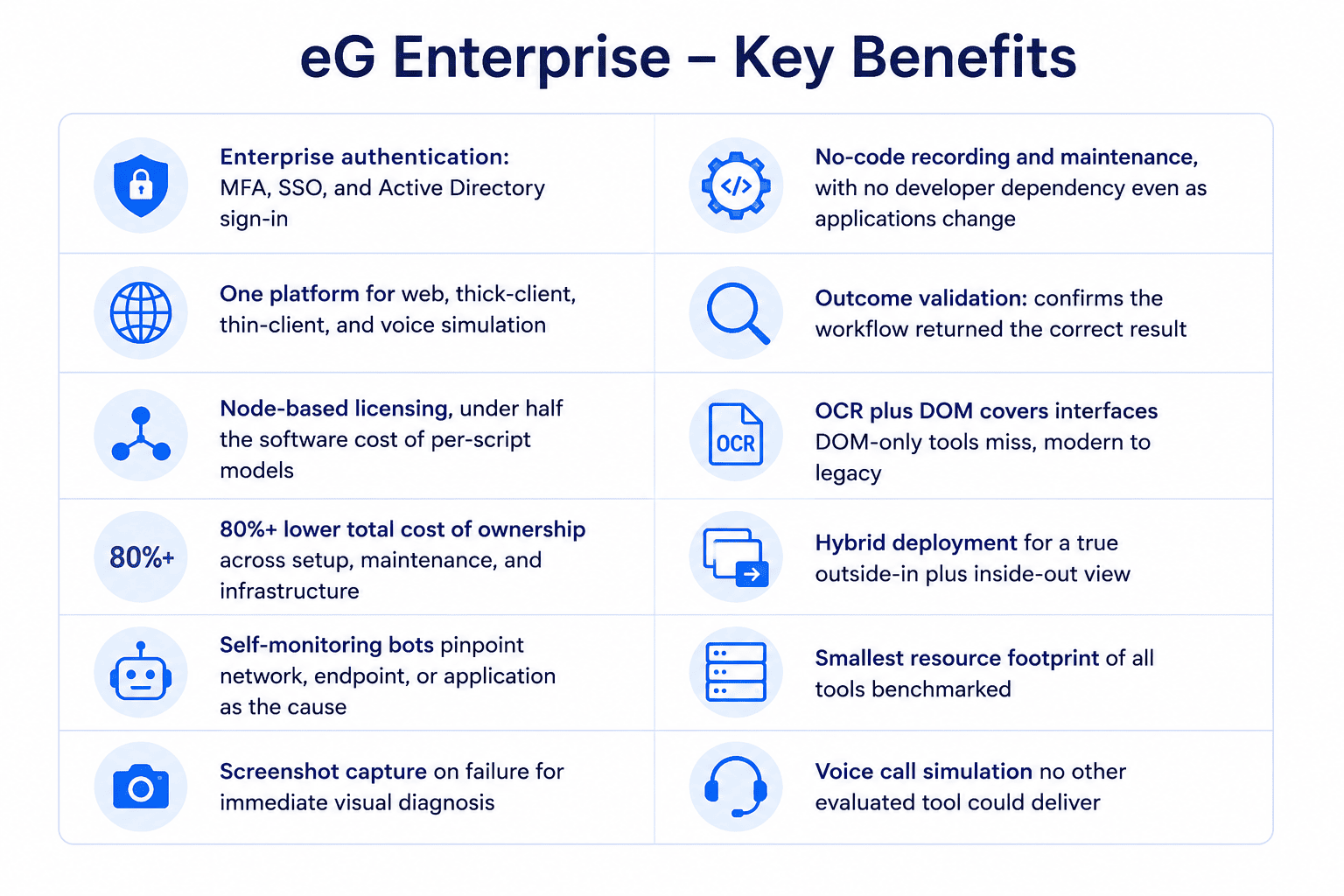
- Simple, no-code recording: walk through the application as a user and eG Enterprise captures every step, with no manual scripting or coding.
- Screenshot capture on failure: immediate visual context at the exact point of failure, so problems are diagnosed faster.
- Self-monitoring bots and diagnostic clarity: the same console shows whether a failure is the network, the endpoint, or the application, reducing mean time to resolution (MTTR).
- Enterprise authentication: simulates MFA, SSO, and Active Directory sign-in, so secured applications are monitored end to end.
- Outcome validation: confirms each workflow completes and returns the correct data, files, or reports, not just that the application is up.
- Node-based licensing: licensed per node, not per script, which made enterprise-scale consolidation viable.
"eG Enterprise showed us exactly why each simulation failed, whether it was a network issue, an endpoint problem, or something in the application. That level of diagnostic clarity is something we simply did not have before."
Senior Infrastructure Engineer, Global Monitoring Team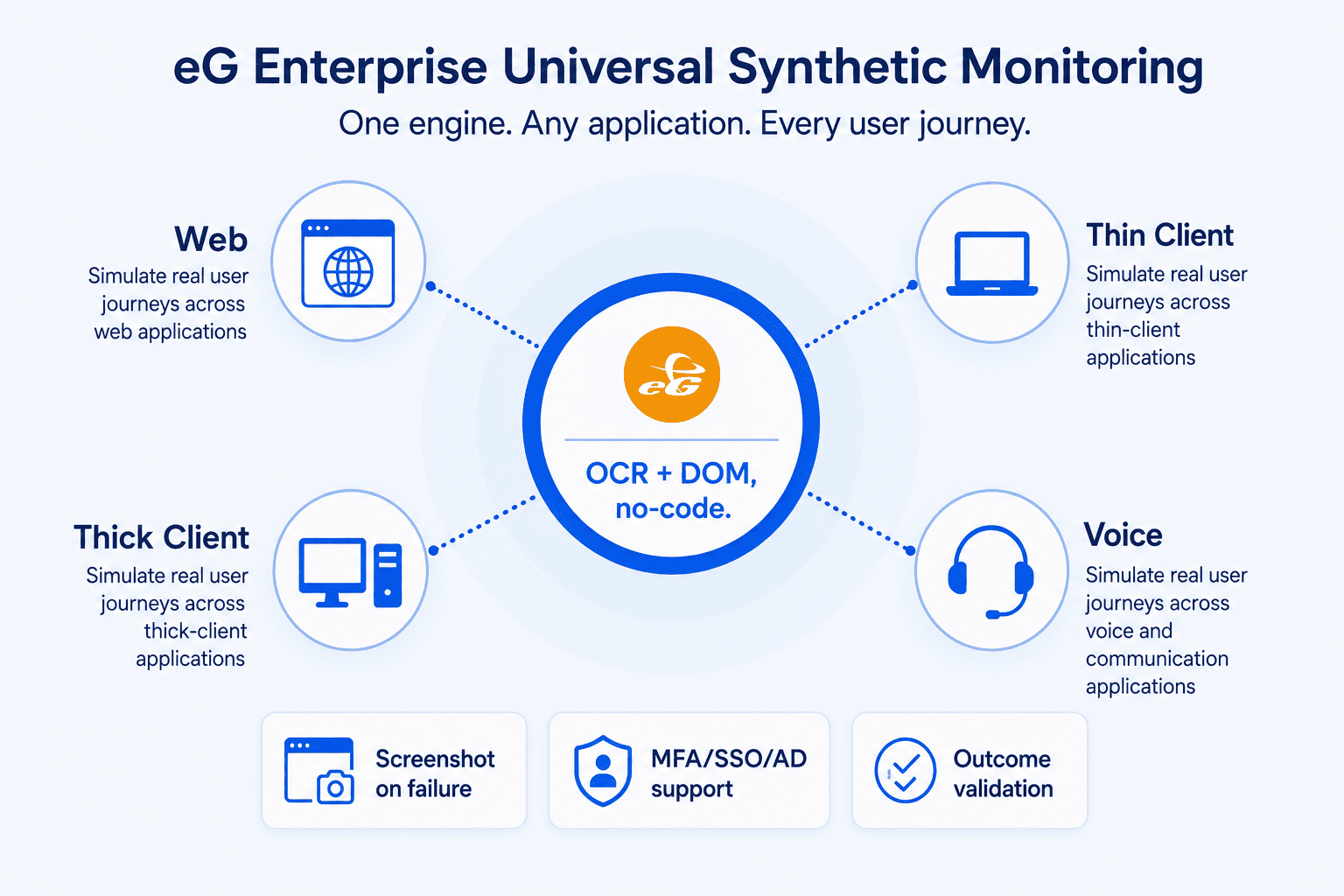
The Deployment
Enterprise scale across 12 locations
The rollout spanned 12 global locations and was completed in a matter of months, with hundreds of multi-step scripts created, tested, and hardened for production. The simulated workloads spanned business-critical enterprise platforms, including a dedicated PLM suite and an ERP-integrated PLM module, where different modules of the same application involve different workflows that are each simulated independently. Many of these applications sit behind enterprise security, so eG Enterprise simulates the full sign-in sequence, including multi-factor authentication, single sign-on, and Active Directory.
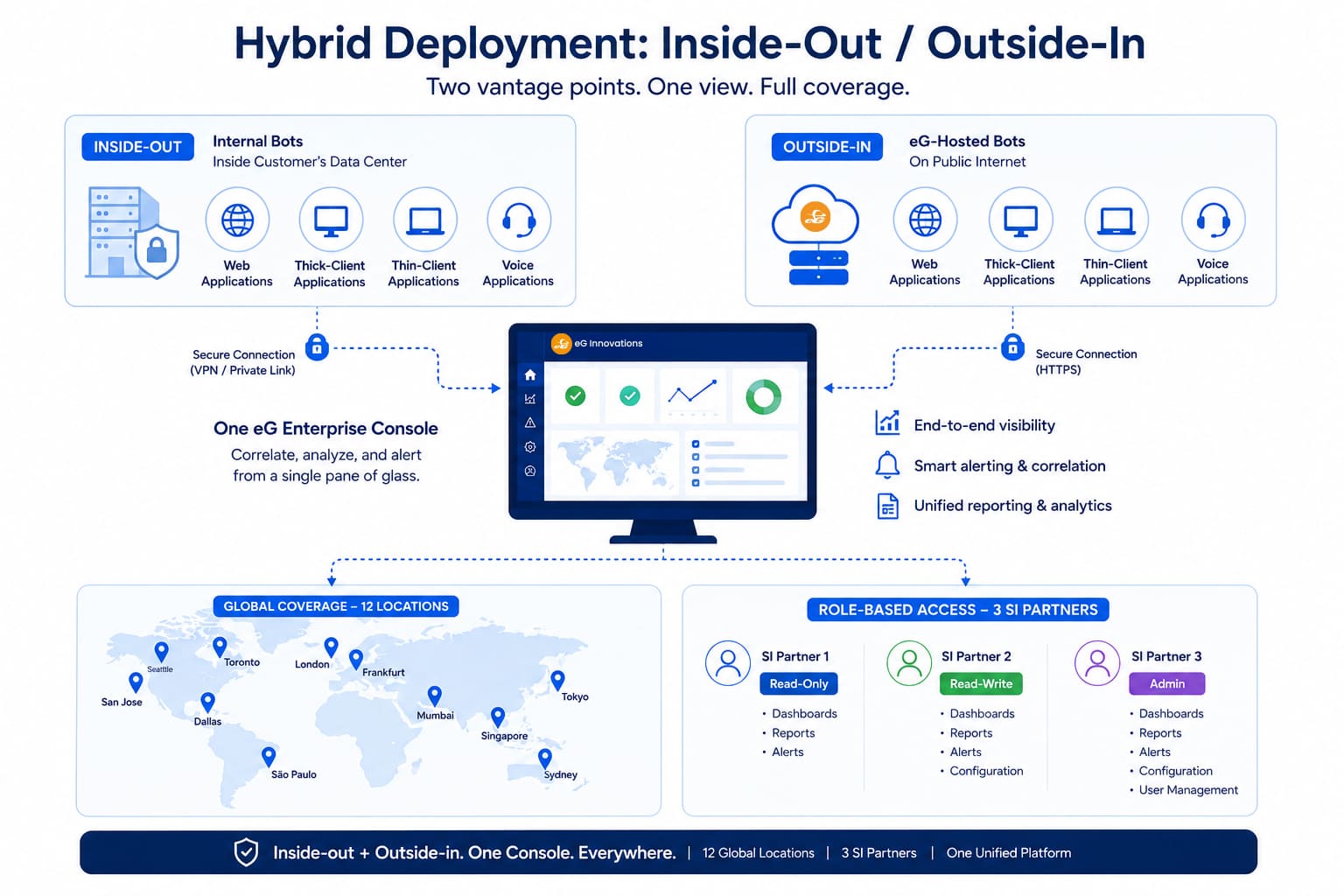
The deployment is hybrid by design. The eG Enterprise management server runs inside the organization's own infrastructure, while additional simulation bots run on the public internet to give an outside-in view of availability, the same view an external user gets, alongside the inside-out view from internal bots. A unified console with role-based access lets each SI partner see only its own services, while the MaaS team keeps enterprise-wide visibility, and geo-based alerting routes notifications to the right regional team. Most simulations run around the clock, with extra checks scheduled around business events such as order-intake windows and supply-chain processing.
Tested Against the Incumbents
Tested against the incumbents, and it won
With the thick-client program delivering results, the MaaS team extended eG Enterprise to web application simulation, consolidating a fragmented toolset onto one platform. Web applications built on different backend technologies were tested against all the incumbent tools, and eG Enterprise came out ahead on every dimension. Part of the reason was coverage: because eG Enterprise pairs OCR-based visual intelligence with DOM automation, it can simulate interfaces that DOM-only tools miss, from modern single-page applications to older legacy front ends. Web simulation was also where the incumbents struggled most on resource use, and eG Enterprise carried the smallest footprint of any tool benchmarked. The team also achieved voice call simulation, used to verify SLA compliance and to benchmark before and after migrations, a capability no other tool evaluated could deliver.
The Payoff
Lower cost, lower effort
eG Enterprise's software cost was less than half that of comparable solutions, but the larger saving came from everything around the software. Synthetic monitoring is never a one-time build: applications change, and their scripts must be reworked. With tools that need a programmer for every change, that maintenance is slow and expensive. eG Enterprise's no-code approach lets the IT operations team adapt scripts themselves, with no developer in the loop. Once faster setup and lower CPU and memory use are added in, the organization estimates an overall saving of more than 80% in total cost of ownership versus its previous approach.
"The recording process was far simpler with eG Enterprise than with any other tool in our estate. No scripting, no developer time. When an application changes, updating the script is something our operations team handles directly."
IT Monitoring Lead, MaaS Team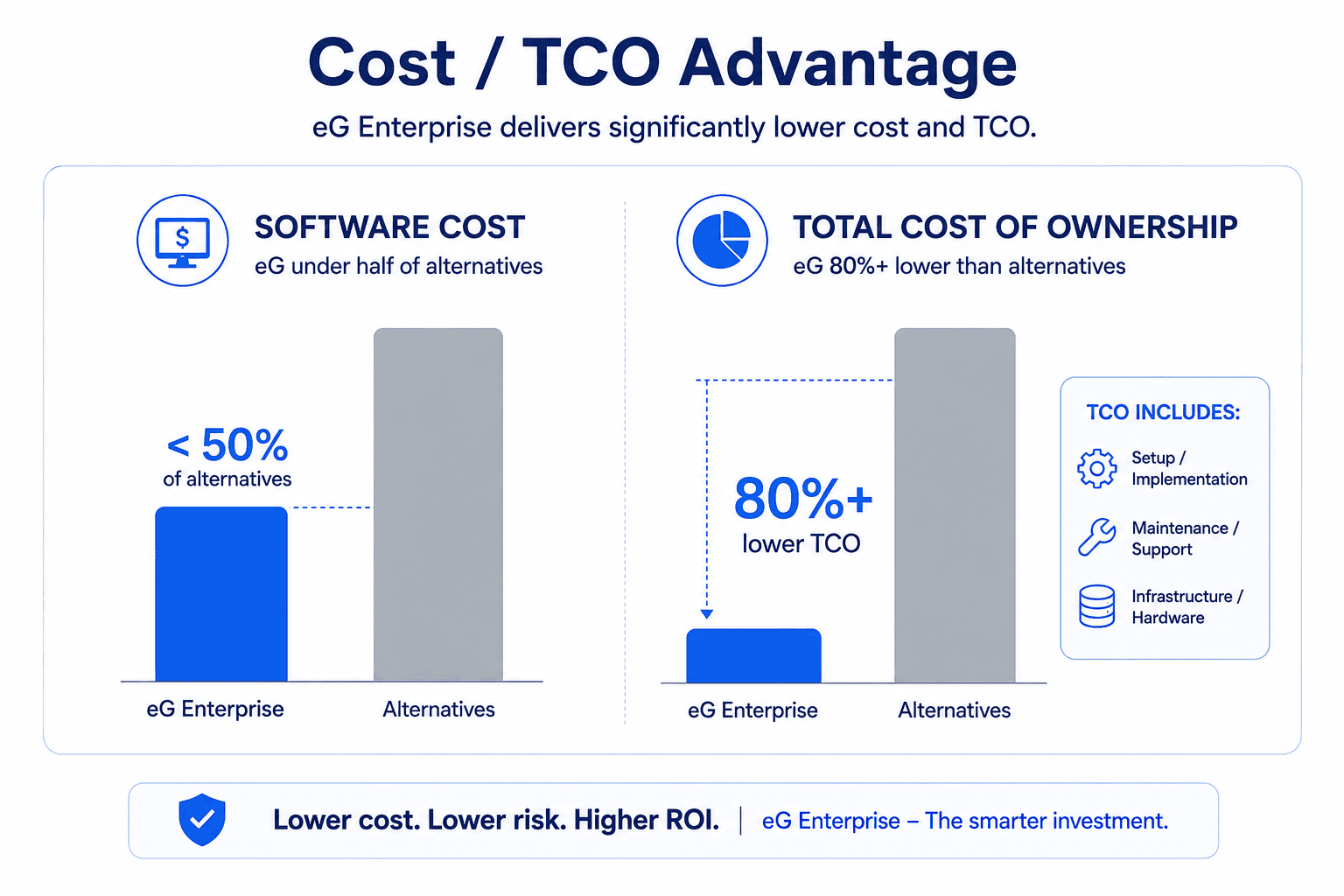
What's Next
From simulation to full user experience
The organization is now deploying eG Enterprise Real User Monitoring (RUM) across its web estate. eG Enterprise correlates real user experience with the backend transactions and infrastructure behind it, so the team can move from a degraded experience to its root cause without switching tools. eG Enterprise is now an integral part of the organization's observability framework, managing the full user-experience layer for employees and external users, with future plans to expand into APM and wider voice simulation.
Why eG Enterprise
eG Innovations is a recognized leader in full-stack observability and digital experience monitoring. Its Universal Synthetic Monitoring combines no-code automation with OCR-based visual intelligence to simulate real user journeys across any application type. Unlike SaaS-only tools, eG Enterprise runs simulations within the customer's own infrastructure, or from eG-hosted bots where an outside-in view is needed, so the customer keeps full control over credentials, screenshots, and execution data.
See how unified synthetic monitoring could work for your estate
Read the full story of how one global healthcare and medical-technology company consolidated thick-client, web, and voice monitoring onto a single platform.
About eG Innovations
eG Innovations is dedicated to helping businesses across the globe transform IT service delivery into a competitive advantage. A leading provider of APM, digital experience monitoring, and full-stack observability solutions, eG Innovations' eG Enterprise platform delivers unified visibility across applications, infrastructure, and user experience. Many of the world's largest enterprises trust eG Enterprise to enhance IT service performance, increase operational efficiency, and deliver on the ROI promise of transformational IT investments.
www.eginnovations.com | sales@eginnovations.com | +1 866 526 6700