English
 Deutsch
 Espanol
 Français
 Portuguese
 中文
中文 한국어
한국어 日本語
日本語
Exchange monitoring made simple
Reduce exchange troubleshooting through proactive monitoring
Free TrialTrusted by leading companies


eG Enterprise for
MS Exchange
Email is the most mission-critical application on the internet today. Any downtime, non-delivery, extremely delayed delivery of email can severely impact the operation of a business. Thus monitoring can be the most critical capability among Microsoft Exchange management tools. The eG Enterprise suite includes specialized capabilities for Exchange server monitoring to help ensure top performance for corporate email systems.
Exchange monitoring safeguards your most critical business service
IT administrators often encounter instances where users complain that mail performance is slow. The key challenge for an administrator is to determine where and why a slow-down is occurring – Is there a problem in receiving data from clients over a network? Is the slow-down in the Microsoft Exchange server's processing? Is the problem due to slow disk read/writes at the operating system level? Only with this discovery can remediation take place.
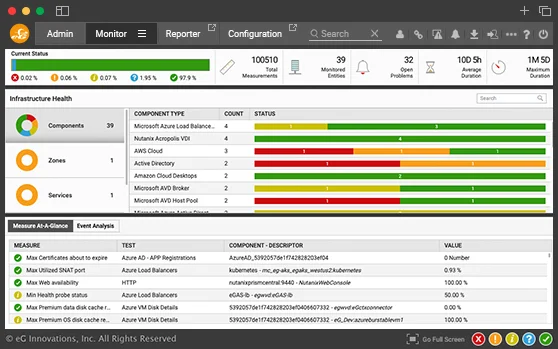
eG Enterprise’s Exchange monitor makes managing Exchange server performance easy and effective. Using either an agent-based or an agentless approach, administrators can monitor various aspects of Microsoft Exchange server performance, including:

- Instantaneous occupancy of the different Microsoft Exchange server queues
- Access patterns of users
- Interaction of the Exchange server with the Active Directory
eG Enterprise's unique layer model representation provides an intuitive and efficient way to correlate the application performance with network, CPU, memory, and disk performance, allowing administrators to quickly interpret where the performance bottlenecks may be. Data collected by the eG agents is stored in eG Enterprise, so historical analysis and diagnosis can be performed to determine how the server can be configured for optimal performance.


eG Innovations delivers a robust, reliable and extremely valuable solution to deliver maximum uptime and user satisfaction. Pre-emptive alerting helps us to address performance issues immediately before they affect system and application availability.

What the eG monitor for Microsoft Exchange server reveals
| Monitoring Capability | Monitoring Details |
|---|---|
| Monitoring Capability | |
| Process Monitoring | |
| Mail Traffic Monitoring | |
| Network Monitoring | |
| Memory Monitoring | |
| Disk Monitoring | |
| CPU Monitoring | |
| Active Directory Monitoring |