

Trusted by leading companies


eG Enterprise is an end-to-end application performance monitoring solution that helps enterprises, service providers, and government agencies radically simplify and accelerate service delivery performance management to boost user experience and ROI across virtual, cloud and physical IT environments.
Its award-winning automated root cause diagnosis technology automatically pinpoints the cause of IT service slowdowns with great accuracy. By auto-correlating the user experience with the underlying infrastructure and application components, eG Enterprise makes application performance monitoring easy, effective and efficient.
Here's a closer look at eG Enterprise's unique capabilities that shows how they help you deliver exceptional performance, user satisfaction and ROI.
Explore the application performance monitoring features in eG Enterprise
In today's dynamic and heterogeneous IT environments, traditional monitoring tools suffer from limited visibility into service dependencies between users, applications, and IT infrastructure.
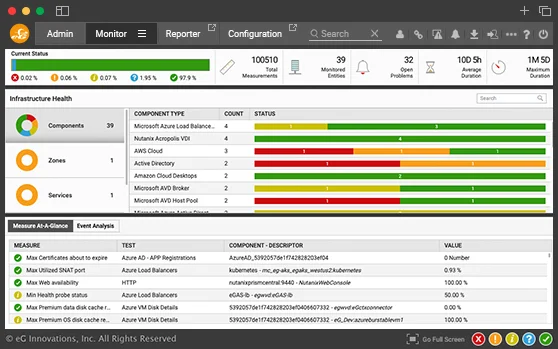
With eG Enterprise, you can monitor every layer and every tier of the IT infrastructure and connect performance insights—across applications, user experience, physical and virtual servers, network, and storage—with service availability and business productivity. Monitor your entire infrastructure from a single pane of glass.

The success of IT initiatives is directly tied to user satisfaction. Therefore, successful IT performance monitoring can no longer be limited to tracking IT resources—CPU, memory, disk, etc.
eG Enterprise monitors all aspects of a user's experience—for web applications, Citrix virtual applications, and more. With its real user monitoring (RUM), you can quickly see which transaction is slow, when, where, and why. Synthetic monitoring complements RUM by consistently testing applications 24x7 from different locations.

Poorly written application code and inefficient database queries affect application performance. Developers need code-level visibility to detect and fix such issues to ensure an optimal user experience.
Using a tag-and-follow approach, eG Enterprise traces web transactions as they are processed by each application tier. Transaction flow graphs help you quickly see where bottlenecks in transaction handling occur and pinpoint the exact Java method, SQL query or external API call that is responsible for transaction slowdowns.

eG Enterprise provides out-of-the-box monitoring for over 650+ enterprise applications including Citrix, SAP, Microsoft Dynamics, SharePoint, Siebel, PeopleSoft, Java, Oracle, and more. From a single pane of glass, administrators and monitor multi-vendor applications and custom applications, track performance metrics, identify anomalies, and correlate with infrastructure problems for faster troubleshooting.
With purpose-built monitoring models for each application, eG Enterprise delivers in-depth insights on intuitive dashboards allowing IT teams to easily isolate bottlenecks in any layer of the application and the underlying operating system. eG Enterprise also monitors over 10 different operating systems (Windows, Linux, AIX, HP-UX, Solaris, and more).

Virtualized IT environments are highly dynamic and heterogeneous, making manual performance diagnosis with legacy tools impossible.
eG Enterprise's unique, patented 'inside-outside' monitoring technology delivers both depth and breadth of insight into virtual infrastructures. The 'outside view' of a VM indicates the hypervisor's physical resources used by a VM, while the 'inside view' of the VM highlights which applications and users are responsible for the resource usage.

Cloud infrastructures are distributed and heterogeneous making monitoring a challenge for IT teams. eG Enterprise provides monitoring support for cloud applications and infrastructures across SaaS, PaaS and IaaS environments. Using out of-the-box reports, easily compare performance of applications before and after cloud migration.
eG Enterprise auto-discovers cloud infrastructures across public (AWS and Azure), private and hybrid cloud environments and maps dependencies with the on-premises infrastructure tiers. Available in a SaaS deployment model (in addition to on-premises deployment), eG Enterprise is best-suited for service providers.

Replace your legacy, silo monitoring tools with eG Enterprise’s universal monitor, which ensures unparalleled flexibility and speed of deployment.
Licensing is based on server operating system or users (for Citrix/VDI), and not on CPUs/cores, the operating system or the specific application components being monitored. Administrators have the flexibility to choose between agent and agentless monitoring options.

Today’s IT infrastructures are highly interdependent. Manually mapping the many dependencies that exist between different tiers is nearly impossible.
eG Enterprise goes far beyond discovering networks, servers, and applications as disparate elements. It auto-discovers all forms of infrastructure dependencies (application-to application, application-to-VM, and VM-to-physical machine) and presents the connected topology on intuitive maps. View service-level topology maps and easily identify how the infrastructure is connected and performing to deliver business services.

When users complain about slow applications, IT teams find it difficult to diagnose the root cause: Is it the application code, web server, database, virtual platform, network, storage, etc.?
Using a virtualization-aware, automatic root-cause diagnosis technology, eG Enterprise accelerates the discovery, diagnosis and resolution of performance issues. Resolve problems with accuracy in minutes rather than days. Allow your IT experts to be focus on productive tasks, instead of fighting fires all day.

To prevent downtime and ensure user satisfaction, IT teams must be alerted to performance deviations well before business services are impacted and users notice them.
eG Enterprise helps you preemptively monitor, accurately detect, and quickly resolve performance issues before users notice. Self-learning baselines, built-in correlation rules and intelligent alerts ensure that your team is proactively alerted to performance issues, configuration changes, and abnormal usage and activity trends.

Many IT expansion and transformation initiatives stall or fail due to cost overruns. Performance issues are often addressed by over-provisioning and adding hardware.
With empirical data, trends and reports from eG Enterprise, you can right-size the IT infrastructure, maximize resource utilization, and reduce hardware and software costs. eG Enterprise allows your team to realize maximum ROI, and efficiently plan future rollouts for any IT environment: virtual desktops, cloud migration, data center consolidation, legacy modernization, and more.

IT administrators and architects need to understand how the IT environment is being used, as well as when and where inefficiencies and bottlenecks occur.
eG Enterprise offers comprehensive pre-built and custom reports on users, applications, and infrastructure components to enable real-time and post-mortem analysis, forecasting and capacity planning, as well as auditing and compliance.
Chart trends and analyze performance over time, and easily compare metrics across components for highlighting performance deviations. Automate delivery of reports to your mailbox based on custom schedules.

A large percentage of performance issues are caused by configuration errors or changes. Administrators spend many hours manually trying to determine what caused a performance impact.
eG Enterprise allows you to track all configuration changes as they happen, compare configurations over time, and correlate performance issues with configuration changes, enabling you to quickly identify and fix issues.

eG Enterprise’s monitoring capabilities are extensible for new and customized infrastructure elements. Easily add new applications and network devices, and build customized models for monitoring.
Make deployment fast and easy through integration with orchestration tools and ensure seamless integration with your service management processes using native integration with tools, such as ServiceNow, PagerDuty, JIRA, Slack, and more. Minimize the learning curve for your operations team through tight integration with management tools like Microsoft SCOM.

eG Enterprise deployment is hassle-free and does not require extensive policy and firewall reconfigurations to collect and communicate metrics.
Since it uses standard web protocols (HTTP/HTTPS) for all communications, eG Enterprise allows monitoring of servers that are deployed within a private network or in the public cloud.
As long as the agent has connectivity to the management system using HTTP/HTTPS, the monitoring can be started immediately. No additional firewall rules need to be configured.

As a fully multi-tenant solution, eG Enterprise allows collection and integration of metrics from multiple customer sites and geographically dispersed locations into a single web console.
Each customer gets a personalized view to monitor, alert and report on the state of their infrastructure—network, servers, applications, etc. Administrators can also be assigned limited rights to set baselines and configure monitoring for the segments of the IT infrastructure for which they have management access.