eG Total Performance Visibility
  •   Facebook  Linkedin  twitter  Blog


Hyper-V Management & Monitoring


Virtualization technologies are making it possible for IT operations to be more agile and responsive to the needs of their business customers than ever before. The result is many production environments are hosting their business-critical applications on virtualized infrastructures. The continuous operation and prompt delivery of business services now hinges on how well the virtualized infrastructure that supports these services performs. Hence, VM monitoring, diagnosis, and reporting on the virtualized infrastructure is very important.

Microsoft's Hyper-VTM Server 2008 offers a reliable, optimized virtualization platform for enterprises. Built on a Windows Hypervisor, Hyper-V allows efficient use of server hardware investments by consolidating multiple server roles as separate virtual machines (VMs) running on a single physical machine and also efficiently run multiple different operating systems-Windows, Linux, and others-in parallel, on a single server, and fully leverage the power of x64 computing.

Microsoft Hyper-V Monitoring Challenges

A Hyper-V server is used to host multiple VMs and a single malfunctioning application running in a VM can take up excessive resources, thereby degrading the performance of applications hosted on the other VMs. Besides resource contention among virtual guests, applications executing on the root partition can also affect the performance of the virtual infrastructure. Insufficient allocation of resources to VMs can also contribute to problem situations.

Most Hyper-V monitoring solutions are just resource monitors that track only the resource usage of the VMs. They fail to provide visibility into the internal operations of VMs which can shed light on the reasons for slowdowns experienced by your virtualized infrastructure. A high-cost, resource-intensive, and high-maintenance alternative to this is to deploy monitoring agents in each of the VMs for monitoring the guest operating systems and the applications running in the VMs.

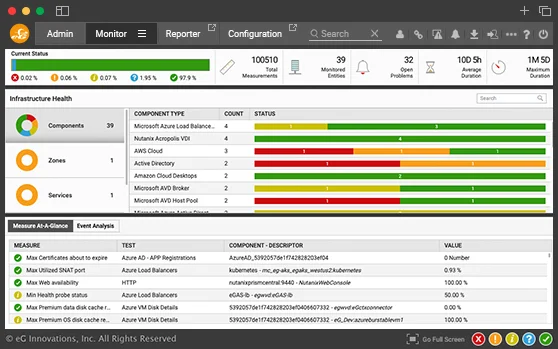
The eG VM Monitor, part of the eG Enterprise Suite, serves as a one-stop-shop for monitoring and managing heterogeneous virtualization environments. Administrators can use a common web-based console to monitor server applications and desktops running on Microsoft Hyper-V, AIX LPARs on IBM pSeries servers, Citrix XenServer, VMware vSphere/ESX, Microsoft Virtual, and other virtualization environments. Coupled with the ability of the eG Enterprise Suite to monitor over 120 applications, including Citrix Monitoring, Windows Server Monitoring, Oracle Monitoring, IBM, SAP Monitoring , and others, the eG VM Monitor provides a comprehensive end-to-end solution for monitoring and managing the performance of virtual IT infrastructures.