

Redis (Remote Dictionary Server) is an in-memory data structure store, used as a distributed, in-memory key-value database, cache and message broker, with optional durability. Redis supports different kinds of abstract data structures, such as strings, lists, maps, sets, sorted sets, HyperLogLogs, bitmaps, streams, and spatial indices. Redis is open-source software released under a BSD 3-clause license although commercially supported paid versions are also available for enterprise users; Redis, Inc. commercially supports Redis Enterprise, which is available as an on-premises software deployment and a fully-managed cloud service.

Redis’ popularity is owed to its ability to support high performance caching at scale, making it particularly well-suited to cloud, large datacenter and microservices use cases. Redis enables faster application interactions such as quick data retrieval and a balanced load of backend services with caching.
Redis의 일반적인 사용 사례는 다음과 같습니다:
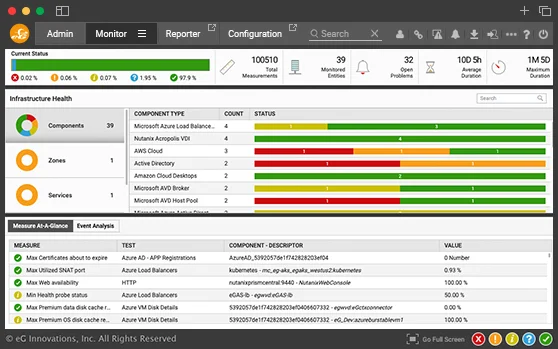
eG Enterprise monitors Redis effectively as it supports end-to-end monitoring of the whole application and infrastructure stack. Domain specific functionality provides deep insights, observability and root-cause diagnosis of the applications reliant on Redis, Redis servers and the resources they depend on.
Beyond this, eG Enterprise monitors all underlying and interconnected infrastructure and dependencies to identify issues that impact on Redis performance and availability but lie beyond the Redis stack itself. eG Enterprise supports both agent-based and agentless monitoring of Redis.
Out-of-the-box alerting and metric thresholds, dedicated help desk features, rich dashboards, service topology maps, live and historical reports, synthetic monitoring and user-experience views enable Redis monitoring to be integrated with modern IT workflows and business processes and with ITSM platforms such as ServiceNow, Microsoft Teams, WhatsApp and more.

eG Enterprise is available for use on-premises, in the cloud or via our ready-to-go SaaS service. 24x7, follow-the-sun support enterprise options serviced by 12 regional offices worldwide supporting 8 native languages ensure you can rely on eG Innovations.
eG Enterprise is a powerful AIOps observability platform designed to remove manual effort and human error from the Redis administrator, capable of scaling beyond the capabilities of the human operator and automating deployment, root-cause diagnosis and anomaly detection. eG Enterprise is a cloud-ready performance monitoring solution:


분산 메모리-객체 캐싱 시스템의 즉각적인 가시성 및 선제적 알림이 다음을 포함한 일반적인 문제를 식별합니다:

eG Enterprise는 관리자가 복잡한 문제를 해결하여 Redis 성능을 최적화할 수 있도록 다음과 같은 일반적인 문제를 진단하기 위한 핵심 지표를 포함합니다:

eG Enterprise는 단일 통합 인터페이스 내에서 다음을 포함한 Redis를 지원하는 모든 상호 의존성과 기반 인프라 및 서비스에 대한 진정한 엔드투엔드 모니터링을 제공합니다:

Redis began as a caching database, but it has since evolved into a primary database. Many applications built today use Redis as a primary database. However, most Redis service providers support Redis as a cache but not as a primary database.
With Redis Enterprise, you can use Redis as both an in-memory cache and a primary database in a single system, thus eliminating the complexity and latency of two separate systems. Not only that, you can use it as a multi-model primary database, enabling you to build modern applications, as well as low-latency microservice-based architectures, all on top of Redis.
See: Redis as a Cache vs Redis as a Primary Database in 90 Seconds | Redis
Redis는 오픈소스 인메모리 키-값 데이터 구조 저장소로, 데이터베이스, 캐시 또는 메시지 브로커로 사용할 수 있습니다. NoSQL 데이터베이스입니다.
eG Enterprise supports over 200 different technology stacks, see: End-to-End Monitoring: Applications, Cloud, Containers (eginnovations.com), including many popular database offerings such as: MongoDB, Maria, Oracle, Microsoft SQL Server, Azure SQL Managed Instances and Database, Azure Cosmos DB, SAP HANA, MySQL and others.
The Redis architecture contains two main processes: Redis client and Redis Server. Redis client and server can be on the same computer or VM / container or on distinct separate computers/VMs.
Redis server is responsible for storing data in memory. It handles all kinds of management and forms the major part of the Redis architecture. Redis client can be Redis console client or any other programming language’s Redis API.
Redis is a storage of data structures of the NoSQL type. Redis stores everything in primary operational memory. Primary memory is volatile and therefore we will lose all stored data once we restart our Redis server or computer. Therefore, for data persistence, Redis supports the following mechanisms:
Redis also supports replication for fault-tolerance and data accessibility. To enhance storage capacity, you can also group two or more Redis servers to form a cluster. As such, Redis employs a primary-replica architecture and supports asynchronous replication where data can be replicated to multiple replica servers. This provides improved read performance as requests can be split and distributed amongst the servers and enables faster recovery when the primary server experiences an outage.
An excellent community article on Redis terminology and architectures is, How Redis Internally works ? What is redis ? | by N Singh | Nov, 2022 | Medium.
As mentioned already, all Redis data resides in-memory, in contrast to databases that store data on disk or SSDs. By eliminating the need to access disks, in-memory data stores such as Redis avoid seek time delays and can access data in microseconds.
Because of the reduced seek time and improved accessibility of data, Redis is the 'go-to' database for search engines.
Also, Redis supports Pub/Sub with pattern matching and a variety of data structures such as lists, sorted sets, and hashes. This allows Redis to support high performance chat rooms, real-time comment streams, social media feeds and server intercommunication such as Twitter, Flickr, Pinterest etc.
To summarize, many widely popular applications rely on Redis for their data storage and retrieval needs. This means that even a short break in the availability of the database or any slowness in its performance, no matter how negligible, can adversely impact user experience with that business-critical application. To avoid this, administrators should continuously monitor the health and performance of the Redis server and capture performance issues, well before they impact the quality of user interactions with the dependent applications.
eG Enterprise’s proactive monitoring and out-of-the-box alerting ensures administrators can avoid most issues and outages and when issues do impact performance resolve them rapidly.
Third-party platforms such as eG Enterprise simplify the monitoring of Redis Servers. Redis does provide some functionality to access performance data and metrics directly. MONITOR is a debugging command that streams back every command processed by the Redis server. It can help in understanding what is happening to the database. This command can both be used via redis-cli and via telnet. See: MONITOR | Redis.
예, 지원합니다. 문서에서 지원에 대해 자세히 읽을 수 있습니다. 참조: Azure Redis 캐시 테스트(eginnovations.com).
Redis용 eG Enterprise를 사용하면 관리자는 다음과 같은 일반적인 성능 질문에 신속하고 정확하게 답변을 찾을 수 있습니다:
예, 핵심 eG Enterprise 제품에는 라이브 및 과거 보고서가 기본으로 포함되어 있으며, 간단한 GUI 사용자 정의 보고서 작성기와 함께 감사, KPI 및 SLA 추적, 경영 인사이트를 위한 보고서를 예약하고 생성할 수 있습니다. 장기 추세 및 사용 패턴을 분석하고 추적하여 Redis 인프라를 계획할 수 있습니다.