English
 Deutsch
 Espanol
 Français
 Portuguese
 中文
中文 한국어
한국어 日本語
日本語
Cloud Monitoring Solution: Hybrid, Multi-Cloud & Performance Visibility
Monitor hybrid and multi-cloud environments with unified visibility, AIOps insights, and real-time performance monitoring across applications and infrastructure.
Free TrialTrusted by leading companies




Why Cloud Performance Monitoring is Critical
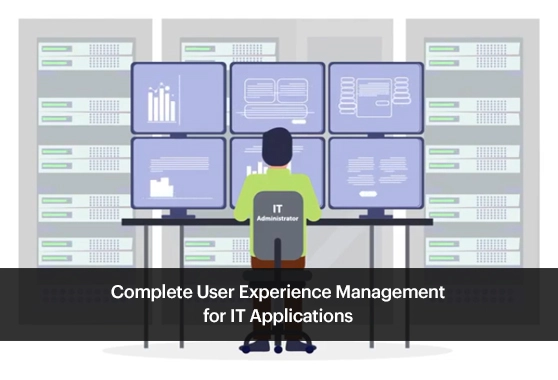
For enterprises that are accelerating their journey to the cloud—deploying new applications, migrating services to the cloud, and using cloud infrastructures to operate their business—success in cloud computing depends on ensuring that the performance of the applications and their service quality is equal to those deployed in their on-premises data centers. Whether a public, private or hybrid cloud infrastructure is used, holistic performance visibility is required to ensure successful service delivery and achieve high efficiency.
Not sure how to start monitoring cloud infrastructure and performance? A cohesive application performance monitoring (APM) strategy that focuses on customers’ digital experience, business transactions, application dependencies and infrastructure performance is key to achieving application performance success.
Challenges in Cloud Monitoring & Observability
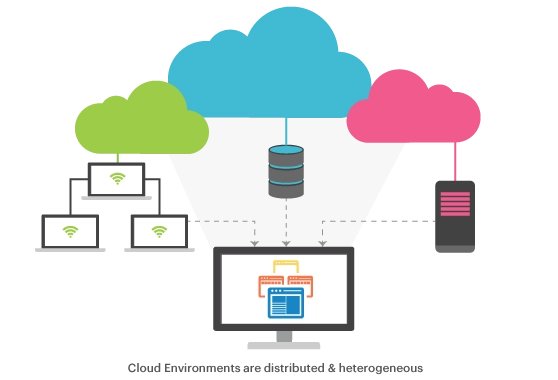
While cloud computing offers enterprises many benefits, it also poses several monitoring and management challenges. Given the distributed and heterogeneous nature of cloud environments, it is difficult to pinpoint the root cause of performance problems. To utilize cloud technology effectively, you need to figure out how to monitor and control elements across the entire infrastructure.
- Most cloud infrastructures involve multiple interdependent tiers: application, virtualization, storage, network, etc. A problem in one tier affects other tiers—making root cause diagnosis a challenge.
- Cloud environments involve multiple domains of control—one for infrastructure, another for applications, etc. Lack of centralized visibility makes performance difficult.
- The cloud infrastructure is shared and has workloads from multiple customers. A surge in demand from one customer’s workload can affect the performance of applications for another customer.
eG Enterprise: Unified Cloud Monitoring Platform
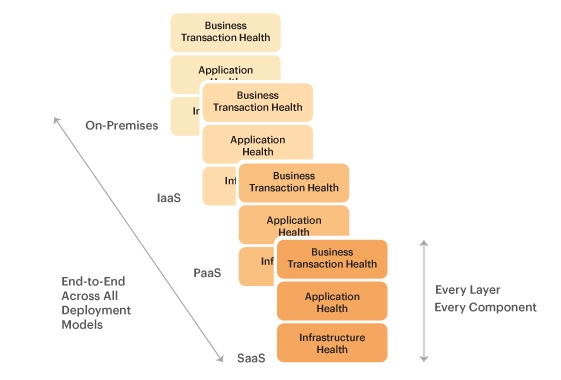
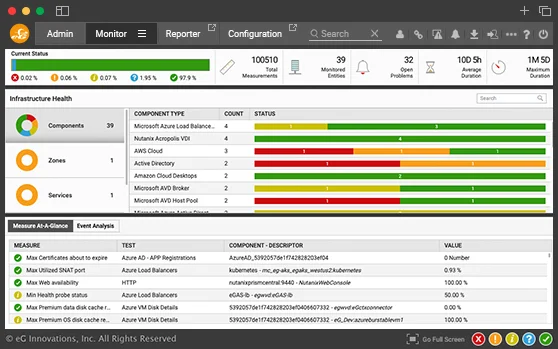
eG Enterprise is a comprehensive unified performance management and hybrid cloud monitoring solution for cloud and on-premises infrastructures. Available in SaaS-based and on-premises deployment models, eG Enterprise enables the success of your cloud initiatives by delivering end-to-end visibility across user experience and performance of applications, database, virtualization, storage and network. From a single pane of glass, administrators can use the cloud monitoring platform to automatically:
- Discover cloud (public, private, hybrid) and on-premises infrastructures.
- Map inter-dependencies between tiers.
- Correlate performance insights across heterogeneous components.
- Identify the root cause of performance issues to provide faster resolution.
eG Enterprise is a cloud monitoring software that offers total performance management across SaaS, PaaS and IaaS infrastructures, serving the needs of enterprises deploying applications in the cloud (cloud consumers) and service providers hosting cloud infrastructures (cloud providers).
eG Enterprise for Cloud monitoring
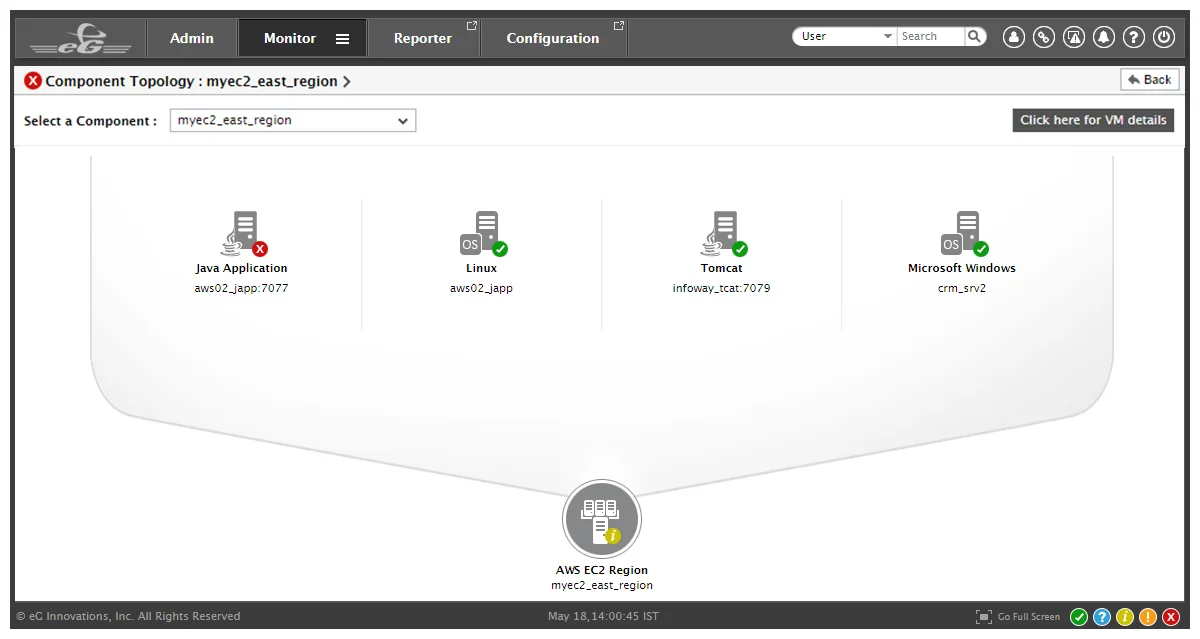
eG Enterprise delivers comprehensive hybrid cloud network monitoring to ensure performance, availability, and end-to-end visibility across cloud and on-premises infrastructures.
This gives you the confidence to deploy critical business applications in the cloud, while supporting smooth cloud migration and effortless scalability:
- Single console to monitor all your cloud infrastructure and applications running on the cloud.
- Deploy and correlate between physical, virtualized and cloud-based systems with eG Enterprise hybrid, private and public cloud monitoring solutions.
- Auto-baseline usage and get alerted in advance when abnormal usage patterns are detected.
We are truly impressed with eG Innovations cloud performance management solution. eG beats out most of the competition in terms of coverage for diverse virtual server environments as well as for its distinctive 'top down' and 'bottom up' real-time analytics.


Advanced Features of
eG Enterprise Cloud Monitoring
Public Cloud monitoring
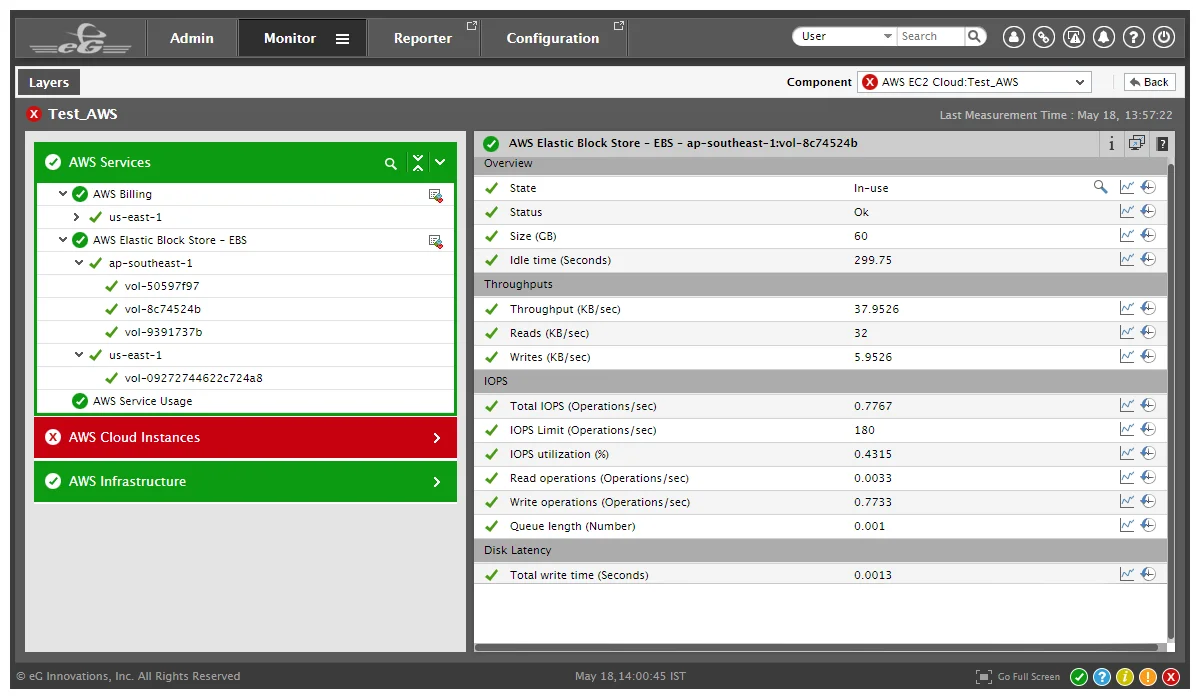
eG Enterprise provides out-of-the-box hybrid cloud monitoring support for applications and services running on the public cloud including AWS and Microsoft Azure.
Private Cloud monitoring
eG Enterprise monitors your private cloud from end to end, providing actionable insights for performance troubleshooting and infrastructure optimization.

Hybrid Cloud monitoring
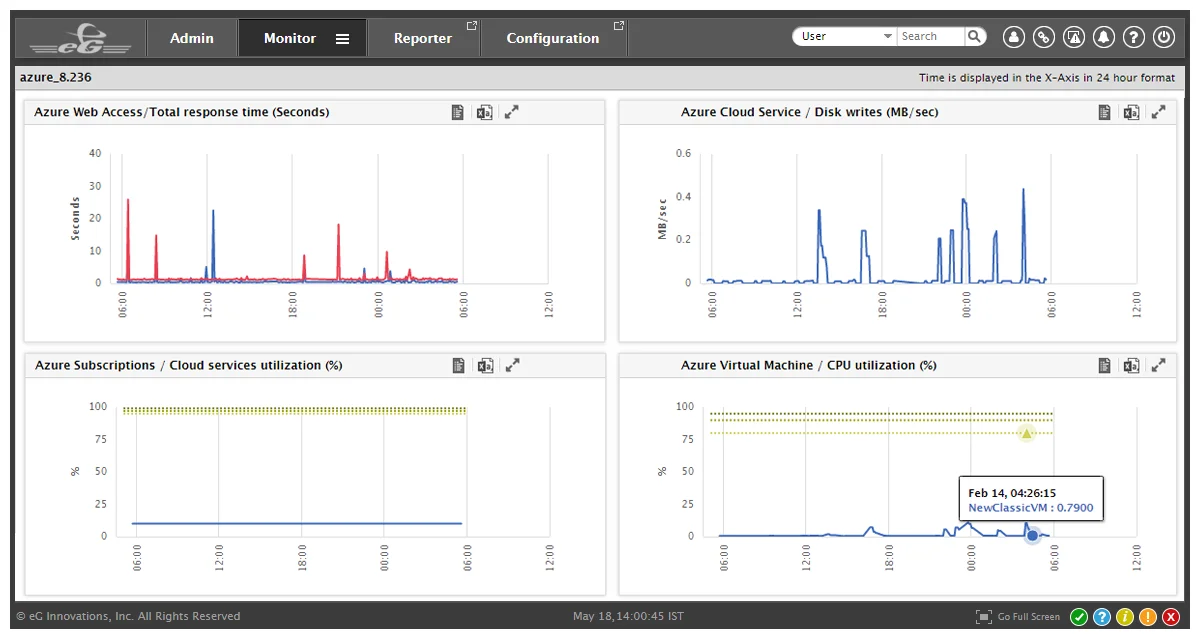
From a secure and reliable web-based console, eG Enterprise enables you to monitor your applications and services wherever they are hosted—on-premises, in the public cloud, in colocation facilities, or in hybrid cloud infrastructures. Using automated discovery and mapping between various infrastructure tiers, eG Enterprise helps administrators understand the relationships and interdependencies between cloud and on-premises infrastructure tiers.
It provides advanced hybrid cloud monitoring solutions that help meet security and compliance goals, save your team’s time, and optimize and improve your operations through data analysis. It also incorporates enterprise cloud monitoring capabilities to enable your team to proactively manage and enhance the end-user experience. That will directly contribute to increased customer satisfaction and business efficiencies.
Whether you need public, private, hybrid, or multi-cloud monitoring tools, eG Enterprise has got you covered.
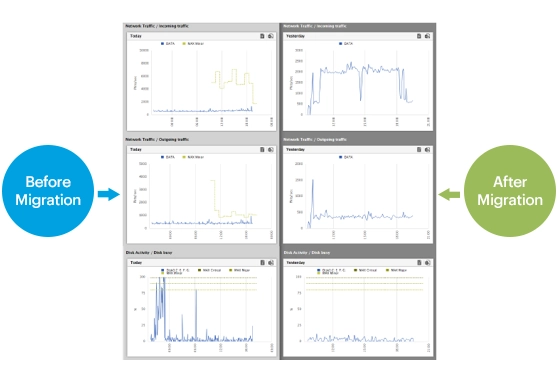
Cloud Migration Monitoring & Performance Optimization
eG Enterprise provides in-depth performance visibility for migrating your on-premises applications and server workload to the cloud.
Benefits of Cloud Monitoring for Enterprises
Cloud monitoring helps enterprises maintain visibility and control across dynamic cloud environments while ensuring performance and reliability.
Use Cases: SaaS, Hybrid IT & Cloud-Native Applications
Cloud monitoring supports modern deployment models by delivering consistent performance insights across environments.
Business Impact: Performance, Cost Optimization & Scalability
Effective cloud monitoring balances performance, cost control, and growth at scale.
Frequently Asked Questions (FAQs) about Cloud Monitoring
Cloud monitoring tracks the performance, availability, and usage of cloud resources, services, and applications to ensure reliability and efficiency.
Cloud monitoring focuses on tracking known metrics and alerts, while observability provides deeper insights by correlating metrics, logs, and traces to diagnose unknown issues.
eG Enterprise delivers unified visibility across multi‑cloud and on‑prem environments through a single console.
Common challenges include tool sprawl, inconsistent metrics, limited cross cloud visibility, and difficulty correlating issues across providers.
AIOps uses AI to correlate data, detect anomalies, reduce alert noise, and predict issues, enabling faster and more proactive cloud operations.
Key metrics include response time, availability, CPU and memory usage, storage IOPS, network latency, and error rates.
By detecting performance issues early and ensuring application stability, cloud monitoring helps deliver fast, reliable experiences to end users.