Why Predictive Analytics Matters in IT Observability
 Learn how predictive analytics and AIOps forecasting models improve IT observability, anomaly detection, capacity planning, and proactive monitoring. Predictive Analytics Models and Algorithms are an important component of eG Enterprise’s AIOps engine for proactive observability. eG Enterprise collects and analyses metrics, events, logs and traces and the data including real usage data is used to make intelligent predictions to forecast future system behavior and IT resource metric levels.
Today, I’ll familiarize you with some of the models and algorithms used within AIOps platforms such as eG Enterprise and how you can access intelligent metric forecasting for your IT systems.
Key Use Cases of Predictive Analytics in IT Monitoring
Many eG Enteprise customers leverage our forecasting analytics for a range of uses including:
- Capacity Planning – Forecast disk usage, memory, or node count to plan scaling ahead of time
- Latency Prediction – Anticipate increases in request latency before SLAs (service Level Agreements) are breached
- Traffic Forecasting – Predict incoming requests to auto-scale pods or services
- Error Rate Forecasting – Spot rising trends in error logs or HTTP 5xxs before a failure
What is Time Series Forecasting?
Time series forecasting is the process of predicting future values based on previously observed data points collected over time. It identifies patterns such as trends, seasonality, or cycles to model and forecast future outcomes. Commonly used in finance, operations, and weather prediction, it helps organizations plan resources, manage risks, and make data-driven decisions.
Core Components of Forecasting Models
The core components of a time series forecasting model can include:
- Trend – Long-term increase or decrease in the data.
- Seasonality – Regular, repeating patterns or cycles over fixed periods (e.g., weekly, monthly).
- Cyclicality – Irregular, non-fixed patterns related to economic or external cycles.
- Level – Baseline value around which variations occur.
- Noise (Residuals) – Random or irregular fluctuations not explained by other components.
Time Series Analysis vs Forecasting: Key Differences
Time series analysis involves examining data points collected or recorded at specific time intervals to identify patterns, trends, and seasonal effects. It helps understand the underlying structure of the data and detect any changes over time. In contrast, time series forecasting uses historical data to make predictions about future events. While analysis focuses on interpreting past behavior, forecasting aims to estimate what will happen next. Together, they provide valuable insights for decision-making by combining historical understanding with future outlooks based on temporal patterns in the data.
Common Predictive Analytics Models Used in AIOps
Autoregressive (AR) Forecasting Models
An autoregressive forecasting model predicts future values in a time series by using previous observations as input. It assumes that past values have a direct influence on current and future outcomes. The model analyzes how previous data points relate to each other over time to identify patterns, making it useful for short-term, linear, and stable data trends. AR models are the fundamental building blocks in more complex models such as ARIMA.
Polynomial regression for forecasting fits a curved line (polynomial function) to time series data, capturing non-linear trends. It models relationships using higher-degree terms (e.g., quadratic, cubic) beyond linear ones (straight lines) to predict future values based on past observations.
ARIMA Models for IT Performance Forecasting
ARIMA forecasting predicts by analyzing past trends, seasonality, and irregularities, selecting optimal model parameters, and generating forecasts. It consists of 3 components:
- AutoRegressive (AR) Component: models the relationship between the current observation and its lagged values. Past values are used to predict and forecast future values.
- Integrated (I) Component: This component involves differencing the time series data to make it stationary. A stationary time series is one whose statistical properties such as mean, variance, and autocovariance remain constant over time. Differencing helps remove trends and seasonality, making the data more amenable to modeling.
- Moving Average (MA) Component: This component models the relationship between the current observation and a linear combination of past forecast errors. It captures short-term irregularities or noise in the data i.e. it uses past forecasting errors to improve predictions.
STL Forecasting for Seasonal Trend Analysis
STL is a time series decomposition algorithm that separates a series into three components – Seasonal, Trend and Remainder (Residual). STL forecasting is effective for time series with complex seasonal patterns and irregular trends. It decomposes time series data into trend, seasonal, and residual components using Loess smoothing. It enables the extraction of underlying patterns and facilitates forecasting by modeling the trend, seasonality, and remainder separately.
STL uses LOESS (a non-parametric local regression) to smooth and separate these components. Unlike classical decomposition, STL is flexible and robust to outliers.
STL strengths:
- Works with both short and long seasonal periods
- Handles changing seasonality
- Robust against outliers
- Suitable for both additive and multiplicative models
STL is often used to pre-process data for ARIMA, STL analysis is used to enable forecasting via ARIMA. STL is also good at anomaly detection on historical data sets.
Frequency Domain Forecasting & Fourier Analysis
Frequency Domain Forecasting involves analyzing time series data in the frequency domain rather than the time domain. It’s like looking at a song’s melody in terms of its harmonies and rhythms rather than the sequence of notes/sounds over time. In this model, techniques such as Fourier analysis is used to decompose the time series into its constituent frequencies. This helps in identifying periodic patterns, seasonality, and trends more clearly, making it easier to forecast based on the underlying frequency components.
Frequency Domain Analysis is often used alongside or as a pre-processing step for time domain modelling using algorithms such as ARIMA.
Predictive Analytics Capabilities in eG Enterprise v7.5
From version 7.5 a customized ARIMA model is the default used for forecasting and predictive analytics within eG Enterprise. Additional algorithms and predictive analytics models that eG Enterprise support include options for:
- Frequency Domain
- Polynomial Autoregression
- STL
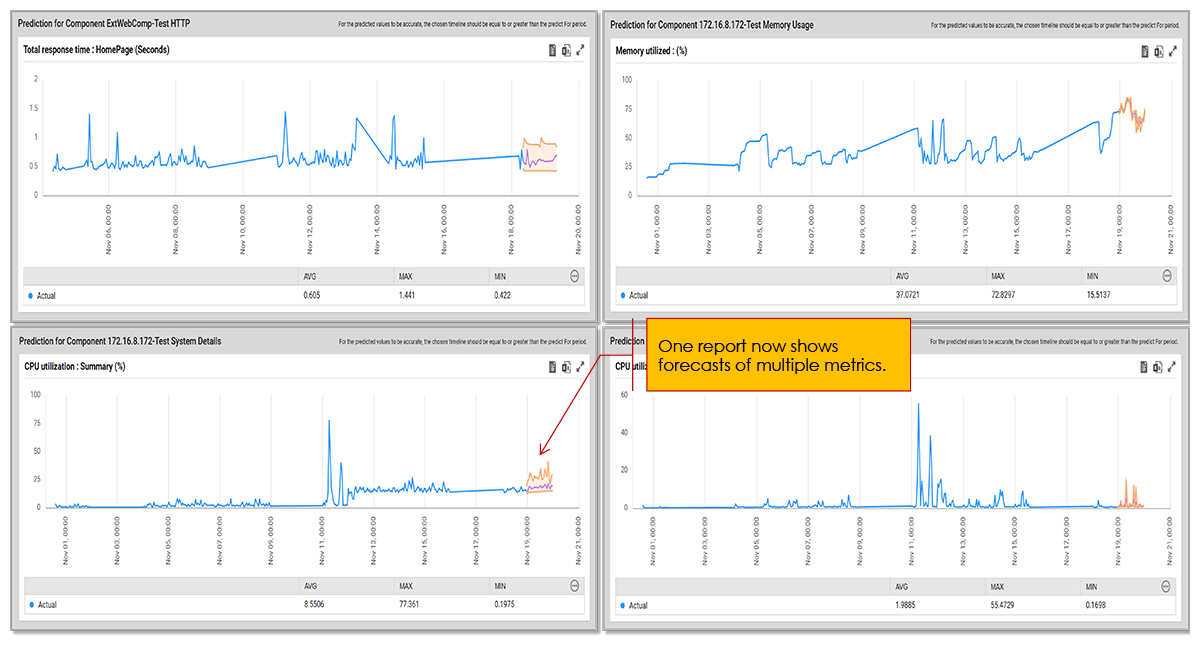
Forecasts are now also displayed with ranges by default.
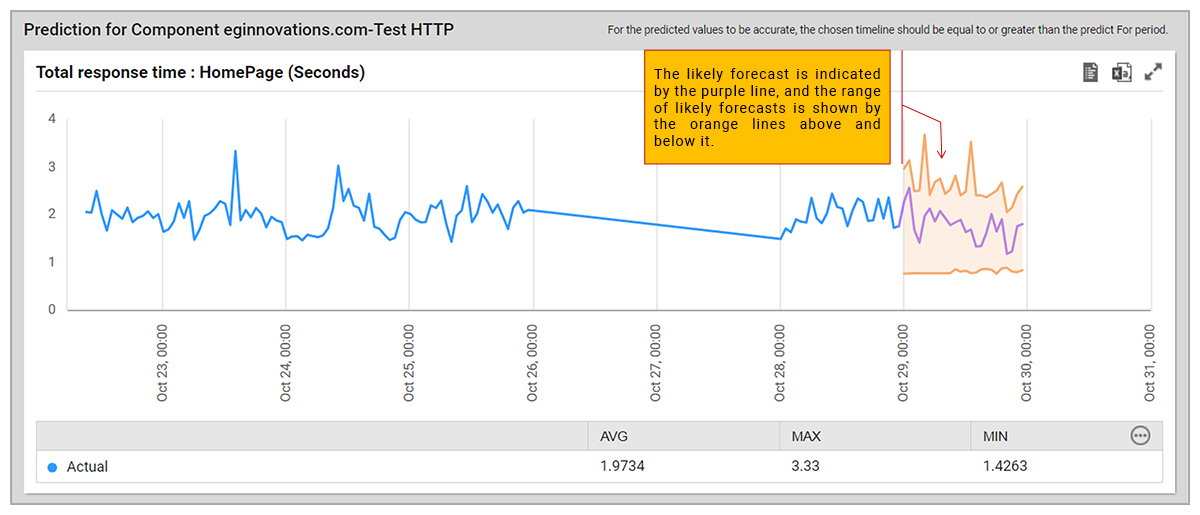
In previous versions you could only forecast one measure at a time. Now, with eG Enterprise v7.5, you can also add multiple measures for forecasting.
How to Access Forecasting Reports in eG Enterprise
It’s easy to access ready-built predictive analytics reports in eG Enterprise v7.5. From the “Reporter” tab in the main console select “Prediction Analysis” under the Reports section by function.

Benefits of Predictive Analytics in IT Monitoring
Predictive analytics in IT monitoring enables organizations to move from reactive troubleshooting to proactive operations by forecasting future system behavior based on historical data. By applying statistical and machine learning models to metrics such as CPU usage, memory consumption, response times, and capacity trends, IT teams can anticipate performance degradation and resource bottlenecks before they impact users.
Predictive analytics support smarter decision-making by estimating future demand patterns, allowing teams to right-size infrastructure and optimize resource usage. Overall, it improves reliability, efficiency, and service continuity in complex IT environments.
Why AIOps & Forecasting are Critical for Modern IT Operations
AIOps and forecasting are essential for modern IT operations because today’s environments are highly distributed, dynamic, and constantly evolving. Cloud, hybrid, and containerized systems generate massive volumes of telemetry data that cannot be effectively analyzed manually. AIOps uses machine learning to correlate events, detect anomalies, and automate root-cause analysis, while forecasting models predict future performance trends and capacity needs.
Why Choose eG Enterprise for Predictive IT Observability
eG Enterprise delivers advanced predictive IT observability by combining full-stack monitoring with a wide range of statistical and machine learning models, including time series forecasting, regression analysis, moving averages, and baseline deviation techniques. These models enable accurate prediction of capacity trends, performance degradation, and potential failures across complex IT environments.
With over two decades of experience in enterprise performance monitoring, eG Innovations has deep expertise in applying predictive analytics to real-world IT operations. This long history ensures models are tuned with strong domain context, improving accuracy and reducing false predictions.
By unifying predictive insights with observability across applications, infrastructure, and cloud, eG Enterprise helps organizations move from reactive monitoring to proactive, data-driven operations.
eG Enterprise is an Observability solution for Modern IT. Monitor digital workspaces,
web applications, SaaS services, cloud and containers from a single pane of glass.
Frequently Asked Questions
Predictive analytics in IT monitoring uses statistical models, machine learning, and historical performance data to forecast future system behavior and identify potential issues before they impact users. By analyzing trends in metrics such as CPU, memory, storage, application response times, and network performance, predictive analytics can detect early signs of degradation, capacity shortages, or impending failures. This enables IT teams to take proactive action, reducing downtime, improving reliability, and preventing performance issues before they become business-impacting incidents.
Time series forecasting is a predictive analytics technique that uses historical data collected over time to estimate future values. In IT monitoring, metrics such as CPU utilization, memory consumption, disk capacity, application response times, and network traffic are analyzed to identify patterns, trends, seasonality, and recurring behaviors. Forecasting algorithms use these historical patterns to predict how a metric is likely to behave in the future. For example, if storage usage has been steadily increasing, a forecasting model can estimate when capacity limits will be reached. Similarly, it can predict future spikes in resource consumption or application demand based on past usage patterns.
ARIMA stands for Autoregressive Integrated Moving Average and it's a technique for time series analysis and for forecasting possible future values of a time series. ARIMA consists of three components:
- AutoRegressive (AR) Component: models the relationship between the current observation and its lagged values. Past values are used to predict and forecast future values.
- Integrated (I) Component: This component involves differencing the time series data to make it stationary. A stationary time series is one whose statistical properties such as mean, variance, and autocovariance remain constant over time. Differencing helps remove trends and seasonality, making the data more amenable to modeling.
- Moving Average (MA) Component: This component models the relationship between the current observation and a linear combination of past forecast errors. It captures short-term irregularities or noise in the data i.e. it uses past forecasting errors to improve predictions.
Predictive analytics enhances observability by extending visibility beyond current system health to provide insight into what is likely to happen next. While traditional observability helps teams understand the current state of applications, infrastructure, and user experience, predictive analytics analyzes historical telemetry data to identify trends, forecast future behavior, and detect potential issues before they affect services. By applying forecasting models to metrics such as resource utilization, application response times, and capacity consumption, predictive analytics enables IT teams to anticipate performance degradation, capacity constraints, and emerging bottlenecks. This allows organizations to move from reactive troubleshooting to proactive operations, improving service reliability, reducing downtime, and supporting better capacity planning across complex cloud and hybrid environments.
Anomaly detection in AIOps is the automatic identification of unusual behavior in IT systems using machine learning. It learns normal patterns from metrics, logs, and events, then flags deviations such as spikes in CPU usage, latency, or error rates. Unlike fixed-threshold monitoring, it adapts to changing workloads and environments. This helps reduce alert noise, detect issues earlier, and enable faster incident response before they impact users.
eG Enterprise incorporates predictive analytics into its AIOps engine to help IT teams identify and address potential issues before they impact users or services. Rather than relying solely on current performance data, the platform analyzes historical trends and behavioral patterns to forecast future resource utilization, performance degradation, and capacity constraints.