AWS Savings Plan Details Test
Savings Plans offer a flexible pricing model that provides savings on AWS usage.
Savings Plans provide savings beyond On-Demand rates in exchange for a commitment of using a specified amount of compute power (measured per hour) for a one or three year period.
-
One year: 365 days
-
Three years: 1,095 days
To make informed decisions about right-sizing commitments, adjusting workloads, and optimizing future purchases to maintain maximum cost effectiveness and budget control in the AWS environment, it is essential to review the performance of the AWS savings plans from time to time. The AWS Savings Plan Details test helps administrators in this regard!
For each savings plan, this test reports the status, validity, utilization and net savings. Using this test, administrators can confirm that the committed spend aligns with the actual usage of the savings plan. This test proactively alerts administrators whenever the validity of the savings plan is about to expire.
Target of the test: Amazon Cloud
Agent deploying the test : A remote agent
Outputs of the test : One set of results for each AWS Regions on the target AWS Cloud being monitored.
Descriptor: AWS Region
| Parameter | Description |
|---|---|
|
Test Period |
How often should the test be executed. |
|
Host |
The host for which the test is to be configured. |
|
Access Type |
eG Enterprise monitors the AWS cloud using AWS API. By default, the eG agent accesses the AWS API using a valid AWS account ID, which is assigned a special role that is specifically created for monitoring purposes. Accordingly, the Access Type parameter is set to Role by default. Furthermore, to enable the eG agent to use this default access approach, you will have to configure the eG tests with a valid AWS Account ID to Monitor and the special AWS Role Name you created for monitoring purposes.
Some AWS cloud environments however, may not support the role-based approach Note that the Secret option may not be ideal when monitoring high-security cloud environments. This is because, such environments may issue a security mandate, which would require administrators to change the Access Key and Secret Key, often. Because of the dynamicity of the key-based approach, Amazon recommends the Role-based approach for accessing the AWS API. |
|
AWS Account ID to Monitor |
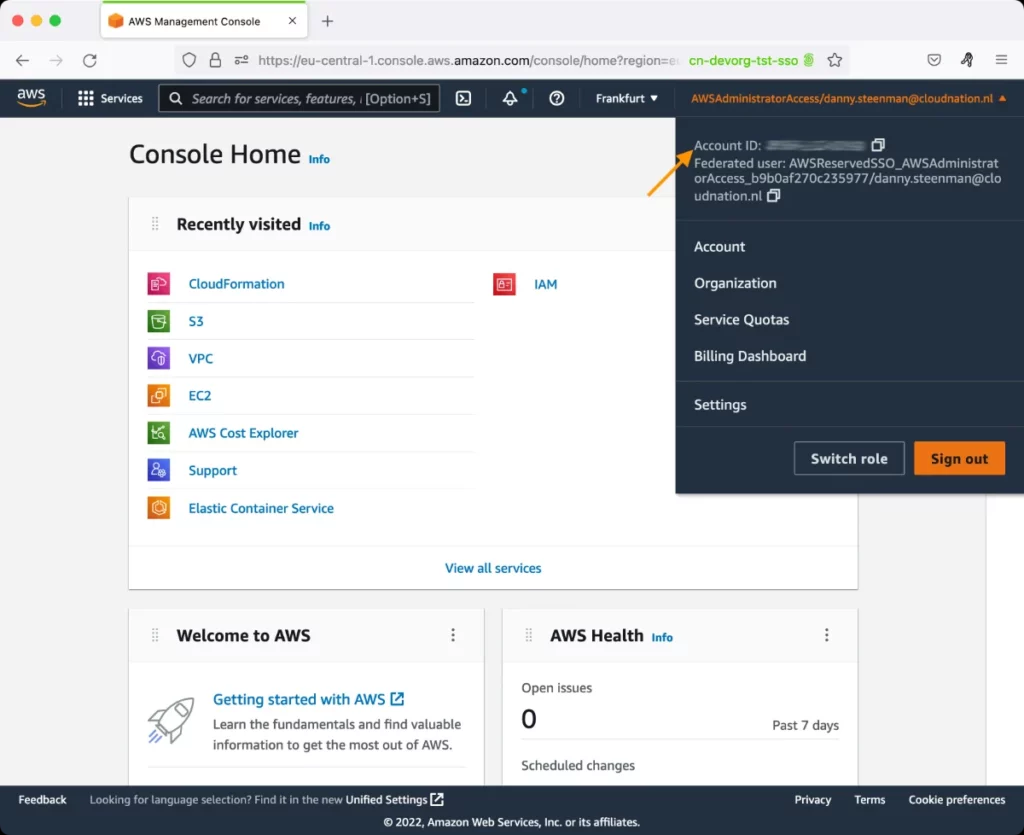
This parameter appears only when the Access Type parameter is set to Role. Specify the AWS Account ID that the eG agent should use for connecting and making requests to the AWS API. To determine your AWS Account ID, follow the steps below:
|
|
AWS Role Name |
This parameter appears when the Access Type parameter is set to Role. Specify the name of the role that you have specifically created on the AWS cloud for monitoring purposes. The eG agent uses this role and the configured Account ID to connect to the AWS Cloud and pull the required metrics. To know how to create such a role, refer to Creating a New Role. |
|
AWS Access Key, AWS Secret Key, Confirm AWS Access Key, Confirm AWS Secret Key |
These parameters appear only when the Access Type parameter is set to Secret.To monitor an Amazon cloud instance using the Secret approach, the eG agent has to be configured with the access key and secret key of a user with a valid AWS account. For this purpose, we recommend that you create a special user on the AWS cloud, obtain the access and secret keys of this user, and configure this test with these keys. The procedure for this has been detailed in the Obtaining an Access key and Secret key topic. Make sure you reconfirm the access and secret keys you provide here by retyping it in the corresponding Confirm text boxes. |
|
Proxy Host and Proxy Port |
In some environments, all communication with the AWS cloud and its regions could be routed through a proxy server. In such environments, you should make sure that the eG agent connects to the cloud via the proxy server and collects metrics. To enable metrics collection via a proxy, specify the IP address of the proxy server and the port at which the server listens against the Proxy Host and Proxy Port parameters. By default, these parameters are set to none , indicating that the eG agent is not configured to communicate via a proxy, by default. |
|
Proxy User Name, Proxy Password, and Confirm Password |
If the proxy server requires authentication, then, specify a valid proxy user name and password in the Proxy User Name and Proxy Password parameters, respectively. Then, confirm the password by retyping it in the Confirm Password text box. By default, these parameters are set to none, indicating that the proxy sever does not require authentication by default. |
|
Proxy Domain and Proxy Workstation |
If a Windows NTLM proxy is to be configured for use, then additionally, you will have to configure the Windows domain name and the Windows workstation name required for the same against the Proxy Domain and Proxy Workstation parameters. If the environment does not support a Windows NTLM proxy, set these parameters to none. |
|
Exclude Region |
Here, you can provide a comma-separated list of region names or patterns of region names that you do not want to monitor. For instance, to exclude regions with names that contain 'east' and 'west' from monitoring, your specification should be: *east*,*west* |
|
Default Connection Region |
By default, this test connects to the endpoint URL of the us-east-1 region to collect the required metrics. If the default us-east-1 region is not enabled in the target environment, then, for this test to collect the required metrics, specify the region that is enabled in the target environment. |
|
DD Frequency |
Refers to the frequency with which detailed diagnosis measures are to be generated for this test. The default is 1:1. This indicates that, by default, detailed measures will be generated every time this test runs, and also every time the test detects a problem. You can modify this frequency, if you so desire. Also, if you intend to disable the detailed diagnosis capability for this test, you can do so by specifying none against DD frequency. |
|
Detailed Diagnosis |
To make diagnosis more efficient and accurate, the eG Enterprise embeds an optional detailed diagnostic capability. With this capability, the eG agents can be configured to run detailed, more elaborate tests as and when specific problems are detected. To enable the detailed diagnosis capability of this test for a particular server, choose the On option. To disable the capability, click on the Off option. The option to selectively enable/disable the detailed diagnosis capability will be available only if the following conditions are fulfilled:
|
|
Measurement |
Description |
Measurement Unit |
Interpretation |
||||||
|---|---|---|---|---|---|---|---|---|---|
|
Status |
Indicates the current status of this savings plan. |
|
The values that this measure reports and their corresponding numeric values are listed in the table below:
Note: By default, this measure reports the Measure Values listed in the table above to indicate the current status of each savings plan. In the graph of this measure however, the same is represented using the numeric equivalents only. The detailed diagnosis of this measure lists the Account ID, Account name, Savings plan type, Instance family, Purchase term, Start date time, End date time and Hourly commitment. |
||||||
|
Remaining days |
Indicates the number of days that are remaining for this savings plan to be valid. |
Number |
|
||||||
|
Utilization |
Indicates the utilization of this savings plan. |
Percent |
|
||||||
|
Total commitment |
Indicates the hourly amount (in USD/hour) that administrators agree to pay based on this savings plan. |
US Dollars |
By closely tracking this measure helps administrators obtain visibility into spending patterns, accuracy in budgeting and forecasting, and enable proactive adjustments as workloads change. |
||||||
|
Unused commitment |
Indicates the portion of hourly commitment amount that is already paid but remains unused based on this savings plan. |
US Dollars |
A value close to the Total commitment measure may indicate:
|
||||||
|
Used commitment |
Indicates the portion of hourly commitment amount that is already used based on this savings plan. |
US Dollars |
A value close to Total commitment measure may indicate that the savings plan is being utilized efficiently. A low value for this measure may indicate:
|
||||||
|
Net savings |
Indicates the total cost reduction or discount achieved by using this savings plan. |
US Dollars |
Net savings = On demand cost equivalent - Total amortized commitment. By tracking Net savings, businesses can assess whether the savings plan is delivering the expected value, optimize future commitments, and ensure they are maximizing their return on investment. Essentially, Net savings helps confirm that the savings plan strategy is effectively reducing costs and improving long-term cloud spend management. |
||||||
|
On demand cost equivalent |
Indicates the amount that would have been paid if the same workloads were run without this savings plan. |
US Dollars |
Using this measure administrators can:
|
||||||
|
Total amortized commitment |
Indicates the total cost of this savings plan commitment spread evenly (amortized) over a given period, such as a month. |
US Dollars |
By closely monitoring the value of this measure, administrators can:
|
||||||
|
Amortized upfront commitment |
Indicates the portion of any upfront payment that is evenly distributed (amortized) over the duration of this savings plan. |
US Dollars |
This measure helps ensure that both upfront and recurring (hourly) costs are reflected proportionally over time. |
Use the detailed diagnosis of the Status measure to view additional details of the Savings Plan such as Purchase term, Plan Type, etc.
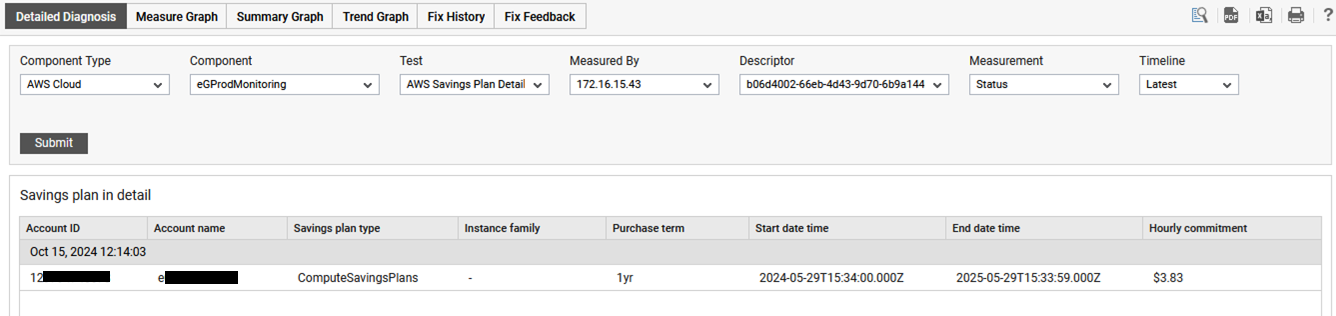
Figure 2 : The detailed diagnosis of the Status measure