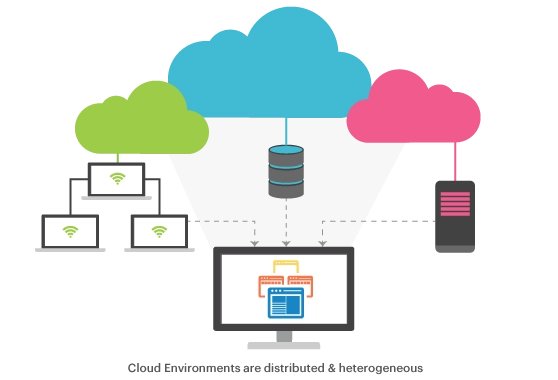


Hybrid Cloud is a cloud computing architecture that combines on-premises infrastructure, private cloud environments, and public cloud services into a unified IT environment. It enables organizations to run workloads where they perform best while balancing scalability, security, compliance, and cost optimization.
As organizations increasingly adopt hybrid cloud strategies, they also require comprehensive cloud monitoring services and IT infrastructure monitoring to maintain visibility across on-premises infrastructure, public cloud platforms, applications, and network resources.
Modern cloud computing monitoring tools provide centralized visibility across hybrid environments by monitoring cloud resources, infrastructure, applications, databases, virtual machines, containers, and network services from a single platform. This helps organizations reduce operational complexity while improving service reliability.
Hybrid cloud is how many enterprises first start with cloud. Traditionally, organizations bought and ran their own infrastructure on-premises, they bought servers installed operating systems and applications on those servers and were responsible for updating and maintaining everything – both software and hardware.
Hybrid cloud is the practice of running some (but only _some_ – not all) of what could be on-premises on someone else’s computers usually in cloud, and usually a big public cloud such as AWS (Amazon Web Services), whilst retaining some of your workloads on-prem. In practice this could mean rather than buying a new Dell Server and installing Microsoft SQL Server to run databases that an organization rents virtual servers as VMs from the Microsoft Azure cloud and installs / maintains SQL server as they do on-prem (IaaS), or it could mean they use an Azure Managed SQL (PaaS) instance where Microsoft are also responsible for maintaining the SQL software.
Whereas Cloud is often coined as running “your applications on someone else’s computer”, hybrid cloud is about running “only some of your applications on somebody else’s computer”.
Hybrid cloud is often a result of an organization’s desire to move to a cloud-first or cloud-only model where practical considerations and constraints mean that some application workloads and / or infrastructure must be retained on-premises. Security concerns and data localization and compliance are common reasons why organizations are forced to retain on-premises IT infrastructure, application performance can also be a factor.
You may like to read about some of the factors that determine whether hybrid cloud is the best solution for an organization or use case, see: On-premises, Cloud First or Cloud Repatriation - What's the Trend? Which is Best? | eG Innovations.
Google Cloud released a collection of statistics on cloud usage in 2023, see: 40 cloud computing stats and trends to know in 2023 | Google Cloud Blog. This included details on hybrid cloud usage such as: “Some 26% of people reported using multiple public clouds in 2022, up from 21% in 2021. Hybrid cloud use also increased from 25% to 42.5%.”
The big hyperscale public cloud providers recognize that many of their customers have a need to retain some on-premises infrastructure and workloads. As such many now offer products that allow customers to effectively deploy the public cloud on-prem, on the customers own infrastructure. Examples of this type of hybrid cloud platform include AWS Outposts, Azure HCI / Azure Stack, Azure Arc, Azure VMware Solution, Google Anthos, Nutanix Cloud Infrastructure, and VMware Cloud Foundation.
Hybrid cloud integrates on-premises infrastructure with public and/or private cloud services, enabling data and application portability across different environments. It emphasizes a unified infrastructure where organizations can balance the benefits of both on-premises and cloud resources. In contrast, multi-cloud involves leveraging services from different cloud providers simultaneously, sometimes prioritizing diversity in service selection over integration with on-premises infrastructure. The focus is on strategically choosing the best-fit solutions from various providers to meet specific business needs. Both hybrid cloud and multi-cloud strategies offer flexibility, scalability, and the ability to optimize services, providing organizations with options to tailor their IT infrastructure according to their unique requirements and objectives.
It is not uncommon for organizations to adopt both a multi-cloud and a hybrid cloud strategy, a route that can be challenging when implementing monitoring and management tools.
Hybrid and Multi-Cloud are sometimes discussed in the context of “Supercloud”, for more detail on the nuances of and variations on these models, see: What is Supercloud? What to consider when monitoring and observing a Supercloud? | eG Innovations.
The advantages and benefits of hybrid cloud include:
While hybrid cloud offers numerous advantages, it also comes with certain disadvantages:
Workloads commonly retained on-premises in a hybrid cloud environment include:
Once an organization has adopted a hybrid strategy, they often face challenges unifying and synchronizing their on-prem components with their cloud components and usually end up supporting some sort of cloud connector architecture; for example: it is very common to see organizations using on-prem Active Directory in conjunction with Azure AD (Entra ID) connected via Azure AD Connector. Monitoring and troubleshooting these architectures becomes challenging as the native cloud monitoring tools such as Azure Monitor do not cover those on-prem dependencies such as Active Directory. This is why organizations leveraging hybrid cloud usually turn to a third-party monitoring solution such as eG Enterprise designed for hybrid cloud.
A good cloud observability platform such as eG Enterprise offers features that overcome the challenges of visibility of hybrid cloud environments, such as:
Using a monitoring tool with AIOps (Artificial Intelligence for IT Operations) capabilities is essential when monitoring hybrid cloud environments due to its ability to leverage advanced analytics and automation. AIOps enhances the monitoring process by detecting patterns, predicting potential issues, and automating responses. In the dynamic and complex nature of hybrid clouds, AIOps helps in proactive issue identification, reducing downtime, improving system performance, and optimizing resource utilization. This capability is key to managing the scale and complexity of hybrid cloud architectures, ensuring efficient operations, and providing timely insights for informed decision-making.
A modern AIOps platform enables organizations to automate event correlation, anomaly detection, intelligent alerting, predictive analytics, and root-cause analysis across hybrid cloud environments. These AIOps solutions reduce alert fatigue, improve operational efficiency, and accelerate incident resolution.
Hybrid Cloud monitoring is important because it gives teams unified visibility across on-premises systems and public or private cloud environments. It helps detect performance issues, manage latency between environments, improve security and compliance, and optimize costs by showing how resources are actually being used.
Cloud monitoring services are tools that continuously collect and analyze metrics, logs, traces, and alerts from cloud workloads and infrastructure. They help IT teams monitor availability, performance, security, and cost so they can identify issues quickly and keep services running smoothly.
The best cloud monitoring tools depend on the use case. For hybrid environments, eG Enterprise is a strong choice because it combines infrastructure, application, and user-experience visibility in one platform, helping teams monitor performance consistently across cloud and on-premises systems.
AIOps improves Hybrid Cloud monitoring by correlating data from multiple tools and environments, reducing alert noise, detecting anomalies earlier, and accelerating root-cause analysis. It can also support predictive insights and smarter resource management, which helps teams move from reactive firefighting to proactive operations.