|
|
Citrix XenServer virtual server technologies provide companies with the ability to do more with less resources. While this technology makes computing easier and efficient, virtualization makes IT infrastructures harder to monitor and manage. Effective monitoring and management is critical for these environments to be adequate replacements for traditional hardware-based infrastructures.
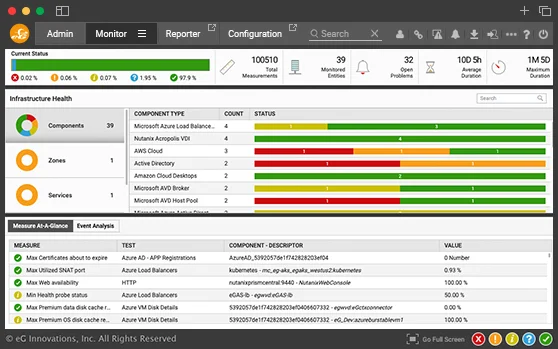
The eG Monitor for XenServer Infrastructures (the eG VM MonitorTM), part of the eG Enterprise Suite, is a comprehensive solution for monitoring and managing all aspects of virtual hosts and guests, whether the infrastructure is used to support server or desktop applications. Coupled with the ability of the eG Enterprise Suite to monitor over 80 applications, including Citrix, Microsoft, Oracle, IBM, SAP, and others, the eG VM Monitor – with its patent-pending In-N-Out MonitoringTM technology -- provides a comprehensive end-to-end solution for monitoring and managing the performance of virtual IT infrastructures.
Administrators can use the eG VM Monitor to monitor the performance of their physical and virtual infrastructures, troubleshoot problems to determine where the root-cause lies, assess where capacity bottlenecks are, and plan the usage of their servers and applications to optimize the utilization of the physical and virtual resources. The key customer benefits of this solution include higher uptime, better end-to-end performance, and operational cost savings through more effective utilization of key IT staff. |
|
Multi-tier IT infrastructures are a nightmare to troubleshoot because of the dependencies that exist between application tiers. For instance, a failure in the database tier could result in slow downs in the application and web server tiers. Hence, monitoring solutions that view the infrastructure as independent silos cannot effectively monitor and diagnose problems in such infrastructures. The addition of virtualization to such infrastructures makes monitoring and management of these infrastructures even more challenging!
 |
Fig 1: A problem in one application can affect all the other applications involved in the service delivery. |
 |
 |
Fig 2: Excessive disk reads by the media server slow down Oracle database accesses |
Since a single Citrix XenServer is used to host multiple virtual machines (VMs), a single malfunctioning application on a VM can degrade the performance seen by applications hosted on the other VMs. Figures 1 and 2 illustrate such an example. In this scenario, users are experiencing slowness in their access to a web-based service. From the service topology, it is clear that the database server is the cause of the slowdown. Figure 2 illustrates that since the database server is hosted on the same ESX/ESXi server as a media server, high I/O activity due to increased access to the media server is resulting in the database server seeing slow disk accesses. To accurately diagnose the problem in this example, a monitoring solution must not only consider the inter-dependencies between applications that are involved in service delivery, but it must also consider the existential relationships between applications, virtual machines, and physical machines. Besides resource contention among guest virtual machines, applications executing on the ESX/ESXi service console can also affect the performance of the virtual infrastructure.
While knowing which VM is consuming excessive resources is helpful, it is even more important to understand whether the VM's behavior is normal. For instance, a memory leak in one of the applications executing inside a VM may be causing the VM's memory usage to increase over time. In such cases, it is essential that the monitoring solution be able to look in-depth into each guest VM and detect abnormalities. While deploying individual agents inside each VM provides this level of visibility, this can result in additional resource overhead, licensing fees, and maintenance cost.
Performance degradations in a virtual infrastructure may also be because a virtual machine has not been configured with sufficient resources to handle its workload. A monitoring solution must be able to differentiate problems resulting from inadequate virtual machine configuration and those resulting from hot-spots created by uneven distribution of load across ESX/ESXi servers. |
|
The eG VM Monitor extends the eG Enterprise monitoring technology to virtual environments. Using a patent-pending In-N-Out MonitoringTM approach, the eG VM Monitor provides a comprehensive view of an ESX/ESXi Server, including the performance of the VM kernel, the service console and all of its virtual machines. Agent-based monitoring can be used for ESX 3 or 3.5 servers, while agentless monitoring can be used for ESXi servers. When agent-based monitoring is used, eG agents only have to be installed on the ESX server -- not on individual guests. Using ESX server APIs, the agents provide an “outside view” of a guest VM’s performance. The relative resource usage levels of the guest VMs show where the performance hogs exist. To complement the outside view, the eG agent obtains an “inside view” that details the user activity, resource allocation and the application mix running inside the VM guest operating system. All the capabilities of agent-based monitoring are also available with the agentless monitoring option for Citrix XenServers. The eG VM Monitor automatically baselines all the metrics it collects, so that IT administrators can be informed proactively of any deviations from the norm. No other virtualization monitoring solution offers this combination of features.
 |
Monitoring VM guests: eG agents track the performance of each guest VM relative to shared infrastructure resources (outside view) as well as the workload and application mix of the individual guest VMs (inside view). |
From a monitoring and management standpoint, the eG monitor for XenServer infrastructures goes well beyond managing virtualized servers as discrete entities. End-to-end business service views show the applications and network devices that support each business service, and the inter-dependencies among them. Applications are associated with the virtual machines they run on, and each virtual machine is mapped to the physical machine upon which it is hosted.
The dependency of the virtual machines to physical machines is determined dynamically, so as to support the XenMotion® Live Migration technology. A patented root-cause diagnosis engine analyzes the service topology graphs and the virtual-to-physical machine mappings to pin-point where the problems areas in the infrastructure lie.
|
| |
 |
Monitoring and Reporting of ESX servers: Using a custom ESX Server model, the eG VM Monitor correlates performance across the host and guest VMs. Extensive pre-built reports enable rapid identification of bottlenecks and streamline capacity planning. |
 |
 |
 |
 |
| ESX Host Monitoring |
 |
What is the CPU load on the ESX kernel, on the console, and each of the virtual guests? |
 |
What is the free memory in the ESX kernel and the console? |
 |
Which network interfaces are seeing the most traffic? |
 |
Which storage devices are seeing high activity? |
 |
How much free space is available on each of the disk partitions? |
 |
Are there processes on the console VM that are taking up excessive resources? |
| |
|
| Virtual Guests Monitoring |
 |
How many virtual guest machines are running? What are their IP addresses/host names and operating systems? |
 |
What portion of the ESX Server’s CPU is used by each guest? |
 |
Are there times when a guest is not getting CPU cycles; i.e., is the ready time too high? |
 |
How much of the memory allocated is a guest actively using? |
 |
Is the balloon driver enabled for a guest, and how much memory has it freed for each guest? |
 |
Which processes on a guest are taking up high disk, CPU or memory resources? |
|
| |
|
 |
Is there excessive paging or memory thrashing in a guest? |
 |
Do all the disk partitions inside the guest operating system have adequate space? |
 |
Is there excessive queuing for disk access on any guest operating system? Which applications could be causing these accesses? |
| |
|
| Virtual Desktop Monitoring |
 |
How many desktops are powered on simultaneously on the ESX Server? |
 |
Which users are logged on and when did each user login? |
 |
How much CPU, memory, disk and network resources is each desktop taking? |
 |
What is the typical duration of a user session? |
 |
Who has the peak usage times? |
 |
What applications are running on each desktop? |
| |
|
| VMotion Monitoring |
 |
Which ESX Server is a virtual guest running on? |
 |
When was a guest moved from an ESX Server? Which ESX Server was the guest moved to? |
 |
Why was the guest migrated? What activities on the ESX host caused the migration? |
|
|
|
 |
 |
 |
 |
 |
 |
 |
 |
| Combined external and an internal views of XenServer servers |
Real-time performance views of what the XenServer host sees about the guests and what the guests see internally. |
| Deep diagnostics for XenServers |
With a few clicks, drill down to the exact processes causing a problem. |
| Automatic correlation of performance |
Analyze performance across layers of the XenServer infrastructure - the VM host, between the host and the guests, and across VM guests. |
| In-depth XenServer VDI monitoring |
Know which users logged in, when, what applications they accessed, what resources they used, etc. |
| Monitor virtual environments with service views - not as silos |
Correlate the performance across applications hosted in the XenServer environments, discover VM dependencies, and identify performance bottlenecks. |
| Single agent licensing for XenServer servers |
One agent monitors the VM kernel, console, and all the VM guests. |
| Compatible with XenServer Live Migration |
Detect live migration of servers across ESX guests, determine the efficiency of live migration. |
| Extensive Reporting |
Customizable executive and operations reports on every aspect of your ESX servers. Identify bottlenecks in real-time, plan the capacity of your XenServer server farm. |
|
 |
 |
 |
 |
|
Are You Ready for Virtualization 2.0?
Where Virtualization Gets Real ...
By now, most of us have been through Virtualization 1.0. We know the benefits of virtualization. We have done the testing in limited environments. We know virtualization helps:
 |
Free up expensive back office real estate |
 |
Whittle down utility bills |
 |
Speed installation and implementation times. |
| Now it’s time to get real with virtualization. |
Why Don’t Most Virtualization Monitoring Solutions “Get It”?
Most management vendors are still touting virtualization monitoring solutions built for Virtualization 1.0: Churning out graphs that only “prove virtualization works” in a light-weight environment of under-packed servers. All you get is raw data. If there is a problem, guess who gets to do the root–cause analysis? You! Not a good use of your time and expertise.
And once you start to actually run critical business services on your virtual infrastructure, and start packing more virtual machines on to your servers ...adding a whole new level of complexity...watch out. Because of the inter-dependencies between virtual machines (VMs) and applications running inside these VMs, monitoring this kind of an infrastructure is going to be much MORE complex than a standard physical infrastructure, not LESS complex.
 |
 |
 |
 |
|
| |
Suddenly, those graphs with simple “outside” information about VMs just don’t cut it anymore. You need a monitor for virtualized infrastructures which also goes “inside” to tie your virtual infrastructure with business services it supports ...and gives you real-time insights into the exact root cause of problems. |
 |
|
 |
 |
 |
 |
The eG Monitor for Citrix XenServers goes beyond Virtualization 1.0. Of course, it provides you the “outside” view of how the VMs are using a physical server, but it also goes inside and analyzes the service delivery infrastructure end-to-end: |
 |
Network devices
|
 |
Java applications |
 |
Exchange servers |
 |
Load balancers |
 |
Active directory servers |
 |
Citrix and terminal servers |
 |
Web frontend servers |
 |
Databases |
 |
Virtualization platforms |
Our patented automatic root-cause diagnosis technology evaluates your entire service delivery infrastructure from one end to the other. We don’t limit our focus to your servers. We analyze your entire infrastructure and correlate the performance of these diverse network, server, and application elements in real time. |
 |
You can immediately start working on the REAL root cause problem ... BEFORE users come screaming. |
eG Enterprise makes Virtualization 2.0 Simple
Imagine, how much easier your life would be if you could...
 |
Move low-level troubleshooting to your help desk, freeing you to tackle more productive projects |
 |
Get 30-50 hours back each month, hours you used to spend on routine firefighting. |
 |
Avoid those “tiger team meetings” where all the silo experts get together to point fingers at each other. |
 |
Bridge the gap from administrator to end-user views, so everyone has a consistent view of the service performance |
|
 |
Ultimately, your job is all about providing a SERVICE to your end user, and eG Innovations helps you do exactly that by focusing on the service performance, end-to-end.
 |
 |
 |
 |
The Simplest, Most Cost-Effective Path to Virtualization 2.0
In addition to offering the only XenServer monitoring solution that “gets it”, we’ll also help you “get it” in the simplest, most cost-effective possible.
Our Single Agent Solution does not care what operating system, what type of server, what size server, what application or how many applications you are running on a server. The only question is “how many servers?” That’s it. Because of this simple, single agent architecture, you get...
 |
One price for monitoring a server |
 |
One license to maintain |
 |
No consultants to put up with (and overpay!) |
 |
Fast flexible implementation, instead of 100s of CDs to load and install, with more modules to buy every time you make one simple change to your environment. |
|
 |
Simple, flexible, portable, agnostic and FAST. Justifying your recommendation to the number crunchers has never been easier. |
 |
 |
 |
 |
|
|
|