English


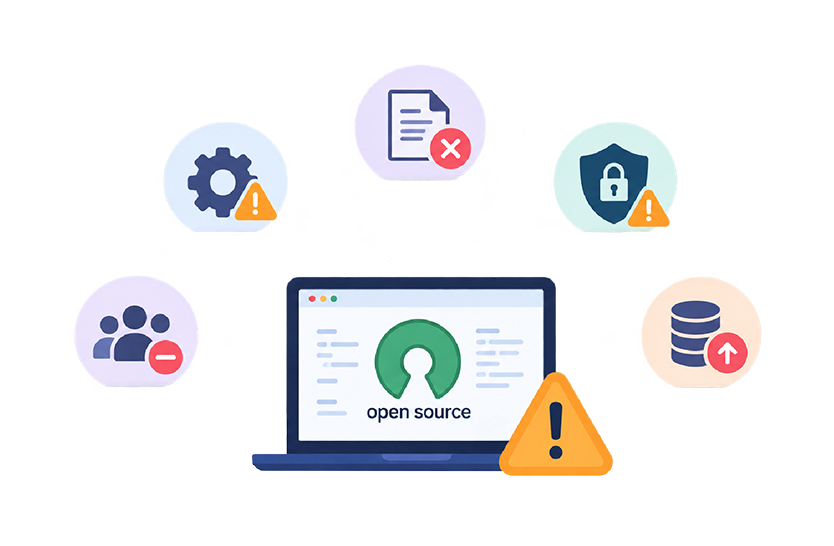
Open source software (OSS) offers organizations access to flexible, customizable, and often free software. It can reduce licensing costs and provide access to a large community of developers and users. However, open source does not automatically mean free, simple, secure, or risk-free. Organizations using OSS can face challenges around technical support, security, licensing, maintenance, functionality, and internal expertise. These challenges can become particularly important when open source software is used for business-critical applications or enterprise IT operations.

What are the Main Challenges of Open Source Software?
The main challenges and limitations of open source software include:
- Limited or inconsistent technical support
- Security and vulnerability management responsibilities
- Complex or restrictive licensing requirements
- Gaps in enterprise functionality
- Ongoing maintenance and administration
- Dependence on internal technical expertise
- Uncertain product direction
- Compatibility and vendor-support issues
- Hidden costs associated with implementation and management
Understanding these limitations is important before adopting OSS for critical business systems.
1. Limited Technical Support
One of the biggest challenges of open source software is determining who is responsible for providing technical support. Unlike commercial software, many open source projects do not include guaranteed support or service-level agreements.
Community forums, documentation, and user groups can provide valuable assistance, but they may not offer the response times required for business-critical systems. Organizations may need to rely on internal IT teams or purchase commercial support from a third party.
This can make the true cost of open source software higher than the initial licensing cost suggests.
2. Open Source Security Challenges
Open source software is not inherently insecure, but organizations must take responsibility for identifying vulnerabilities, applying patches, and keeping dependencies up to date.
The large number of components and dependencies used by modern applications can make vulnerability management particularly challenging. Organizations also need to understand which projects they depend on, whether those projects are actively maintained, and how quickly security issues are addressed.
Security can therefore become an operational responsibility rather than something handled entirely by a software vendor.
The 2026 State of Open Source Report identifies security updates and vulnerability management as one of the most persistent challenges associated with open source. It found that 20% of organizations surveyed had no specific process for responding to CVEs, while 39% of large enterprises struggled to meet their internal vulnerability-remediation SLAs.
3. Open-Source Licensing Limitations
Although open source software is generally available for use, different open source licenses impose different obligations.
Some licenses allow organizations to modify and redistribute software with relatively few restrictions, while others impose requirements around source-code distribution, attribution, or derivative works.
Organizations using OSS should understand the licenses associated with their software and dependencies. This is particularly important for commercial products, proprietary applications, and software distributed to customers.
License compliance can require significant effort, particularly when an organization has open-source components across its software estate. Consequently, open-source licensing should be treated as a legal and governance consideration, not simply a way to avoid software license fees.
4. Functionality Gaps
Open source software can provide powerful functionality, but it may not include every feature required by an enterprise.
For example, an open source monitoring platform may provide basic infrastructure monitoring but require additional configuration, plugins, scripts, or third-party components to deliver capabilities such as advanced reporting, automated root-cause analysis, role-based access control, auditing, service-level reporting, or enterprise integrations.
These gaps do not necessarily make OSS unsuitable, but organizations need to assess how much additional development and integration will be required.
5. Maintenance and Administration Overhead
Open-source software can require more hands-on administration than a commercial, integrated product.
Installing the software may be relatively straightforward, but building a production-ready environment can involve configuring databases, agents, exporters, plugins, integrations, authentication, alerting and storage.
Updates and configuration changes also need to be managed over time.
This can create a significant operational burden for IT teams. The software itself may be free, but the people required to deploy, configure, troubleshoot, secure and maintain it are not.
The 2026 State of Open Source Report highlights this issue. Nearly half of respondents spend at least half of their time on maintenance and bug fixes rather than feature development, rising to 60% among large enterprises.
This is one reason organizations should consider the total cost of ownership of open-source software rather than comparing only license costs.
6. Reliance on Internal Expertise
Open source software often provides considerable flexibility, but taking advantage of that flexibility can require specialist expertise.
IT teams may need to understand the software’s architecture, configuration, APIs, plugins, dependencies, and troubleshooting processes. If key employees leave the organization, knowledge of custom configurations and integrations can also be lost.
This creates a potential skills and knowledge-management risk for organizations that heavily customize OSS.
7. No Single Owner for Product Direction
Commercial software typically has a vendor responsible for product development, roadmaps, support, and long-term investment. Open source projects can have more distributed governance.
Some projects have strong foundations or commercial organizations behind them, while others depend primarily on volunteer contributors. Project direction, development priorities, and release schedules can therefore vary.
Organizations adopting open source software should assess the health of the project, its contributor community, release history, governance model, and long-term sustainability.
8. Compatibility and Vendor-Support Issues
Using unsupported or unofficial software components can sometimes affect the ability to obtain support from other vendors.
For example, a vendor may support a particular operating system, database, hypervisor, or application only when it is deployed using a specified configuration. Introducing an OSS component or customization may fall outside that supported configuration. Adding a monitoring tool into a hypervisor kernel is rarely supported unless the tool has undergone certification and validation by the hypervisor vendor.
Before deploying open source software in an enterprise environment, organizations should therefore understand how it fits into existing vendor support agreements and technology stacks.
9. Hidden Costs of Open Source Software
The absence of a traditional software license fee does not mean that open source software has no cost.
Organizations may need to invest in implementation, customization, integration, training, security management, monitoring, maintenance, troubleshooting, and technical support.
These costs should be included when calculating the total cost of ownership. A commercial product with a higher upfront price may sometimes be less expensive to operate over its lifetime than a heavily customized OSS solution.
Is Open Source Software Suitable for Enterprises?
Open source software can be highly suitable for enterprise use, but organizations should evaluate more than its licensing model.
The maturity of the project, available support, security processes, licensing requirements, functionality, integration capabilities, internal expertise, and long-term roadmap should all be considered.
For non-critical workloads, the flexibility and low acquisition cost of OSS can make it an attractive option. For business-critical systems, organizations may prefer projects with strong commercial backing, professional support, or enterprise distributions.
Open Source vs. Proprietary Software
The choice between open source and proprietary software is not simply a question of cost.
Open source can provide greater flexibility, customization, transparency, and freedom from vendor lock-in. Proprietary software can provide dedicated support, predictable development roadmaps, integrated functionality, and clearly defined accountability.
The right choice depends on the organization’s requirements, resources, risk tolerance, and technical capabilities.
Are Open-Source Monitoring Tools Enough for Enterprise Observability?
Open source monitoring tools can provide powerful monitoring capabilities, but organizations should consider whether they can deliver the breadth of visibility and automation required by an enterprise environment.
Monitoring increasingly needs to cover infrastructure, applications, databases, networks, cloud services, containers, digital workspaces, and end-user experience. Organizations may need to integrate several open source tools to achieve this level of coverage.
That approach can introduce additional configuration, integration, maintenance, and support requirements.
A unified observability platform can reduce this complexity by providing monitoring across multiple technologies through a single platform, while also providing capabilities such as automated anomaly detection, correlation, root-cause analysis, and reporting.
eG Enterprise – Designed for Enterprise
eG Enterprise is designed for enterprise IT environments that need comprehensive monitoring without the complexity of stitching together multiple open source tools. It provides unified observability across applications, servers, networks, databases, cloud platforms, containers, virtual infrastructure, and digital workspaces.
Key benefits, beyond most OSS options, include:
- Broad technology coverage from a single monitoring platform
- Automated anomaly detection and performance baselining
- Automated root-cause analysis and dependency mapping
- End-to-end visibility from infrastructure to applications and end-user experience
- Centralized dashboards, reporting, alerting, and SLA monitoring
- Enterprise integrations with ITSM and help desk platforms
- Reduced administration compared with managing multiple monitoring tools
- Commercial support and a defined product roadmap
For organizations evaluating the limitations of open source monitoring, eG Enterprise provides an enterprise-ready alternative that combines comprehensive monitoring with automation, support, and centralized management.
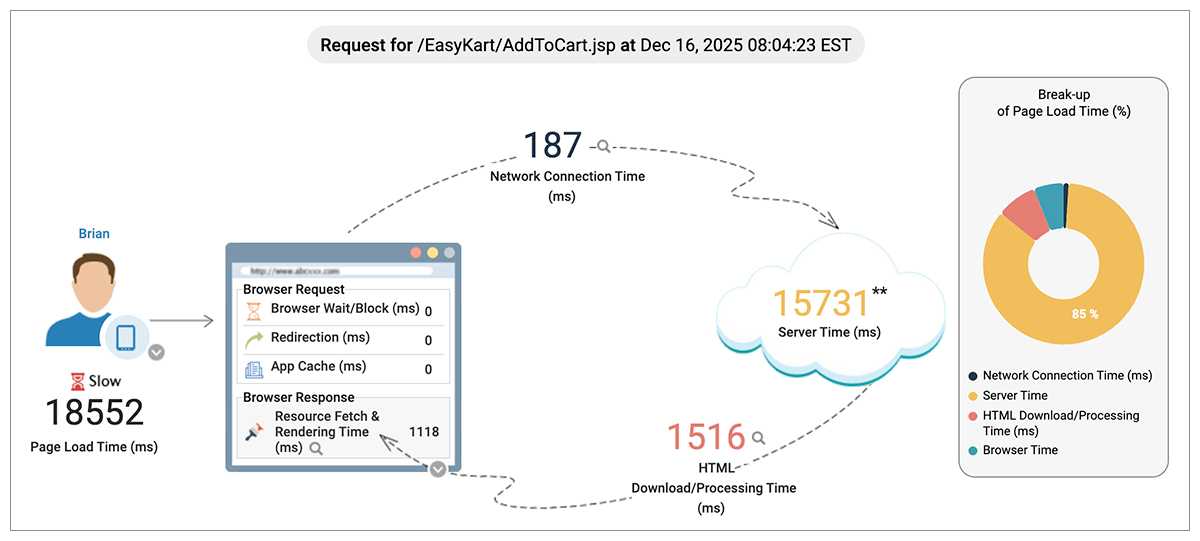
Want to learn more? See how eG Enterprise performs in with real IT systems or in your own environment. Book a demo with an engineer, or start a free trial.
eG Enterprise is an Observability solution for Modern IT. Monitor digital workspaces,
web applications, SaaS services, cloud and containers from a single pane of glass.
Frequently Asked Questions
The main disadvantages include limited technical support, security and vulnerability management responsibilities, licensing complexity, functionality gaps, maintenance requirements, dependence on internal expertise, and uncertain project direction.
Enterprise challenges include maintaining security, ensuring compliance with licensing requirements, supporting business-critical deployments, integrating different components, managing upgrades, and providing reliable technical support.
Open source software may have no traditional license fee, but it is not necessarily free to operate. Organizations can incur costs for implementation, customization, support, maintenance, training, security, and integration.
Not necessarily. Open source software can be highly secure, but organizations may have greater responsibility for identifying vulnerabilities, applying patches, managing dependencies, and maintaining secure configurations.
Security risks can include unpatched vulnerabilities, outdated dependencies, abandoned projects, malicious or compromised components, and insufficient processes for vulnerability monitoring and remediation.
Support varies significantly between projects. Some rely primarily on community support, while others have commercial companies offering professional support, subscriptions, or enterprise versions.
Different OSS licenses have different requirements. Organizations need to understand whether software can be modified, redistributed, or incorporated into proprietary products and what obligations apply to derivative works.
Hidden costs can include deployment, customization, integration, administration, maintenance, security management, employee training, troubleshooting, and third-party support.
It can be, but organizations should assess project maturity, security, support, governance, functionality, availability of expertise, and long-term sustainability before deploying OSS for critical workloads.
An abandoned project may stop receiving security updates, bug fixes, and feature development. Organizations may need to maintain the software themselves, find an alternative project, or migrate to another solution.
OSS often provides significant customization and configuration options. Taking advantage of these capabilities and troubleshooting problems may require specialist knowledge of the software, its dependencies, integrations, and underlying architecture.
Open-source software makes its source code available under an open-source license, allowing users to use, modify, and potentially redistribute it according to the license terms. Proprietary software is controlled by its vendor and generally provides less access to its source code.
They can be, but organizations should consider the amount of integration, configuration, maintenance, support, and expertise required. Enterprise environments may need broader technology coverage, centralized management, advanced analytics, reporting, and automated troubleshooting.