Why AIOps is Essential for Modern Cloud Monitoring
Learn how AIOps-powered cloud monitoring improves observability, anomaly detection, root-cause analysis, and capacity planning across hybrid cloud environments.
How AIOps Improves Cloud Monitoring & Observability
I’ve previously covered how eG Innovations AIOps-powered monitoring benefits those working with Digital Workspaces or leveraging APM; today, I’ll cover how those same AI-powered capabilities benefit those supporting cloud hosted architectures and workloads.
Unified Observability Across Cloud, Applications & Infrastructure
-

Digital Workspace
Monitoring (DWP)Monitor, diagnose and report on any digital workspace to ensure your employees can remain productive.
-
Cloud & Hybrid Cloud Monitoring
Accelerate cloud migration and optimize performance across hybrid and multi-cloud architectures with confidence.
-
Digital Experience
MonitoringMonitor the end-user experience of customers and employees with real user monitoring and synthetic simulation.
-
Application Performance Monitoring (APM)
Monitoring that detects, diagnoses, and resolves application performance issues before end-users are affected.
-
Infrastructure
MonitoringSee everything that’s happening in your IT deployment and quickly troubleshoot server, database and network issues.
-
Enterprise Applications Monitoring
Boost business productivity on SAP, SharePoint, Office 365, and other enterprise applications.
Automated Discovery & Dependency Mapping in Cloud Environments
For cloud technologies and services built-in domain-aware intelligence understands the relationships between components and services. The AIOps engine includes cloud-specific intelligence that makes sense of:
- Application-to-application dependencies.
- Application-to-infrastructure mappings (e.g., virtual machines, cloud services, storage systems).
- Service dependencies across microservices, containers, and databases.
- On-prem dependencies used for hybrid cloud scenarios such as Active Directory or on-prem storage and infrastructure.
These topologies are continuously updated to reflect dynamic changes in the IT environment, ensuring accurate insights even during auto-scale events. Combined with universal agent technologies this allows the AIOps engine to discover the deployment and provide day-0 monitoring even as cloud environments auto-scale up or down.
eG Enterprise builds rich topology visualizations for cloud environments encompassing any on-prem and hybrid cloud components and spanning multiple clouds if required.
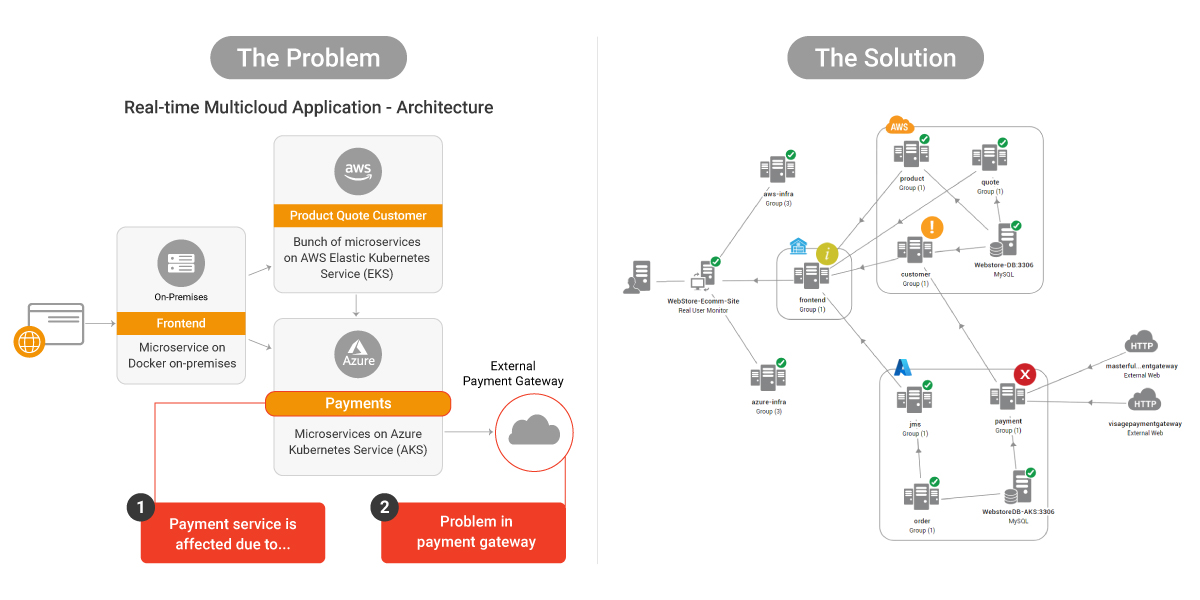
Learn more about monitoring multi-cloud applications, see: Monitoring and Troubleshooting Multi-cloud Infrastructures.
AI-Powered Anomaly Detection & Dynamic Baselines
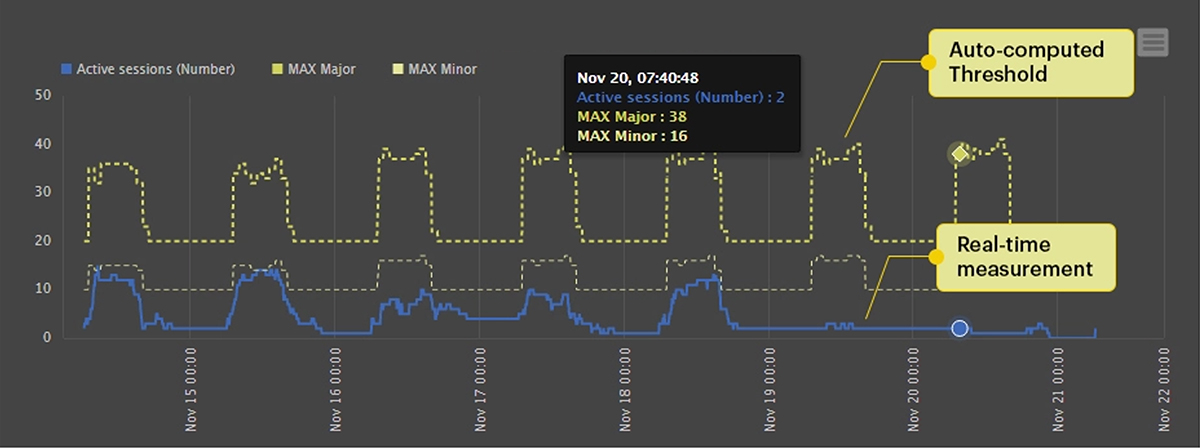
Instead of relying on static thresholds (which often cause false alarms), AIOps platforms use machine learning and statistical methods to create dynamic performance baselines based on historical trends. This enables:
- Detection of unusual spikes or dips in resource utilization, latency, or transaction rates
- Environment-aware alerts that adjust for time of day, day of week, or workload patterns
- Early warning before performance degradation impacts users
Cloud usage varies greatly depending on workload and organization. The powerful AIOps engine within eG Enterprise learns the behavior of each environment ensuring alert thresholds are set up and tuned out-of-the-box. The scales of cloud mean that manual configuration is impractical and costly.
Cloud workloads are elastic and often bursty—static rules just don’t work in dynamic environments. Learn more: White Paper | Make IT Service Monitoring Simple & Proactive with AIOps Powered Intelligent Thresholding & Alerting.
The importance of anomaly detection for critical cloud infrastructure is increasingly being recognized in compliance regulation such as the DORA in the EU (see: What is the Digital Operational Resilience Act (DORA)? DORA – Anomaly Detection and Risk Management).

Automated Root-Cause Analysis for Cloud Applications
AIOps systems automatically correlate telemetry data across cloud services (compute, storage, DB, network), containers, and applications to:
- Identify the source of issues (e.g., memory leak in a container affecting a web app)
- Cut through alert noise and pinpoint what matters
- Reduce Mean Time to Repair (MTTR) by highlighting cause-effect relationships
Especially in multi-cloud or hybrid environments, root cause analysis across layers is nearly impossible manually. AIOps reduces troubleshooting from hours to minutes or seconds.
Intelligent Alert Suppression and Event Correlation for Cloud Service Issues: AIOps platforms intelligently group related alerts and suppress redundant notifications.
A problem with cloud storage might trigger cascading issues across applications, databases, and end-user services. eG Enterprise’s deterministic event correlation links these events, so IT teams don’t have to sift through multiple unrelated alerts. For example, if a storage service is slow, eG Enterprise identifies this as the root cause of degraded application performance or failed database calls.
Learn more about event correlation, see: What is Event Correlation? And Why Does Event Correlation Matter when Monitoring? | eG Innovations
AI-Driven Capacity Planning & Cloud Cost Optimization
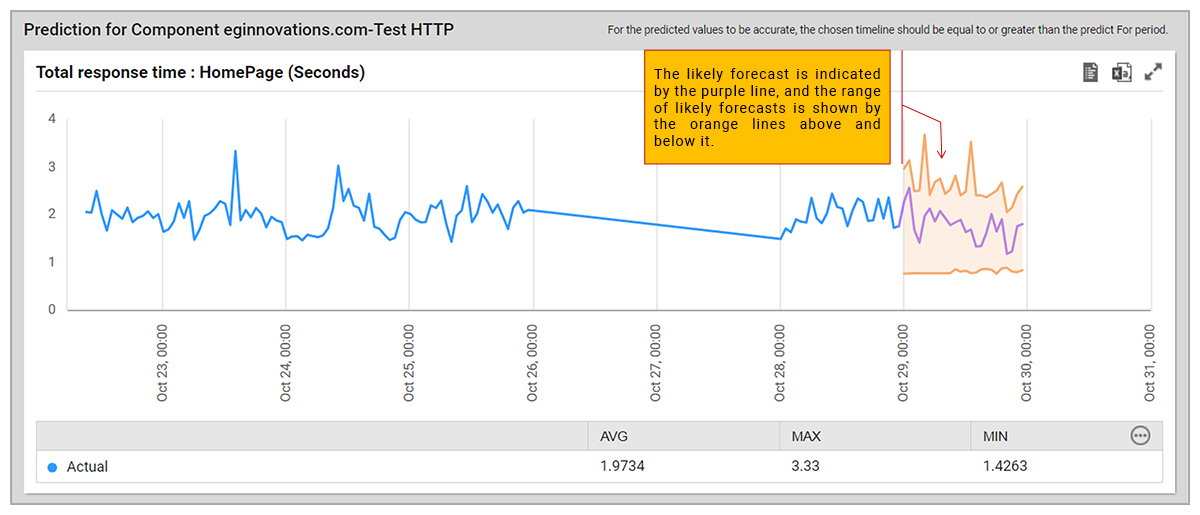
Leveraging AIOps for cloud monitoring, eG Innovations provides predictive analytics for resource allocation. For instance, if virtual hosts are nearing capacity, AIOps-enabled eG Reporter predicts future resource demand, enabling proactive scaling. This proactive approach empowers IT teams to address potential capacity bottlenecks before they lead to application slowdowns or failures on VMs or containers, ensuring uninterrupted service and optimal performance.
Over-provisioned resources become expensive in cloud, whilst under-utilized ones lead to bottlenecks and performance issues. AI-driven analytics allow eG Enterprise to make right-sizing recommendations for cloud instances.
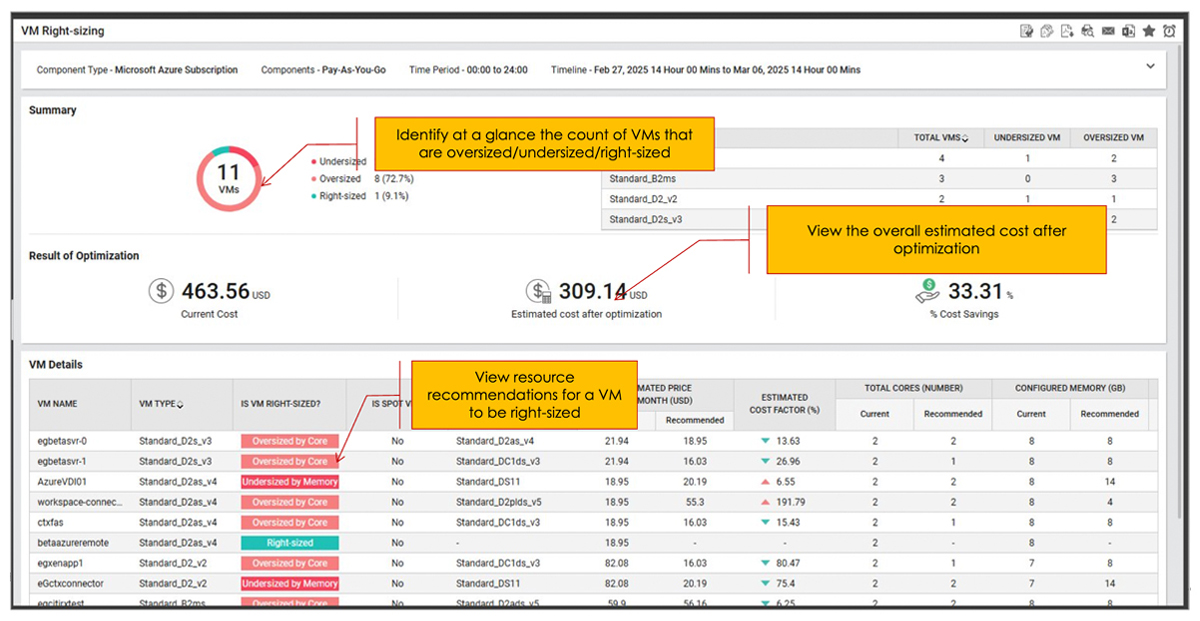
The powerful AI engine within eG Enterprise uses a range of machine learning and statistical analysis technologies to provide a powerful toolkit of predictive analytics and forecasting tools for IT teams to plan and understand future needs.
Benefits of AIOps in Cloud Monitoring
Cloud and hybrid cloud environments are dynamic by nature. Resources scale automatically, workloads move between platforms, and dependencies constantly change. Traditional monitoring tools struggle to keep pace with this complexity, often generating excessive alerts and requiring significant manual effort to identify the source of issues. AIOps helps organizations manage cloud environments more effectively by automating analysis, correlation, and troubleshooting.
AIOps-powered cloud monitoring automatically discovers cloud services and maps dependencies across applications, infrastructure, containers, databases, and hybrid environments. Machine learning establishes dynamic performance baselines, enabling the detection of anomalies that static thresholds often miss. It also correlates telemetry from multiple cloud layers to accelerate root-cause analysis and reduce alert noise. In addition, predictive analytics supports proactive capacity planning, right-sizing recommendations, and cloud cost optimization by forecasting future resource demand. The result is faster incident resolution, improved service reliability, better cloud visibility, and more efficient use of cloud resources.
Use Cases of AIOps in Hybrid & Multi-Cloud Environments
Cloud and hybrid environments are highly distributed, dynamic, and complex, making manual monitoring inefficient and error-prone. AIOps is needed to handle large volumes of telemetry, correlate signals across multiple platforms, and quickly identify root causes. It reduces blind spots, manages frequent changes, and ensures faster, more accurate incident resolution at cloud scales.
Why Choose eG Enterprise for AIOps-Powered Cloud Monitoring
eG Enterprise delivers full-stack observability with built-in AIOps to simplify monitoring of complex cloud and hybrid environments. It provides unified visibility across applications, infrastructure, containers, databases, networks, and user experience in a single platform.
Its AIOps capabilities use machine learning, anomaly detection, and intelligent event correlation to reduce alert noise and speed up root-cause identification. Automatic dependency mapping helps correlate issues across cloud layers, enabling faster and more accurate troubleshooting.
With deep domain expertise across 650+ technologies, eG Enterprise improves diagnostic accuracy and reduces blind spots in dynamic cloud environments. This helps IT teams resolve issues faster, improve service reliability, and optimize cloud resource usage while shifting from reactive monitoring to proactive operations.
eG Enterprise is an Observability solution for Modern IT. Monitor digital workspaces,
web applications, SaaS services, cloud and containers from a single pane of glass.
eG Enterprise is an Observability solution for Modern IT. Monitor digital workspaces,
web applications, SaaS services, cloud and containers from a single pane of glass.
Related information
Frequently Asked Questions
AIOps in cloud monitoring refers to the use of artificial intelligence and machine learning to automate how cloud environments are monitored, analyzed, and managed. Instead of relying on manual dashboards and static alerts, AIOps continuously processes large volumes of telemetry data—such as metrics, logs, traces, and events—from across cloud infrastructure, applications, and services. It helps detect anomalies in real time, correlate related alerts, and reduce noise by filtering out redundant or irrelevant notifications. AIOps also supports automated root cause analysis by identifying patterns across multiple layers of the cloud stack, enabling faster troubleshooting and resolution of issues. In addition, AIOps enables predictive capabilities such as forecasting capacity needs, identifying performance degradation before it impacts users, and recommending or triggering automated remediation. This makes cloud monitoring more proactive, efficient, and scalable in complex hybrid and multi-cloud environments.
AIOps improves observability by automatically analyzing and correlating data from metrics, logs, traces, and events across complex IT environments. It reduces alert noise, detects anomalies, and identifies root causes faster than manual analysis. By adding machine learning and predictive analytics to observability data, AIOps helps IT teams move beyond visibility into system behavior and take proactive action to prevent issues, improve reliability, and accelerate troubleshooting.
Anomaly detection in cloud monitoring is the use of AI and machine learning to automatically identify unusual patterns in cloud performance data that deviate from normal behavior. Instead of relying only on fixed thresholds, it establishes a dynamic baseline of “normal” activity for metrics such as CPU usage, response time, memory consumption, and transaction latency. When cloud workloads behave differently from these learned patterns—such as sudden spikes in latency, unexpected drops in throughput, or irregular resource consumption—the system flags them as anomalies. This helps IT teams detect early signs of performance degradation, outages, or security issues before they escalate into major incidents. In eG Enterprise’s AIOps approach, anomaly detection is tightly integrated with correlation and root cause analysis, allowing teams not only to see that something is wrong but also to quickly understand which layer (application, infrastructure, or cloud service) is responsible.
Automated root-cause analysis in AIOps works by collecting telemetry (metrics, logs, traces, and alerts) across applications, infrastructure, and cloud services. This data is then combined with built-in models of the dependencies between components of the system to distinguish primary root-causes from secondary effects. The level of domain expertise built into models supplied to an AIOps engine will determine the accuracy of the outcomes. The dependency relationships between components supplied by these models need to provide context such as that an application depends on an API service, which depends on a database, which depends on storage, as when an incident occurs, multiple alerts may fire across these layers.
Hybrid cloud environments are inherently fragmented—combining on-prem systems, private cloud, and multiple public cloud services—each with different monitoring tools, data formats, and performance behaviors. This fragmentation creates visibility gaps, makes root cause analysis slow, and leads to alert overload when issues cascade across layers. AIOps is valuable here because it unifies telemetry from all environments, in real time, into a single analytical layer. It correlates events across cloud and on-prem systems, so teams can see how a storage delay in one layer impacts application performance in another. It also reduces noise by grouping related alerts across platforms that would otherwise look unrelated. Most importantly, AIOps adds automation and intelligence at scale—detecting anomalies earlier, predicting failures in distributed services, and accelerating diagnosis across hybrid dependencies where manual troubleshooting is too slow and error-prone.
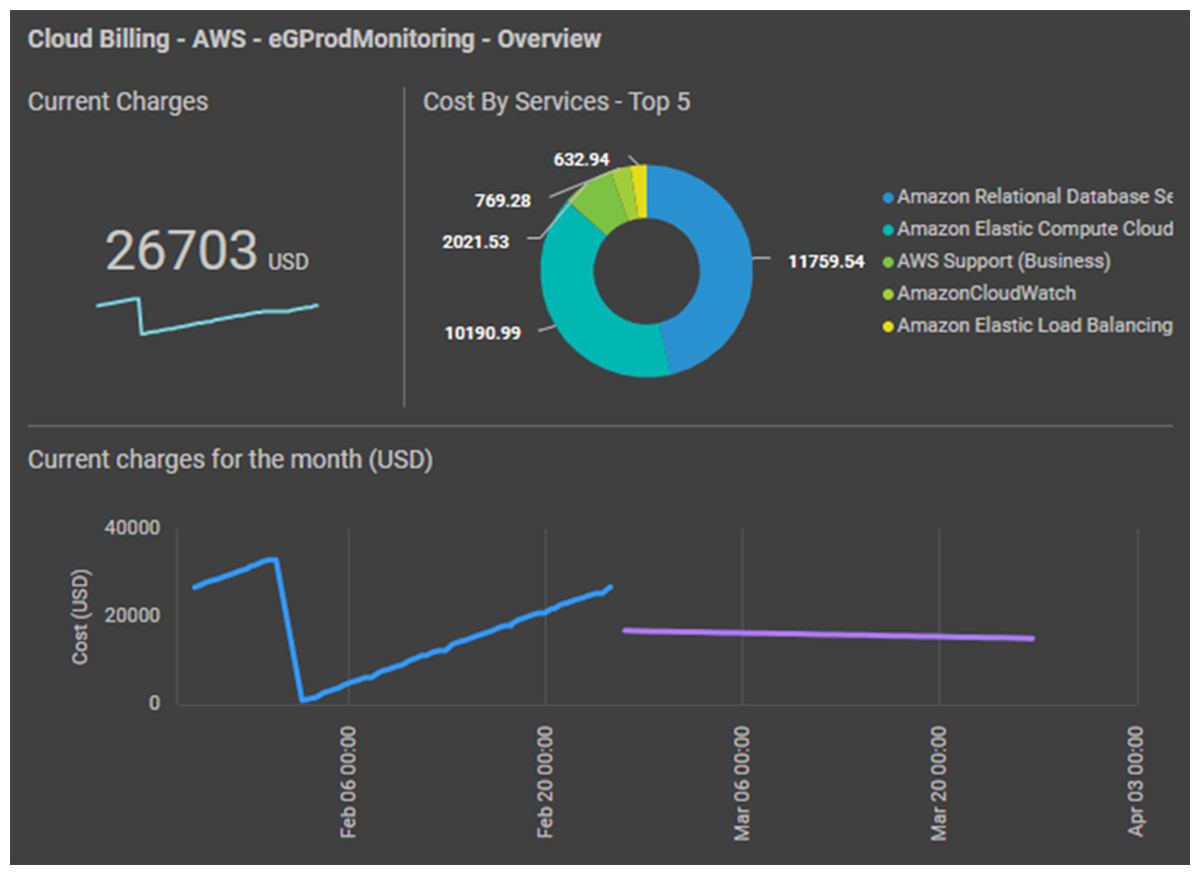
AIOps monitoring can be applied to cloud billing data beyond resource IT metrics. This means the same proactive alerting can be applied to anomaly detection on cloud billing costs ensuring unusual spend costs are detected early. AIOps-enabled capabilities such as predictive analytics can forecast trends effectively allowing data-driven capacity planning to ensure that cloud environments evolve cost-effectively. By removing manual effort and the need for specialist staff to source and diagnose issues, AIOps automation reduces the staffing resource costs needed to manage cloud environments.