




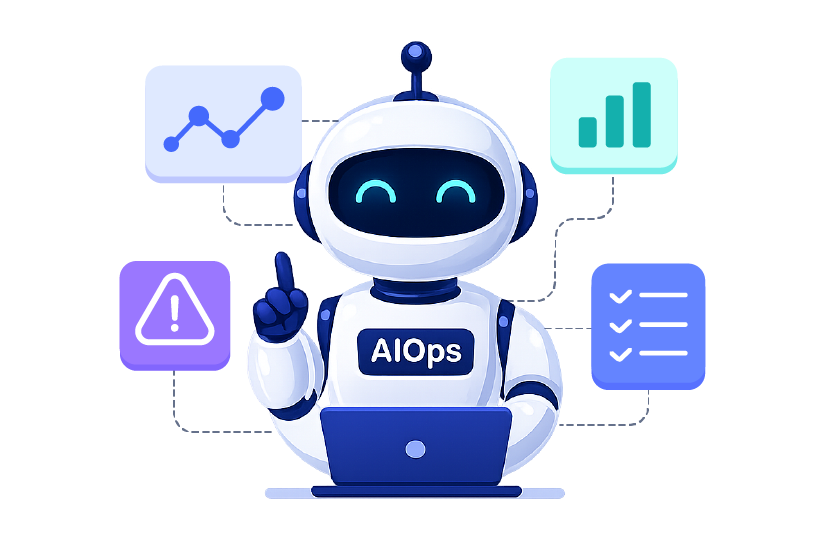
Decades ago, IT operations was relatively simple, with a few components such as client, server, network, and the static environments. IT teams relied on manual analysis to manage these systems. Over time, however, IT operations has evolved significantly, driving the adoption of AIOps technologies.
- Dynamic IT Environments: Technologies like containers and orchestration (e.g., Kubernetes) enable systems to scale up and down automatically based on demand, without manual intervention. Manual analysis of such environments is just not possible.
- Complexity of IT Environment Monitoring: As IT technologies have become more automated, there have been many new components introduced in an IT architecture. Failure or malfunctioning of any of these components can affect IT services. Each component in an IT infrastructure needs to be monitored. This dramatically increases the amount of data collection for monitoring. Teams regularly collect metrics from components. As diverse as thermostats, power supplies, CPU, memory, application logs, user end points, and various other data points. Making performance monitoring truly a big data problem.
- IT is Vital for Businesses: Businesses have become more dependent on IT. Failure or slowness of IT systems affect business revenues. For example, consider a scenario where hundreds of workers from home are not able to login to a corporate network to do their jobs. This could cost the business hundreds of thousands of dollars in lost productivity. Hence, the need for IT operations to be proactive and efficient, so when a problem happens, it is resolved in the fastest possible manner.
- Expert IT Staff Shortages: IT organizations are struggling to deal with shortage of expert IT staff. As a result, there is an expectation of IT operations to do more with less resources. This can only happen with more intelligent software that can automate and simplify IT operations tasks.
What is AIOps?
AIOps (Artificial Intelligence for IT Operations) is a term coined by Gartner in 2016 as an industry category for machine learning analytics technology that enhances IT operations analytics covering operational tasks include automation, performance monitoring and event correlations, among others.
AIOps Definition Explained
Gartner themselves define [1] an AIOps Platform thus: “An AIOps platform combines big data and machine learning functionality to support all primary IT operations functions through the scalable ingestion and analysis of the ever-increasing volume, variety and velocity of data generated by IT. The platform enables the concurrent use of multiple data sources, data collection methods, and analytical and presentation technologies.”

How AIOps Uses AI and Machine Learning
AIOps (Artificial Intelligence for IT Operations) uses AI and machine learning to analyze large volumes of IT data from systems, applications, and infrastructure in real time. It processes metrics, logs, and events to detect anomalies, identify patterns, and predict potential issues before they impact users.
Machine learning models help AIOps platforms reduce alert noise by correlating related events and filtering out false positives. They also support root cause analysis by automatically linking symptoms across different layers of the IT environment. Over time, AIOps systems improve accuracy by learning from historical incidents and resolution patterns, enabling faster troubleshooting, proactive remediation, and more efficient IT operations.
The quality of AI platforms largely depends on the domain intelligence provided to guide data collections and the machine learning models. Human-curated information that gives the algorithms and AI technologies context and an understanding of the dependencies and causality of systems is essential for obtaining meaningful actionable results from AIOps-enabled systems.
Key Technologies Behind AIOps Platforms
The figure below shows a simplified view of the different components of an AIOps platform:
- The data layer acts as the eyes of the AIOps platform, continuously observing the IT landscape. Metrics/data are obtained from different sources in the IT landscape. Data sources can include different monitoring tools, application logs, ITSM tools, etc.
- The AI layer is the brain of the platform – it uses the data that is ingested and extracts actionable insights out of it. Different forms of machine learning including anomaly detection, prediction and correlation are some of the capabilities embedded in this layer.
- The visualization layer offers the interface through which different stakeholders – business executives, DevOps teams, IT Ops teams, etc. interact with the platform.
- The ultimate goal of AIOps is to simplify and automate IT operations. Based on the results of monitoring and analysis, intelligent automation can be used to automatically address anomalies/issues in the IT landscape, wherever possible. This is where IT automation comes in.

How AIOps Works
AIOps combines artificial intelligence, machine learning and statistical methods with real IT operations data to improve visibility, speed up issue resolution, and reduce manual effort. It works by continuously analyzing large volumes of operational data to detect patterns, filter noise, and automate responses.
Data Collection and Correlation
AIOps platforms gather data from across the IT environment, including metrics, logs, events, traces, and alerts. This data is then correlated across systems, applications, and infrastructure layers to build a unified view of performance and dependencies.
It is essential that AIOps platforms build in an understanding of the significance of the data they are collecting to ensure the most significant metrics are prioritized and sampled at an appropriate frequency. Over-sampling metrics and data introduces noise into systems and degrades the ability of the system to yield meaningful correlations.
Event Intelligence and Noise Reduction
Machine learning is very good at learning from historical data as to what normal behavior of an individual system should look like. This means AIOps systems can auto-baseline performance and metrics to provide automated anomaly detection that detects the first signs of issues, often long before users or systems experience detectable or perceivable impacts. This ability to detect anomalous events is key to identifying significant events early.
AIOps systems also filter and group related alerts to reduce “alert noise.” Instead of thousands of individual alerts, AIOps identifies meaningful patterns and prioritizes the most critical incidents that require attention.
Automated Root Cause Analysis
AIOps systems analyze correlated events to identify the most likely root cause of an issue. By connecting symptoms across multiple layers of the IT stack, they help IT teams quickly pinpoint where a problem originated.
Predictive Analytics and Self-Healing IT
Using historical data and machine learning models, AIOps can predict potential failures before they occur. In advanced setups, it can trigger automated remediation actions, enabling self-healing systems that resolve issues without human intervention.
Predictive analytics are an important component of eG Enterprise’s AIOps engine, learn more about the statical forecasting models leveraged, Predictive Analytics Models and Algorithms for IT Systems and Metrics | eG Innovations.
Top Benefits of AIOps for Enterprises
AIOps delivers significant value to enterprises by improving how IT teams detect, diagnose, and resolve issues across complex, distributed environments. It reduces manual effort while increasing speed, accuracy, and system reliability.
Faster Incident Detection and Resolution
AIOps continuously analyzes IT data in real time at scales impossible for a human operator to manage to detect anomalies early and accelerate root cause identification. Thus, reducing mean time to detect (MTTD) and mean time to resolve (MTTR).
Reduced Alert Fatigue
By correlating and deduplicating alerts, AIOps filters out redundant or low-value notifications, allowing IT teams to focus only on meaningful, high-priority incidents. Administrators are not overwhelmed by alert storms and can focus on resolving issues that have significant consequences.
Improved IT Efficiency and Uptime
AIOps improves IT efficiency and uptime by automatically analyzing and correlating data across applications, infrastructure, and cloud environments. It reduces alert noise, detects anomalies faster, and accelerates root cause analysis, helping IT teams resolve incidents more quickly.
By identifying issues proactively before they cause outages, AIOps minimizes downtime, improves operational efficiency, and ensures more reliable performance across complex hybrid and cloud infrastructures.
Better User Experience Monitoring
AIOps helps correlate user complaints with underlying infrastructure or application issues, accelerating diagnosis and ensuring that productivity-impacting problems are resolved quickly. As a result, organizations can improve user satisfaction while reducing the business impact of service disruptions.

Most Common AIOps Use Cases
Infrastructure Monitoring
Infrastructure monitoring is one of the most common AIOps use cases because modern IT environments are highly distributed and constantly changing. AIOps continuously analyzes performance data from servers, networks, storage, and cloud resources to detect anomalies, identify bottlenecks, and predict potential failures. This helps IT teams move from reactive monitoring to proactive issue prevention, improving system reliability and reducing downtime.
Cloud and Hybrid Environment Monitoring
Cloud and hybrid environments are highly distributed, dynamic, and complex, making manual monitoring inefficient and error-prone. AIOps is needed to handle large volumes of telemetry, correlate signals across multiple platforms, and quickly identify root causes. It reduces blind spots, manages frequent changes, and ensures faster, more accurate incident resolution at cloud scales.
Learn more in our deep-dive into AIOps for Cloud Monitoring, see: eG Innovations’ AIOps Cloud Monitoring | eG Innovations.
Application Performance Monitoring
Many modern environments include applications leveraging technologies such as Node.js, Java, .NET, PHP, and containerized environments using technologies such as Docker, Podman, Kubernetes (K8s) and OpenShift. Moreover, these environments are usually designed to be dynamic and to auto-scale up and down on-demand. AIOps is a good fit for automating the monitoring of these challenging environments.
Learn more in a deep-dive on AIOps for APM, eG Innovations’ AIOps-Powered APM | eG Innovations eG Innovations’ AIOps-Powered APM.
Security Operations and Threat Detection
AIOps-enable platforms often provide auto-baselining whereby the system learns the normal behavior of the applications and their infrastructure dependencies, this in turn enables anomaly detection whereby the system can alert on deviations from the normal operation of the system. Anomaly detection is a powerful tool for improving the security of IT systems and detecting potential threats and breaches. A good AIOps system will alert on scenarios such as an unusual number of sign-in attempts at an unexpected time of day and many other footprints of malicious attacks.
IT Service Desk Automation
AIOps improves service desk automation by automatically correlating alerts, identifying root causes, and prioritizing incidents based on business impact. It reduces manual ticket triage, eliminates duplicate alerts, and accelerates issue resolution. Organizations can gain significantly by empowering service desk teams (particularly Level 1 and Level 2 staff) to triage problems quickly and effectively.
When help desk teams triage problems quickly and well:
- Help Desks triage problems effectively. They can direct the problem to the right specialist, and thereby, reduce the mean time to repair (MTTR).
- Unnecessary problems will not be directed at the domain experts. They will have more time to focus on productive activities, rather than spending a large amount of time firefighting routine problems. This enhances IT productivity.
- Users will get a rapid and accurate response to their complaints, which improves user satisfaction.
- IT operations costs are also reduced because any user complaints are handled by lower cost help desk resources, rather than domain experts.
By integrating monitoring data with ITSM workflows, AIOps helps service desks respond faster, reduce workload, and improve user satisfaction.
AIOps vs Traditional IT Operations
Traditional IT operations were built for relatively stable environments with predictable workloads and manually managed infrastructure. However, modern enterprises now operate across hybrid cloud platforms, distributed applications, remote work environments, and dynamic digital services that generate massive volumes of operational data. As IT complexity increases, organizations are increasingly adopting AIOps to improve scalability, automation, and operational efficiency.
Key Differences Between Traditional Monitoring and AIOps
Traditional monitoring relies heavily on static thresholds, predefined rules, and manual analysis of alerts and logs. While effective for identifying certain issues, it struggles to manage the scale and complexity of modern IT environments. AIOps, on the other hand, uses machine learning, analytics, and automation to correlate telemetry across systems, detect anomalies in real time, and identify root causes automatically. This reduces alert noise, accelerates troubleshooting, and enables more proactive operations.
Why Enterprises are Moving Toward AI-Driven Operations
Enterprises are moving toward AI-driven operations because modern cloud and hybrid environments generate too much operational data for manual management. IT teams need faster ways to detect issues, reduce downtime, and maintain service performance across distributed infrastructures. AIOps helps organizations handle this complexity by automating analysis, improving incident response, and providing deeper operational insights. As a result, businesses can improve service reliability, reduce operational overhead, and deliver better digital experiences for users and customers.
Challenges Enterprises Face When Implementing AIOps
AI-powered monitoring and observability can help predict issues, automatically resolve incidents, and optimize performance across the IT infrastructure. However, onboarding an AIOps monitoring tool can be more complicated than it sounds on paper.
The quality of implementation varies significantly across AIOps monitoring solutions. Fundamental to the quality of outcomes is the quality of the domain expertise built into the monitoring tool.
Data Silos
IT environments have evolved much that they are rarely simple. With the rise of microservices, containers, and multi-cloud architectures, IT stacks often become chains of networks of interconnected systems and services.
When choosing an AIOps tool you need to select one that is built with purpose-built support for all of the technologies in your stack. eG Enterprise currently supports over 650+ different technology stacks to ensure data is collected in a single platform avoiding data silos.
Integration Complexity
Good AIOps platforms utilize models of dependencies to facilitate auto-discovery and auto-deploy technologies. These technologies allow monitoring to be rolled out in minutes and also support auto-scaling within IT environments.
Look also for platforms that offer turnkey integrations with ITSM platforms, PowerBI and similar technologies.
Lack of High-Quality Operational Data
The outcomes from machine learning are highly dependent on the quality of the data they ingest and are directed to prioritize. Certain metrics and events are more significant and indicative of a problem. The sampling frequency at which metrics are collected is also very important, under-sampling leads to gaps in visibility and over-sampling introduces redundant data and noise that slows down analysis and lowers the quality of the results.
Effective AIOps engines must be built with domain expertise that provides the AI technologies with context and high quality data inputs. Generic AIOps engines that simply correlate raw data streams are problematic to integrate.
What to Look for in an AIOps Platform
Domain Expertise
Domain expertise is one of the most important factors in the success of any AIOps implementation. Effective AIOps platforms are built with deep knowledge of specific technologies, applications, and infrastructure components. This expertise ensures that the right metrics are collected, sampled appropriately, and analyzed in the proper context. Without domain intelligence, AI models may struggle to distinguish meaningful signals from noise, reducing the accuracy of insights and recommendations.
An effective AIOps platform will have different models built in that understand the differences between a Java and a .NET application or between a Citrix and VMware stack. Each integration needs to be bespoke to collect the most relevant and significant metrics via supported mechanisms such as vendor APIs.
AI-Powered Analytics
Many platforms claim to be AI-powered by virtue of integrations with LLM models. True AIOps platforms embed AI technologies for the real-time analysis of the metrics, logs and traces they process. AIOps platforms should leverage AI and machine learning to automatically detect anomalies, identify trends, predict potential issues, and prioritize incidents. Features such as auto-baselining, anomaly detection, predictive analytics, and intelligent alerting help IT teams identify problems earlier and focus on the issues that have the greatest operational impact.
Cross-Domain Correlation
Modern IT services span applications, infrastructure, networks, cloud platforms, end-user devices, and third-party services. An effective AIOps platform must be able to correlate data across all these domains to understand relationships and dependencies. Cross-domain correlation helps eliminate alert storms, identify root causes faster, and provide a complete view of service health rather than isolated component-level insights.
Full Stack Observability
AIOps is only as effective as the data it can access. Full stack observability refers to the ability to provide insights into the performance and usage of every layer and every tier of the infrastructure, applications, databases, containers, cloud services, networks, and end-user experience. For cross-domain correlation to be effective and ultimately deliver automated root-cause diagnostics full stack observability is essential.
Automated Remediation
AIOps platforms should provide accurate root-cause diagnostics that allow action and ultimately remediation. In case of performance anomalies or failures, an AIOps platform must trigger predefined corrective actions. Such as restarting services, reallocating resources, or executing recovery scripts.
How eG Innovations Supports AIOps Adoption
Organizations can only realize the full benefits of AIOps when they have access to high-quality monitoring data, intelligent analytics, and automated root cause analysis. eG Innovations helps organizations adopt AIOps by combining domain expertise, full-stack observability, and AI-driven analytics to simplify IT operations and accelerate problem resolution.
Intelligent Event Correlation
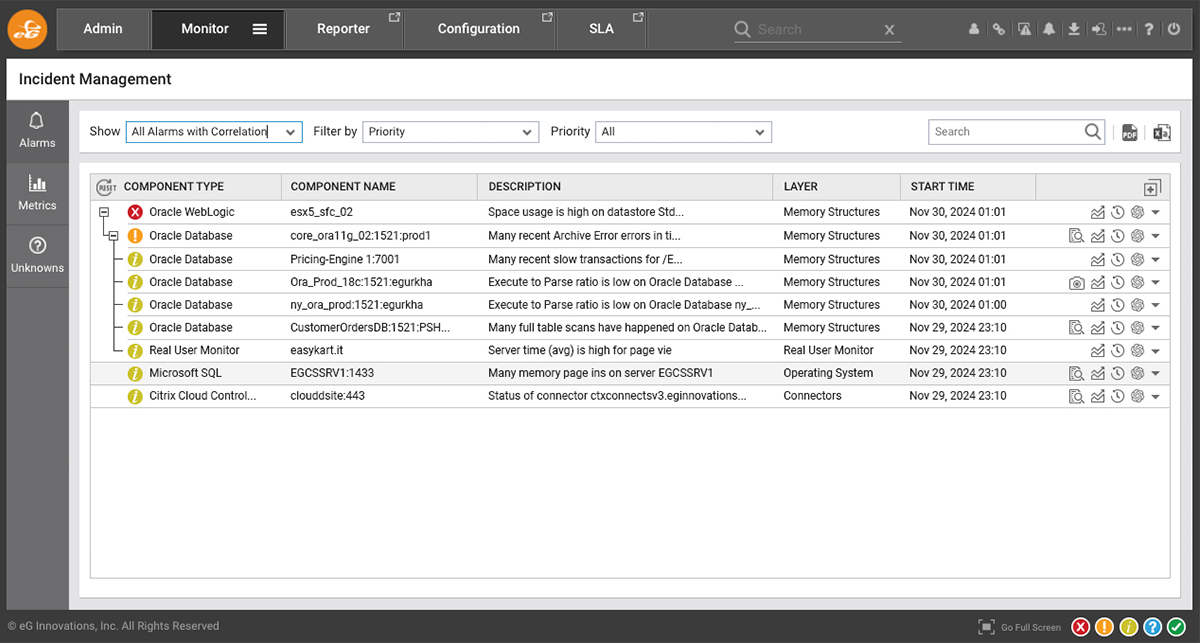
One of the biggest challenges in modern IT operations is alert overload. A single infrastructure issue can trigger dozens or even hundreds of alerts across applications, servers, networks, databases, and end-user systems. Without intelligent correlation, IT teams can waste valuable time investigating symptoms rather than the underlying cause.
eG Enterprise uses intelligent event correlation to automatically group related alerts, suppress secondary symptoms, and identify the root cause of an issue. By understanding dependencies across the technology stack, the platform distinguishes between primary failures and their downstream effects, preventing alert storms and reducing noise.
AI-Based Root Cause Detection
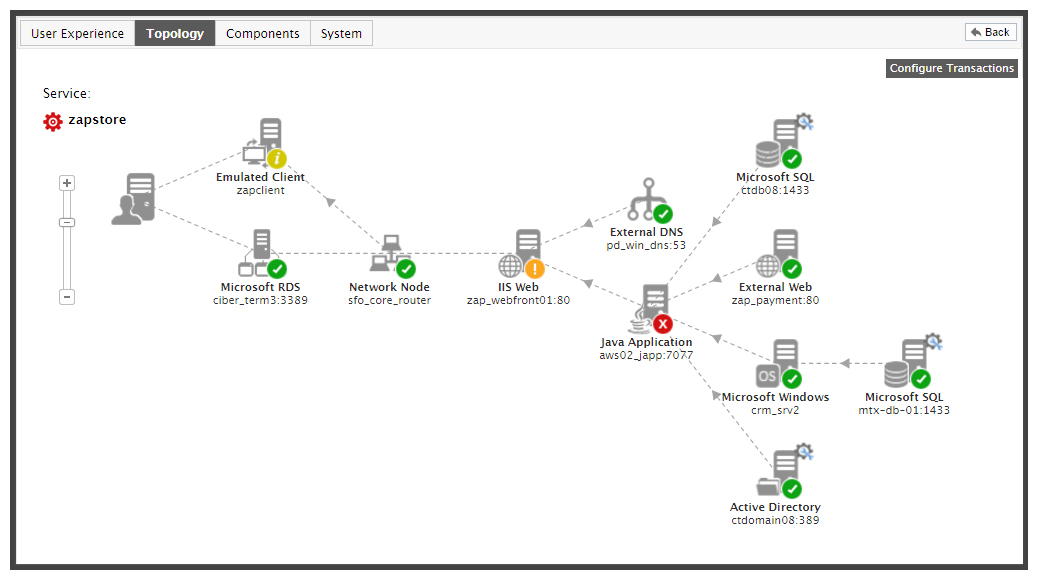
Modern IT environments generate vast amounts of performance data. Making it difficult for operations teams to manually determine the source of an issue. eG Enterprise uses AI-driven analytics, dependency mapping, and cross-tier correlation. These automatically identify the most likely root cause of performance problems. Rather than requiring administrators to investigate multiple alerts and dashboards, the platform analyzes relationships between infrastructure, applications, networks, cloud services, and user experience data to pinpoint where a problem originated. This accelerates troubleshooting, reduces Mean Time to Resolution (MTTR), and minimizes business disruption.
Unified Observability Across the IT Stack
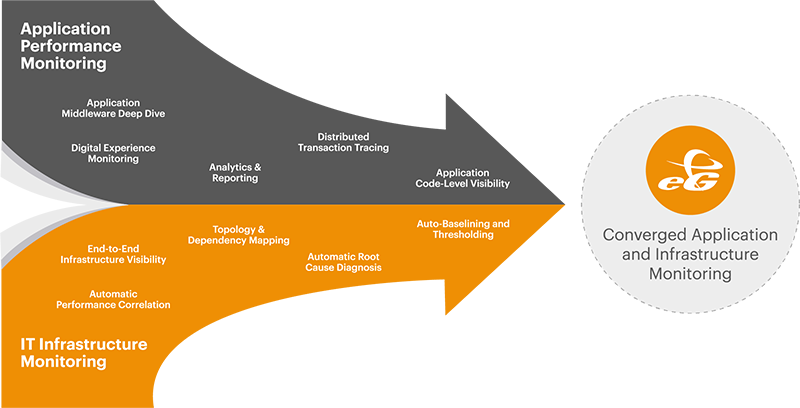
eG Enterprise is a single integrated observability solution that is built for cloud, hybrid and on-premises infrastructures. It covers a wide range of technologies – over 650+ common infrastructure and application components out of the box. Built from ground up, eG Enterprise incorporates built-in domain expertise to address different use cases including digital workspaces (Citrix, Omnissa Horizon, Azure Virtual Desktop, etc.), web applications using languages like Java, Microsoft .NET, PHP, Node.js, etc., enterprise applications like SAP and other ERP applications, Siebel and other CRM technologies, and SaaS applications like Microsoft Office 365 and Zoom.
Conclusion
The future of AIOps is moving toward increasingly autonomous IT operations. Where systems can detect, analyze, and resolve issues with minimal human intervention. Rather than replacing IT teams, AIOps shifts their focus away from repetitive incident management toward higher-value activities. Such as architecture design, optimization, and business-aligned innovation.
Next steps
Early in evaluation? Start with our eBook AIOps Solutions and Strategies for IT Management. It covers the architectural choices that separate strong AIOps implementations from weak ones, and gives you a framework for assessing any platform on the market.
Comparing platforms? Book a 30-minute technical walkthrough of eG Enterprise. We will demonstrate layer models, topology-driven root-cause analysis, and adaptive baselining against scenarios drawn from your own environment, not generic demo data.
Building the business case? Request a personalised ROI assessment. Our team will work with yours to quantify likely downtime reduction, operations cost savings, and compliance impact based on your estate size, industry, and regulatory profile.
eG Enterprise is an Observability solution for Modern IT. Monitor digital workspaces,
web applications, SaaS services, cloud and containers from a single pane of glass.
Frequently Asked Questions
AIOps (Artificial Intelligence for IT Operations) is a term coined by Gartner in 2016 as an industry category for machine learning analytics technology that enhances IT operations analytics covering operational tasks include automation, performance monitoring and event correlations, among others.
The most common AIOps use cases revolve around improving visibility, speeding up incident response, and reducing operational complexity across modern IT environments. Whether applied to infrastructure, cloud and hybrid systems, applications, security operations, or service desks, AIOps is primarily used to continuously analyze large volumes of telemetry data, correlate events across multiple layers, and identify anomalies and root causes faster than manual methods. This enables IT teams to move from reactive troubleshooting to proactive operations, reducing downtime, improving reliability, and ensuring more efficient management of complex, distributed environments at scale.
AIOps improves IT operations by automating the processing and analysis of large volumes of monitoring data in complex environments. It reduces alert noise, detects anomalies earlier, and correlates related events to quickly identify root causes. This speeds up troubleshooting, reduces downtime, and improves operational decision-making by prioritizing issues based on business impact.
Observability provides visibility into system behavior using metrics, logs, and traces to help understand what is happening and why. AIOps builds on observability by using AI and machine learning to automate analysis, detect anomalies, correlate events, and identify root causes. In short, observability provides the data, while AIOps turns that data into automated insights and actions.
No, AIOps is not only for large enterprises, although that’s where it first gained traction. Traditionally, AIOps was adopted by large organizations because they generate huge volumes of IT data—across hybrid cloud, microservices, and global infrastructure—that are difficult to manage manually. The scale and complexity made AI-driven correlation, noise reduction, and automation especially valuable. However, AIOps is increasingly being used by smaller organizations as well. Modern platforms are more accessible and/or offer cloud-based SaaS options, allowing smaller IT teams to benefit from faster incident detection, reduced alert fatigue, and improved visibility without needing massive infrastructure. In short, AIOps is most impactful in complex environments, but it’s no longer limited to large enterprises. Any organization dealing with growing digital complexity and the need to automate can benefit.


