



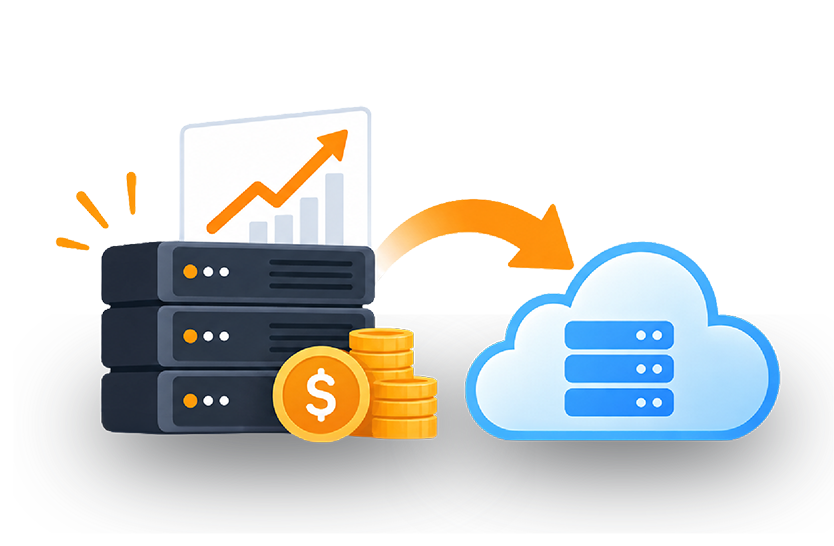
For years, moving workloads to the cloud has been driven by scalability, flexibility and the desire to reduce the capital expenditure associated with running a data center. In 2026, however, there is another factor entering the conversation: the rising cost of buying and refreshing physical servers. The question is now whether rapidly increasing hardware prices are enough to push organizations that might previously have refreshed their on-premises infrastructure towards cloud alternatives. The answer is potentially yes, however moving to the cloud does not automatically mean lower costs. Organizations need to compare the total cost of ownership of both options and monitor performance and consumption before and after migration.
Gartner predicted in January 2026 that “deep, prolonged shortages of DRAM and NAND/SSD in 2026, driven by the AI boom, will result in price surges in data-centre server and storage infrastructure.” It specifically recommends right-sizing infrastructure and extending hardware lifecycles in response.
How Server Prices are Rising in 2026
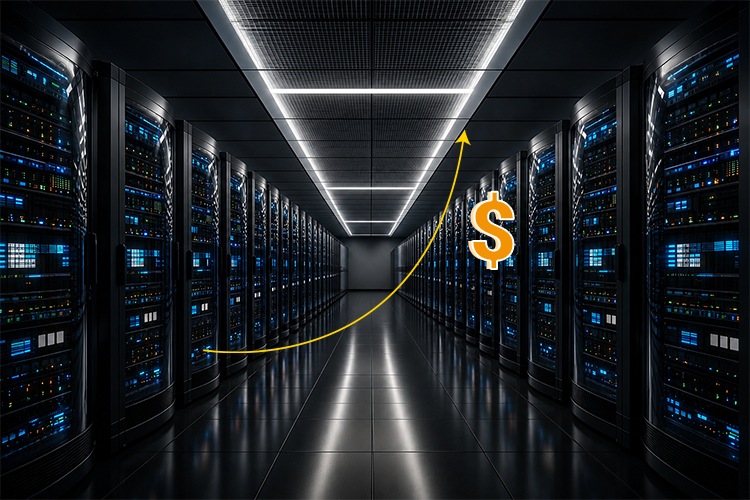
There is substantial evidence that server component costs have indeed increased sharply in 2026. HostKey reported many statistics around rises earlier this year, see: Server Price Increases in 2026: Causes, Forecasts, and Actionable Advice for Business.
IDC provides another indication of the pressure on the market. In July 2026 they reported that worldwide server spending increased 30.7% year-on-year in Q1 2026, while unit shipments increased only 3.3%. IDC attributes the difference partly to the continued deployment of GPU servers and says constrained supplies of DRAM and NAND are limiting shipments of conventional servers.
The impact is also visible in individual purchasing experiences. In a Reddit discussion titled “Server Prices are insane now – 128k for a decent VM host”, a sysadmin described pricing the same 128-core, 512GB RAM, 16TB server at around $17,000 in October 2025, $28,000 in February 2026 and $128,500 in August. The poster also reported that a 64GB DIMM was priced at $8,000.
The Reddit example should not be interpreted as a typical server price, the thread itself contains comments suggesting partner pricing can be substantially lower, but it illustrates how dramatically individual quotes can move when memory availability and vendor pricing are under pressure.
Why Server Prices are Rising in 2026
The biggest factor is the AI infrastructure boom. Hyperscalers and AI companies are buying enormous quantities of GPUs, high-bandwidth memory, server DRAM and enterprise SSDs. Manufacturers are consequently allocating production capacity towards higher-value AI and server applications.
TrendForce report AI and datacenter demand is contributing to tight memory supply. It also reports that shortages in components including CPUs and PCBs are contributing to extended lead times for general-purpose servers.
There is also a broader supply-demand problem. IDC expects elevated memory and NAND pricing to continue at least into the first half of 2027. This means organizations facing a hardware refresh cannot necessarily assume that waiting six months will return prices to previous levels.
For businesses with large virtualization clusters, the implications can be significant. A refresh may require expensive servers, memory, storage, networking equipment, support contracts, data-center space and power. Suddenly, a cloud migration can become financially attractive even if cloud infrastructure was not previously the preferred option.
Cloud Migration Options
Cloud migration provides one way to avoid a large upfront hardware investment. Instead of purchasing physical servers, organizations can consume compute, storage and managed services from providers such as AWS, Microsoft Azure or Google Cloud Platform.
The migration does not have to be an all-or-nothing move. Organizations can move selected workloads where cloud economics make sense while retaining workloads on-premises where predictable, high utilization makes owned infrastructure more economical.
Examples include moving an on-premises Citrix environment to Windows 365 Cloud PCs, replacing physical or virtualized SQL Server infrastructure with Azure SQL, or moving selected application servers to Azure or AWS virtual machines.
However, cloud pricing introduces a different economic model. Capital expenditure becomes operating expenditure, but organizations can face ongoing compute, storage, networking, licensing and data-transfer charges.
Cloud prices can also rise. There is evidence that hyperscalers themselves are facing enormous infrastructure costs. Amazon, for example, raised its 2026 capital expenditure forecast to $220 billion, driven heavily by AI and cloud infrastructure demand. To date though there haven’t been any shock announcements from AWS, Microsoft Azure or Google GCP pertaining to dramatic price increases.
While cloud can reduce the need for upfront hardware investment, it does not necessarily eliminate infrastructure cost inflation. It is one to watch.
How eG Enterprise Helps with Cloud Migration Projects
eG Enterprise can help organizations make cloud migration decisions using performance data rather than assumptions. It monitors a broad range of on-premises and virtualization technologies alongside cloud infrastructure, platforms, databases and digital workspaces.
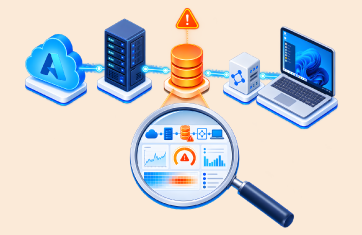
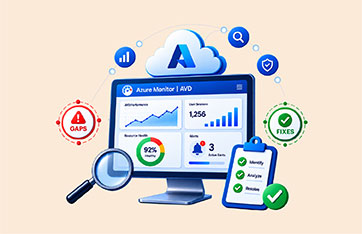
This allows organizations to establish a performance baseline before migration and compare it with the environment after migration. For example, an organization could monitor an on-premises Citrix environment before moving users to Windows 365 Cloud PCs, then continue monitoring the cloud environment to evaluate whether the migration has delivered the expected performance and user experience.
The same approach applies to databases. An organization migrating from on-premises Microsoft SQL Server to Azure SQL can benchmark SQL workload, response times, resource consumption and database performance before and after migration. eG Enterprise is widely used to support baselining and measuring the success of SQL Server-to-Azure SQL migrations.
This creates a much more meaningful migration assessment: not simply “the workload is now in the cloud”, but “the workload performs at least as well, users experience the expected service levels and resource consumption is understood.”

What if Cloud Prices Rise?
Cloud providers are not immune to rising infrastructure costs. Higher prices for memory, storage, CPUs and AI infrastructure increase the cost of building and operating data centers. Whether hyperscalers ultimately pass these costs on to customers through higher cloud prices remains uncertain, however, and there have been no broad-based price increases from AWS, Azure or Google Cloud directly attributed to these hardware costs.
However, the possibility of cloud price increases means organizations should avoid treating cloud migration as a one-way decision. A workload that is economical in Azure today might have a different cost profile several years from now. Equally, hardware prices could fall, making repatriation more attractive. Indeed, many organizations migrating to the cloud consider potential cloud exit strategies even before moving to the cloud.
This makes portability and observability important parts of cloud strategy.
eG Enterprise uses transferable licensing, allowing licenses to move between the more than 650+ technologies it supports. For example, licenses used to monitor on-premises SQL Server can be transferred to Azure SQL as workloads migrate. Similarly, licenses used for on-premises Citrix can be reused for monitoring AVD users as users move to the cloud.
That flexibility supports a more circular approach to IT infrastructure. Organizations can migrate workloads to the cloud when the economics make sense, monitor and benchmark the new environment, and potentially move workloads back on-premises (or between clouds), if economics, performance or strategic priorities change.
eG Enterprise also provides monitoring, alerting and reporting for cloud billing, allowing organizations to make data driven decisions on the economics around where they choose to host their workloads.
In 2026, the choice is therefore not simply server versus cloud. Rising hardware prices may make cloud more attractive, but the potential of rising cloud consumption costs mean organizations need the freedom to evaluate both continuously. The organizations best positioned to respond will be those that maintain visibility across on-premises and cloud environments and can make infrastructure decisions based on measurable performance, utilization and cost rather than assumptions.
Summary
Rising server costs are making cloud migration more attractive, but cloud prices can rise too. Monitoring before and after migration helps organizations prove performance and cost benefits.
eG Enterprise provides the visibility and licensing flexibility to support changing infrastructure strategies. To find out for yourself how eG Enterprise can help you. Book a demo with an engineer, or start a free trial.
eG Enterprise is an Observability solution for Modern IT. Monitor digital workspaces,
web applications, SaaS services, cloud and containers from a single pane of glass.
Frequently Asked Questions
Yes. Server infrastructure costs are under pressure in 2026, particularly for memory, NAND/SSD storage and components used in AI and data-centre servers. Supply constraints and strong AI infrastructure demand are contributing to higher prices.
AI infrastructure demand is increasing demand for GPUs, high-bandwidth memory, DRAM and enterprise SSDs. Manufacturers are allocating capacity towards AI and data-centre applications, contributing to tighter supply and higher component prices.
They can. Higher hardware, memory, storage, data-centre and power costs can make cloud services more attractive for organisations facing a major infrastructure refresh. However, cloud computing does not automatically provide lower total costs.
Not necessarily. Cloud avoids much of the upfront capital expenditure associated with purchasing servers, but organisations still pay ongoing costs for compute, storage, networking, licensing and data transfer. Total cost of ownership should be compared for each workload.
Cloud providers may face higher infrastructure costs as hardware, memory and data-centre expenses increase. However, organisations should distinguish between rising provider costs and actual customer pricing: cloud providers have not necessarily passed all infrastructure cost increases directly to customers.
Not necessarily. Cloud migration should be based on workload economics, performance, scalability, operational requirements and strategic objectives rather than server prices alone. A hybrid approach may provide the best balance for many organisations.
Workloads with variable demand, scalability requirements or relatively low utilisation can often benefit from cloud infrastructure. Highly utilised, predictable workloads may sometimes remain more economical on owned infrastructure.
Organisations should establish a performance and resource-utilisation baseline before migration and compare metrics such as CPU, memory, storage, network utilisation, application response times and user experience after migration.
eG Enterprise monitors on-premises, virtualised and cloud environments, allowing organisations to baseline workloads before migration and compare performance and resource consumption afterwards. This helps identify under- or over-provisioning and validate whether migration has delivered the expected performance.
Yes. eG Enterprise provides monitoring across more than 650 technologies, including on-premises infrastructure, virtualisation platforms, databases, applications, public clouds and digital workspaces.
Yes. eG Enterprise licences are transferable, allowing organisations to move monitoring licences alongside migrated workloads. For example, licences monitoring an on-premises SQL Server workload can be transferred to monitor its Azure SQL environment, helping avoid unused monitoring licences or shelfware.
Potentially. Cloud repatriation can make sense when workloads become more economical to operate on-premises or when performance, compliance or strategic requirements change. Continuous monitoring of cost, resource consumption and performance helps organisations make informed decisions about where workloads should run.