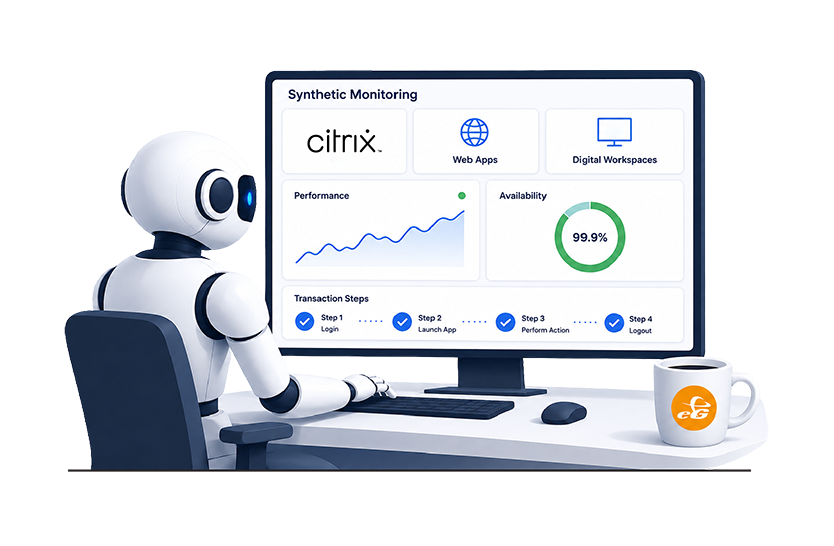
Employee productivity and customer satisfaction depend on the consistent performance of digital workspaces, virtual desktops, web applications, and SaaS platforms. While reactive monitoring identifies issues after users experience them, synthetic monitoring tools enable organizations to detect and resolve performance problems before business operations are affected. For enterprises managing Citrix environments, Azure Virtual Desktop deployments, Omnissa Horizon (formerly VMware Horizon) infrastructure, and business-critical web applications, synthetic monitoring serves as a proactive observability strategy that ensures optimal digital experiences across the organization.
What Is Synthetic Monitoring?
Synthetic monitoring is a proactive monitoring technique that uses automated scripts to simulate user interactions with applications, websites, virtual workspaces, and an business services. Unlike passive monitoring approaches, synthetic monitoring continuously tests application performance regardless of whether real users are actively accessing the system.
Organizations use synthetic monitoring to validate service availability, track performance trends, measure end-user experience, and identify issues before they affect employees or customers.
How Synthetic Monitoring Tools Works
Simulated User Journeys
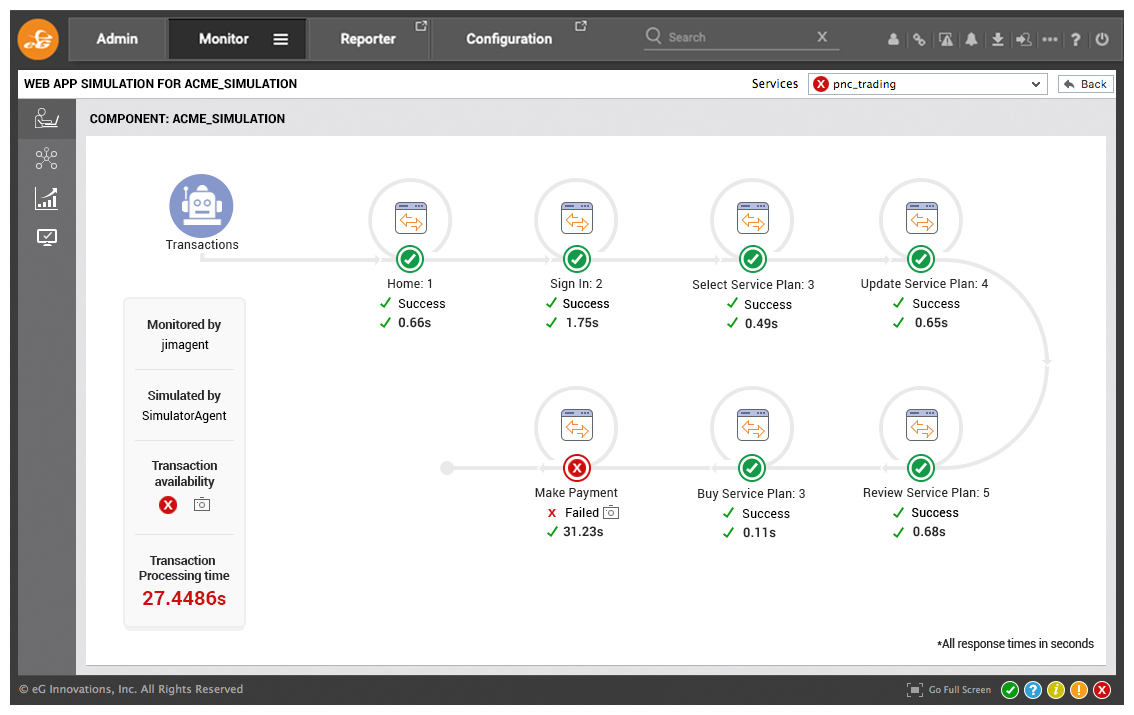
Synthetic monitoring solutions replicate real-world user activities such as logging into a Citrix workspace, accessing a virtual desktop, opening business applications, submitting forms, or completing transactions. These simulated workflows mirror actual user experiences and provide insight into performance across every step of the journey.

Scheduled Testing
Automated tests run at predefined intervals from various locations. Organizations can schedule tests every few minutes to continuously monitor service availability and identify intermittent issues before they escalate.
Performance Measurement
Synthetic monitoring collects critical performance metrics such as login times, application response times, page load speeds, transaction success rates, and infrastructure latency. These insights help IT teams identify performance degradation early and maintain service reliability.
Synthetic Monitoring vs Real User Monitoring (RUM)
Both monitoring approaches play important roles in enterprise observability strategies, but they serve different purposes.
Key Differences
Synthetic monitoring uses automated tests to simulate user behavior, while Real User Monitoring (RUM) captures the actual experiences of real users interacting with applications and services.
Synthetic monitoring provides visibility even when no users are present, whereas RUM gathers performance data only during active user sessions.
Advantages
Synthetic monitoring offers proactive issue detection, consistent testing, SLA validation, and global availability monitoring.
RUM provides insights into actual user behavior, device performance, geographic variations, browser experience, and real-world performance trends.
When to Use Each Approach
Synthetic monitoring is ideal for proactive testing, service validation, and early problem detection. RUM is best suited for understanding actual user experiences and business impact. Leading enterprises often combine both approaches to achieve complete visibility into digital service performance.
Why Enterprises Need Synthetic Monitoring
As digital ecosystems become increasingly distributed, organizations need visibility across applications, infrastructure, virtual workspaces, and cloud services.
Proactive Issue Detection
Synthetic monitoring identifies problems before they affect users. By continuously testing key workflows, IT teams can detect performance degradation, authentication failures, connection issues, or application outages before they generate support tickets.
Better Employee Experience
Digital employee experience (DEX) directly impacts productivity. Monitoring critical employee workflows allows organizations to ensure workers can access desktops, applications, and services without disruption, regardless of location.
Reduced Downtime
Continuous monitoring enables faster incident response and remediation. By identifying warning signs early, organizations reduce service interruptions and maintain business continuity.
SLA Validation
Organizations often depend on internal teams, cloud providers, and service vendors to meet performance commitments. Synthetic monitoring provides objective performance data that helps validate service-level agreements and ensure compliance.

Common Enterprise Use Cases
Citrix Synthetic Monitoring
Citrix synthetic monitoring is one of the most valuable enterprise monitoring use cases. Organizations can simulate user logins, application launches, session creation, ICA connectivity, and desktop access workflows to proactively identify issues that affect end users.
By monitoring Citrix infrastructure from the user’s perspective, IT teams gain visibility into authentication delays, broker issues, profile loading problems, and workspace performance bottlenecks.
Azure Virtual Desktop Monitoring
Azure Virtual Desktop deployments require continuous visibility into user access, desktop responsiveness, session host performance, and cloud service availability. Synthetic testing validates user access paths and ensures reliable digital workspace performance. Learn more: Synthetic Monitoring of Microsoft Azure DaaS | eG Innovations.
Omnissa Horizon Monitoring
Enterprises using Omnissa Horizon can use synthetic monitoring to simulate desktop launches, application delivery, authentication processes, and remote access workflows. This proactive approach helps reduce virtual desktop disruptions and improve end-user experience.
Web Application Availability
Business-critical web applications also require continuous uptime monitoring. Synthetic monitoring validates application availability, transaction functionality, page-load performance, and user workflows from multiple geographic locations. Learn more: Synthetic Monitoring Tools for Multi-step Web Transactions.
SaaS Application Performance
Many enterprises rely on SaaS platforms for collaboration, CRM, ERP, HR, and productivity functions. Synthetic monitoring helps ensure these services remain available and responsive across different regions and user groups.
Key Features to Evaluate in Synthetic Monitoring Tools
When evaluating synthetic monitoring tools, enterprises should consider the following capabilities.
Ease of Deployment
The best solutions provide rapid implementation, minimal configuration requirements, and automated setup processes that accelerate time-to-value.
Browser Testing
Organizations should prioritize platforms that support modern browser testing to accurately replicate real-world user interactions and application workflows.
Global Monitoring Locations
Monitoring from multiple geographic regions helps organizations understand performance from the perspective of distributed users and remote employees.
Alerting
Effective monitoring platforms offer intelligent alerting mechanisms that notify teams about performance degradation, outages, and business-impacting issues while minimizing alert fatigue.
Reporting
Comprehensive reporting on the results of synthetic monitoring enables organizations to track performance trends, demonstrate SLA compliance, support capacity planning, and identify recurring issues.
MFA Support
Synthetic monitoring tools should simulate full user workflows including Multi-Factor Authentication workflows.
Integrations
Enterprises should look for solutions that integrate cleanly with ITSM platforms, observability tools, collaboration solutions, cloud platforms, and existing monitoring ecosystems.
Cost-effective Licensing
Many synthetic monitoring tools license on a per-test basis, and costs can rapidly escalate. Unlike many tools eG Enterprise is licensed on a per location basis allowing unlimited tests from each test location.
Best Synthetic Monitoring Platforms
For enterprises seeking a synthetic monitoring platform that goes beyond basic uptime checks, eG Enterprise delivers comprehensive visibility into user experience, application performance, and infrastructure health. Its ability to simulate real user journeys, proactively detect issues, and correlate performance across the entire technology stack makes it particularly valuable for organizations managing complex digital workspace and hybrid cloud environments. eG runs synthetic user journeys alongside real infrastructure telemetry across 650+ supported technologies, so a failed Citrix login or a slow desktop launch is correlated to its root cause, the network, broker, profile or host, in one console.
By combining synthetic monitoring, real user insights, and automated diagnostics within a single platform, eG Enterprise helps organizations reduce downtime, improve employee productivity, and ensure consistently high-quality digital experiences.
Deployment Best Practices
To maximize the value of synthetic monitoring investments, organizations should follow proven deployment strategies.
Select Critical User Journeys
Focus monitoring on high-priority business transactions such as Citrix logins, virtual desktop launches, application access, customer transactions, and SaaS workflows.
Test From Multiple Locations
Monitoring from multiple regions provides realistic visibility into the experiences of distributed employees and customers.
Combine With RUM
The most effective observability strategies combine synthetic monitoring with Real User Monitoring. This approach delivers both proactive testing and real-world experience insights.
Configure Intelligent Alerts
Use meaningful thresholds and business-aware alerting policies to reduce noise while ensuring critical issues receive immediate attention.
Conclusion
As enterprises continue to expand their digital workspaces, virtual desktop infrastructure, and cloud-based applications, proactive visibility becomes increasingly important. Synthetic monitoring tools empower organizations to detect problems before users are affected, validate service availability, and maintain exceptional digital experiences.
Whether monitoring web applications, SaaS platforms, Azure Virtual Desktop, Omnissa Horizon, or implementing Citrix synthetic monitoring, organizations benefit from proactive performance testing that reduces downtime and accelerates troubleshooting.
For enterprise environments, eG Enterprise stands out by combining synthetic monitoring, digital experience monitoring, application observability, and automated root-cause analysis within a single platform. This comprehensive approach enables organizations to maintain service excellence while improving employee productivity and business continuity.
Next Steps
Learn more about the eG Enterprise Universal Simulator and the latest features available from synthetic monitoring, see: Universal Synthetic Monitoring with eG Enterprise.
Or try out one of our free logon simulators for Omnissa, AVD or Citrix.
eG Enterprise is an Observability solution for Modern IT. Monitor digital workspaces,
web applications, SaaS services, cloud and containers from a single pane of glass.
Frequently Asked Questions
Synthetic monitoring is a proactive monitoring method that uses automated scripts to simulate user interactions with applications, websites, virtual desktops, and digital services to measure availability and performance.
Synthetic monitoring uses simulated user tests that run continuously, while Real User Monitoring (RUM) captures performance data from actual users during live sessions. Synthetic monitoring is proactive, whereas RUM provides real-world experience data.
Yes. Synthetic monitoring helps identify login delays, application launch issues, connectivity problems, and performance bottlenecks before employees are impacted, significantly improving digital workplace reliability and user experience.
The ideal solution depends on business requirements, infrastructure complexity, and monitoring goals. Enterprises often prefer platforms that provide comprehensive visibility across Citrix, Azure Virtual Desktop, Omnissa Horizon, web applications, and user experience monitoring. eG Enterprise is particularly well-suited for organizations seeking end-to-end observability and advanced digital experience monitoring capabilities.